
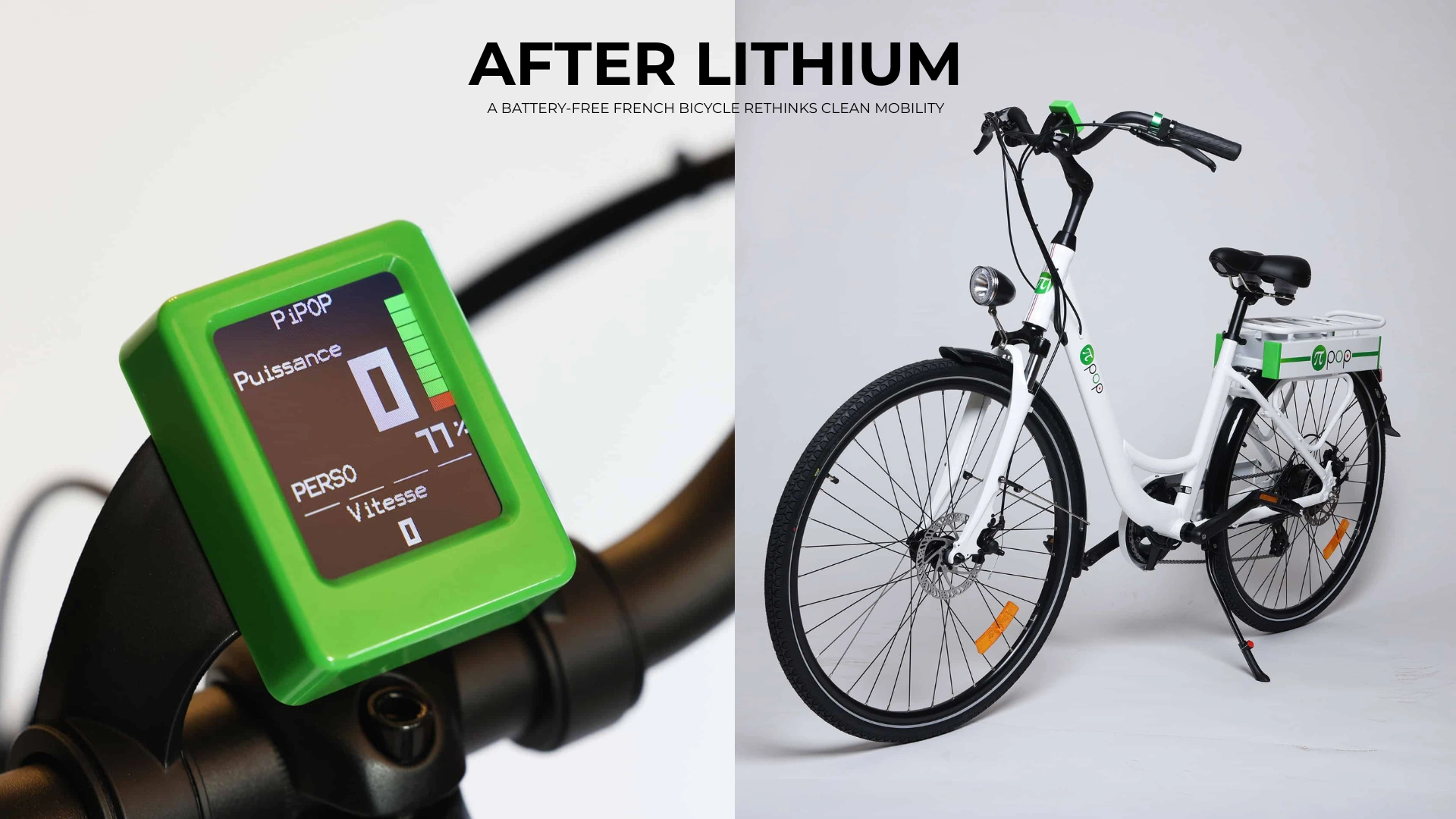
After Lithium: What a Battery-Free French Bicycle Tells Us About the Future of Clean Mobility
For more than a decade now, the future of mobility has been sold to us with a single promise: batteries will save us.
Bigger batteries. Faster charging. Denser lithium packs. Smarter grids. Entire cities redesigned around plugs, ports, and power points. Somewhere along the way, electric mobility became less about movement and more about energy logistics.
And then, quietly, a small French company decided to ask an almost impolite question:
What if electric mobility doesn’t need batteries at all?
That question gave birth to Pi-Pop—a bicycle that looks ordinary, rides familiar, but challenges one of the most unquestioned assumptions of the clean-tech age.
The tyranny of the battery mindset
Lithium-ion batteries are technological marvels, no doubt. But they are also environmental compromises we’ve collectively chosen to tolerate.
They rely on mining-intensive supply chains, geopolitically fragile resources, limited lifecycles, recycling challenges, and infrastructure dependencies that quietly shift emissions upstream rather than eliminate them. We replaced tailpipes with charging cables and told ourselves the story had a happy ending.
Pi-Pop doesn’t reject electric assistance. It rejects the idea that electric assistance must be battery-dependent.
That distinction matters.
A bicycle that remembers energy, not stores it
At the heart of Pi-Pop’s design is a concept that feels almost old-school in its elegance: supercapacitors.
Instead of storing large amounts of energy chemically (like batteries do), supercapacitors store energy electrostatically. They charge rapidly, discharge instantly, last for hundreds of thousands of cycles, and—crucially—avoid many of the toxic material dependencies that plague batteries.
On a Pi-Pop bicycle, energy is harvested continuously:
- when you pedal
- when you brake
- when you coast downhill
That energy is not hoarded. It is remembered briefly and returned when you need help—starting from a stoplight, climbing a gentle incline, pushing through urban fatigue.
No plugging in.
No range anxiety.
No battery degradation curve haunting the ownership experience.
The bicycle behaves less like a gadget and more like an intelligent mechanical partner.
Why this matters more than it seems
It’s easy to dismiss Pi-Pop as a niche European curiosity. That would be a mistake.
Because Pi-Pop is not really about bicycles. It is about design philosophy.
In a world racing toward maximalism—more power, more capacity, more data—Pi-Pop represents a countercurrent: sufficiency over surplus.
It asks:
- How much assistance do we actually need?
- What if energy systems were regenerative by default?
- What if sustainability meant subtraction, not addition?
These are uncomfortable questions for industries built on scale, upgrades, and planned obsolescence.
Which is exactly why they matter.
The India question (without forcing it)
India doesn’t yet need Pi-Pop as a product to benefit from Pi-Pop as an idea.
Urban India is defined by short trips, stop-and-go traffic, mixed infrastructure, and price sensitivity. It is also staring down a future problem few policy decks talk about honestly: battery waste at scale.
In that context, Pi-Pop’s approach nudges an important thought experiment:
- Are battery-heavy EVs the only path for emerging markets?
- Could ultra-light, battery-free, regenerative mobility be more resilient in certain urban contexts?
- Is the next leap not bigger batteries—but fewer of them?
These are design questions India will eventually have to confront.
Better sooner than later.
Europe’s quiet advantage: thinking before scaling
One of the most interesting things about Pi-Pop is what it says about European innovation culture.
While Silicon Valley often chases disruption through speed and scale, Pi-Pop feels deeply continental—patient, precise, and values-driven. It doesn’t scream revolution. It whispers reconsideration.
That restraint may not trend on social media, but it often ages better.
A small bike with a large implication
Pi-Pop will not replace electric scooters, cars, or public transport. It doesn’t pretend to.
Its significance lies elsewhere: in reminding us that the clean-tech future does not have to be resource-hungry by default.
Sometimes, progress is not about adding intelligence to machines—but about removing excess from systems.
In a decade obsessed with charging speeds and battery densities, Pi-Pop quietly reminds us of something almost radical:
The cleanest energy is the energy you never needed to store.
And that might be the most sustainable idea of all.https://thequantiq.com/auto-mobility-india-mobility-future-beyond-evs/




One Comment