AI Tutors Are Coming: Why ChatGPT Could Disrupt the $200 Billion Coaching Industry
For generations, mastering mathematics and science has depended on a familiar formula: classrooms during the day, coaching classes in the evening, and long hours of self-study at night.
Across countries like India, China, South Korea, and the United States, a vast education coaching ecosystem worth hundreds of billions of dollars has grown around this formula. From neighbourhood tuition centres to massive online learning platforms, the industry exists because many students struggle to understand complex subjects in crowded classrooms. Now artificial intelligence may be about to change that equation.
OpenAI, the company behind ChatGPT, is introducing a set of learning tools designed specifically to help students understand subjects like mathematics, physics, chemistry, and computer science more easily. The most notable among them is a feature known as “Study Mode,” which turns ChatGPT into something closer to a personal tutor than a simple question-answer machine.
If widely adopted, tools like these could reshape how students learn — and how the global tutoring industry operates.
The Problem With Traditional Learning
Mathematics and science are subjects that build layer by layer. If a student misses one foundational concept, the rest of the subject quickly becomes confusing.
Teachers in traditional classrooms often face two structural limitations.
First, class sizes are large, making it difficult to provide individual attention. Second, students learn at different speeds, but classroom teaching typically moves at a single pace.
To compensate, families across the world rely heavily on private tutoring and coaching classes.
In India alone, the coaching industry — which prepares students for exams such as IIT-JEE, NEET, and various competitive tests — is estimated to be worth over $20 billion annually. Globally, the tutoring market is believed to exceed $120 billion and growing rapidly.
The demand exists because many students need personalized explanations, something traditional education systems struggle to provide.
Artificial intelligence is now stepping into that gap.
What Is ChatGPT’s “Study Mode”?
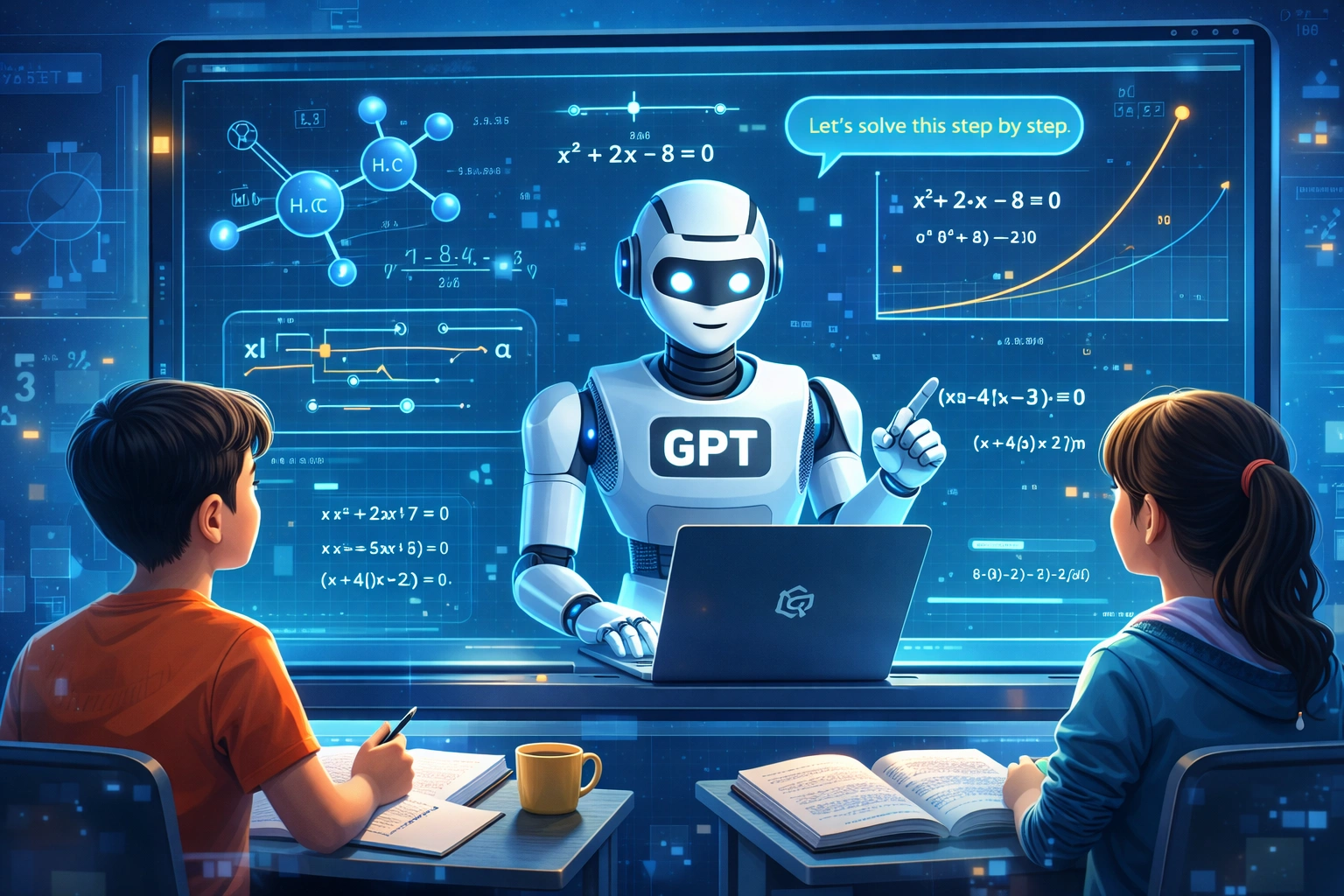
The new Study Mode feature transforms ChatGPT into a guided learning assistant rather than a tool that simply delivers answers.
Instead of immediately solving a problem, the AI behaves more like a tutor.
If a student asks a question such as:
“Help me solve this calculus problem.”
Study Mode may respond by asking:
“What part of the problem do you find difficult?”
Then it guides the student step by step through the process of solving the problem.
The idea is simple but powerful: the AI helps students discover the solution rather than just copying it.
This teaching method is inspired by the Socratic approach, where learners are guided through questions and reasoning rather than being given answers outright.
For many students, this can significantly improve conceptual understanding.
Step-by-Step Learning for Complex Subjects
Subjects like mathematics and physics often require understanding several intermediate steps between the problem and the solution.
AI tutoring tools are particularly good at breaking down these steps.
Instead of presenting a complex equation all at once, the AI can explain:
• what each variable represents
• why a particular formula is used
• how the problem connects to a broader concept
For example, when solving a physics problem involving motion, the AI might explain the concept of velocity, acceleration, and time before moving to the final equation.
This step-by-step explanation can help students build stronger conceptual foundations.
Learning at Your Own Pace
One of the most important advantages of AI tutoring systems is their ability to adapt to the learner’s level.
A student in secondary school may ask for a simple explanation of a concept, while an engineering student might want a much deeper technical breakdown.
AI systems can adjust the level of explanation instantly.
This kind of adaptive learning has been one of the long-standing goals of education technology developers.
In traditional classrooms, teachers must aim for the middle of the class. AI tutors, however, can tailor explanations individually.
For students who struggle with certain concepts, this flexibility can be transformative.
Practice, Feedback, and Self-Testing
Another powerful feature of AI tutoring tools is the ability to generate practice questions and quizzes on demand.
After learning a concept, a student can ask the AI to create practice exercises.
The AI can then evaluate answers and explain mistakes.
This cycle — learning, testing, and reviewing — mirrors the most effective methods used by experienced educators.
But unlike traditional tutoring, AI tools can provide this feedback instantly and continuously.
Visual Learning and Interactive Explanations
Future versions of AI tutoring systems are expected to include more visual learning tools.
Mathematics concepts could be explained through interactive graphs. Physics lessons could include dynamic diagrams showing how forces interact.
In chemistry, molecular structures may be visualized in ways that make abstract concepts easier to grasp.
These visual explanations can help bridge the gap between theory and understanding.
The Economic Shock to the Coaching Industry
If AI tutoring becomes widely accessible, it could have significant implications for the global education economy.
Private coaching exists because personalized teaching is scarce and expensive.
AI changes that equation.
Once developed, AI tutoring systems can deliver high-quality explanations to millions of students simultaneously at near-zero marginal cost.
This means that the price of personalized tutoring could fall dramatically.
For students and families, this is good news.
For the coaching industry, however, it presents a significant challenge.
Many routine tutoring services — particularly those focused on solving homework problems or explaining basic concepts — could face disruption.
A Market Worth Hundreds of Billions
The global tutoring market is massive.
Estimates suggest the broader education support industry — including coaching centres, test preparation platforms, and private tutoring — could exceed $200 billion within the next decade.
If AI tutoring tools capture even a small share of this market, the financial impact could be enormous.
Some analysts believe that AI-powered education platforms could create a new global industry worth tens of billions of dollars within the next five to ten years.
Major technology companies are already investing heavily in this space.
New Opportunities in AI Education
Despite fears of disruption, AI tutoring does not necessarily eliminate the need for human educators.
Instead, it may shift the role of teachers and coaching centres.
Rather than focusing on routine problem-solving, teachers may concentrate on:
• deeper conceptual learning
• mentoring and guidance
• project-based education
• creativity and critical thinking
Coaching institutes could also adopt AI tools to enhance their own teaching methods.
Some education companies are already integrating AI into their platforms to create hybrid learning models combining human expertise with AI assistance.
A Global Race in AI Education
OpenAI is not alone in exploring AI tutoring.
Several major organizations are entering this space.
Google is developing learning tools based on its Gemini AI models. Khan Academy has introduced Khanmigo, an AI assistant designed to help students with school subjects.
These initiatives reflect a growing belief that artificial intelligence could play a central role in the future of education. The competition is likely to accelerate innovation — and adoption.
A Personal Tutor for Every Student?
For centuries, personalized tutoring has been a luxury available mainly to wealthy families.
AI could democratize access to high-quality learning support.
A student with a smartphone and internet connection could potentially access an intelligent tutor capable of explaining complex subjects in multiple ways until the concept becomes clear.
In regions where access to quality teachers is limited, this could dramatically improve educational outcomes.
The Beginning of a New Learning Era
Artificial intelligence is unlikely to replace schools or teachers entirely.
Education is a deeply human process that involves motivation, mentorship, and emotional support — elements machines cannot easily replicate.
But AI can augment learning in powerful ways.
By providing personalized explanations, instant feedback, and unlimited practice opportunities, AI tutoring tools could help millions of students overcome one of the most persistent barriers in education: understanding difficult concepts.
For students struggling with mathematics and science, the arrival of AI tutors may mark the beginning of a new era.
And for the global education industry, it could signal one of the most significant transformations since the rise of the internet.https://thequantiq.com/mid-week-ai-update-3/



One Comment