
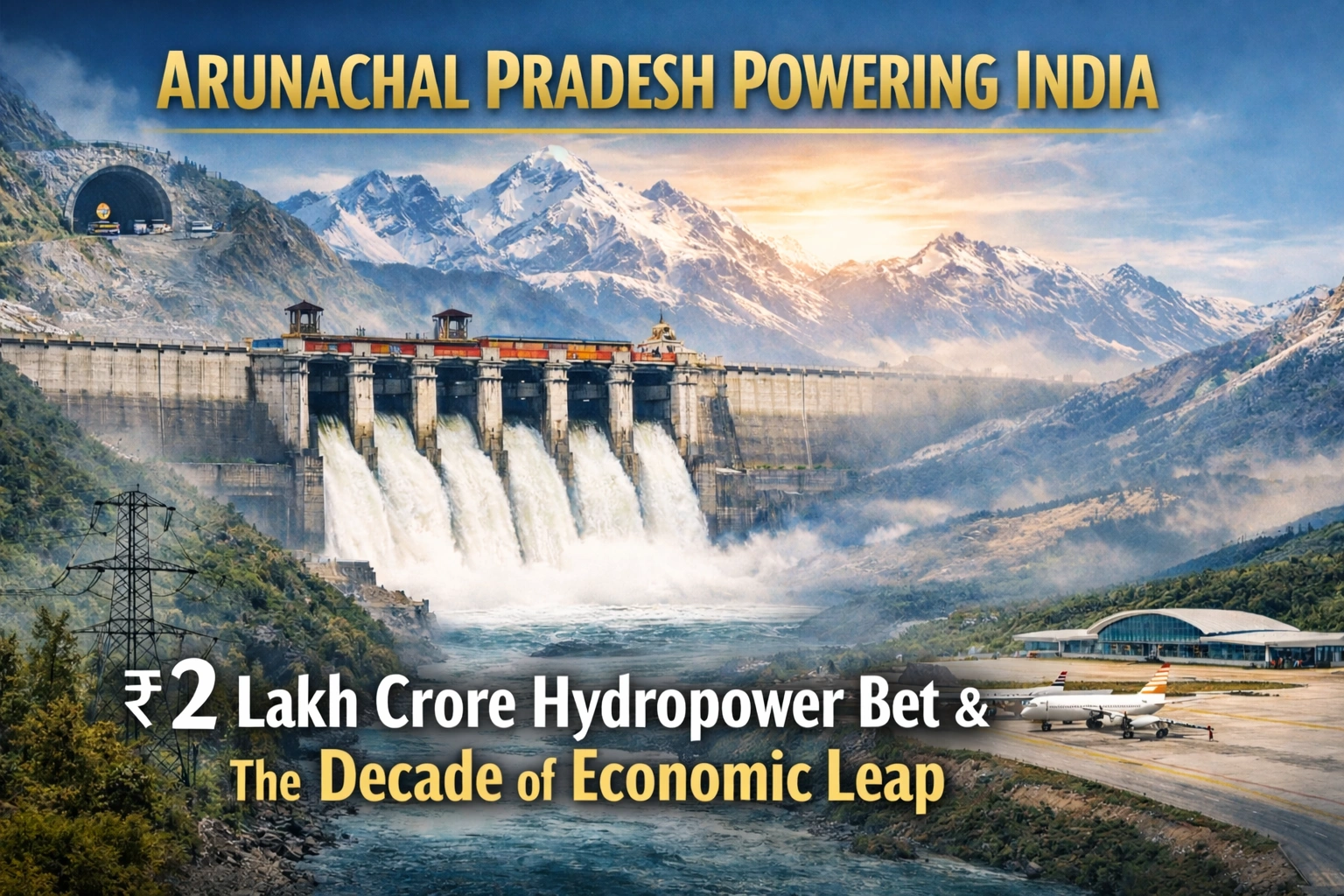
Arunachal Pradesh Powering India: Inside the ₹2 Lakh Crore Hydropower Push and the State’s Decade of Economic Leap
As Arunachal Pradesh completes four decades of statehood, the frontier state is stepping into a new role. It wants to become a key player in India’s future energy landscape.
The government has declared 2025–2035 as the “Decade of Hydropower.” Backed by an estimated ₹2 lakh crore development pipeline, this push aims to turn Arunachal Pradesh from a strategically sensitive border region into a major clean-energy and economic hub.
With one of the largest untapped hydropower reserves in India, the state’s ambitions are shaped by geography, rising electricity demand, and renewed policy momentum.
Hydropower: Turning Natural Strength into Economic Power
Arunachal Pradesh holds the largest hydropower potential in India, estimated at about 50,000 MW — nearly one-third of the country’s total identified hydro resources.
For years, difficult terrain, environmental concerns, funding gaps, and project delays slowed progress. Now the state government, led by Chief Minister Pema Khandu, sees hydropower as the foundation for long-term fiscal independence. Leaders often describe this strategy as a move toward energy self-reliance.
Mega Investments and Project Pipeline
The planned ₹2 lakh crore investment includes central public sector companies, private developers, and joint ventures. Projects are spread across the Siang, Subansiri, Dibang, and Lohit river basins.
Many projects are under construction. Others are awaiting clearances or revival after earlier delays. If completed on schedule, these developments could add around 10,000 MW of capacity in the medium term.
Subansiri Lower Project: The Flagship Development
The 2,000 MW Subansiri Lower Hydroelectric Project on the Assam–Arunachal border is India’s largest hydro project currently under construction. Developed by NHPC, the project faced long delays due to protests and technical redesign.
Work has regained momentum, and commissioning is expected in phases, with full operations targeted around 2026–27.
For Arunachal Pradesh, the project carries strong financial importance. Once operational, it will generate revenue through free power entitlement and royalties. Estimates suggest the state could earn hundreds of crores annually, potentially approaching ₹1,000 crore, depending on tariffs and output.
Fiscal Impact: Revenue, Jobs, and Economic Stability
Hydropower could become one of the state’s biggest non-tax revenue sources.
Annual income from upcoming projects may reach several thousand crores once major plants begin operating. This would reduce the state’s dependence on central transfers over time.
The sector will also create large employment opportunities. Construction, logistics, services, and plant operations together could generate tens of thousands of direct and indirect jobs.
For a small state with limited industrial activity, this shift could reshape the economy.
Economic Momentum: Growth Beyond Power Projects
Arunachal Pradesh has already seen strong economic expansion over the past decade. Public investment, infrastructure spending, and better connectivity have supported this growth.
Rising GSDP
Official figures show the state’s Gross State Domestic Product has more than doubled since the mid-2010s. Growth has come from construction, hydropower activity, services, and public administration.
While exact growth rates vary by calculation method, the trend is clear. Arunachal Pradesh ranks among India’s faster-growing smaller states.
Expanding Public Spending
The state budget has grown steadily, allowing higher investment in:
- roads and bridges
- education and healthcare
- rural electrification
- border infrastructure
- digital connectivity
This spending shows stronger administrative capacity and improved ability to execute large projects.
Fiscal Discipline
Despite higher expenditure, the state has generally stayed within India’s fiscal responsibility limits. Central assistance and infrastructure programs continue to support this balance.
Connectivity Revolution: Opening the Frontier Economy
Economic transformation in Arunachal Pradesh is no longer limited to hydropower. Improved connectivity is changing tourism, logistics, and regional mobility.
Sela Tunnel: A Strategic Lifeline
The Sela Tunnel, nearing completion, will provide all-weather connectivity to Tawang. It bypasses high mountain passes that often close during winter.
The tunnel will:
- reduce travel time
- improve military logistics near the border
- support year-round tourism
- ensure steady supply routes to remote areas
For local businesses and tourism operators, this could be a major turning point.
Donyi Polo Airport: Bringing Arunachal Closer
The Donyi Polo Airport near Itanagar, operational since 2022, connected the state capital directly to India’s aviation network.
Passenger movement has increased since its launch. Better air access helps investors, tourists, officials, and entrepreneurs reach the state more easily.
More importantly, it reduces Arunachal’s long-standing sense of geographic isolation.
Education, Technology, and Social Infrastructure
The government is also investing in people, not just infrastructure.
Mission Shikshit Arunachal
Under Mission Shikshit Arunachal, schools are adopting technology-enabled systems such as:
- smart classrooms in remote areas
- digital attendance and monitoring
- improved teacher training programs
- modern learning assessment tools
Some experimental projects, including innovative classroom construction methods, are still at pilot stage. Still, the overall direction shows a clear push toward stronger education outcomes.
Vibrant Villages: Turning Borders into Growth Zones
Arunachal Pradesh is a major participant in the Vibrant Villages Programme, which focuses on developing border settlements.
The programme supports:
- rural housing and roads
- telecom and electricity access
- tourism facilities
- livelihood schemes
- local crafts and border trade
Large national investments under this initiative aim to turn remote settlements into active economic and strategic hubs, rather than isolated outposts.
The Bigger Picture: Big Opportunity, Real Challenges
Arunachal Pradesh’s hydropower vision is ambitious. Success will depend on careful execution.
Key challenges include:
- environmental protection in fragile Himalayan ecosystems
- resettlement and community consent issues
- transmission network readiness
- financing and construction timelines
- changing river flows due to climate variability
Even so, if most planned projects move forward, Arunachal Pradesh could become:
- India’s leading hydropower producer
- a major contributor to clean energy goals
- a stronger economic centre in the Northeast
- a strategic energy supplier to the national grid
Conclusion: A Frontier State Rewriting Its Future
The “Decade of Hydropower” is more than an infrastructure slogan. It reflects Arunachal Pradesh’s attempt to redefine its place in India’s development story.
From dams and tunnels to airports, schools, and border villages, the state is investing in energy, connectivity, and human capital at the same time.
If current momentum continues, the next decade could determine whether Arunachal Pradesh remains a distant frontier — or becomes one of India’s most important engines of clean energy and regional growth.https://thequantiq.com/tinsukia-anchor-hub-assam-arunachal-tourism/






One Comment