
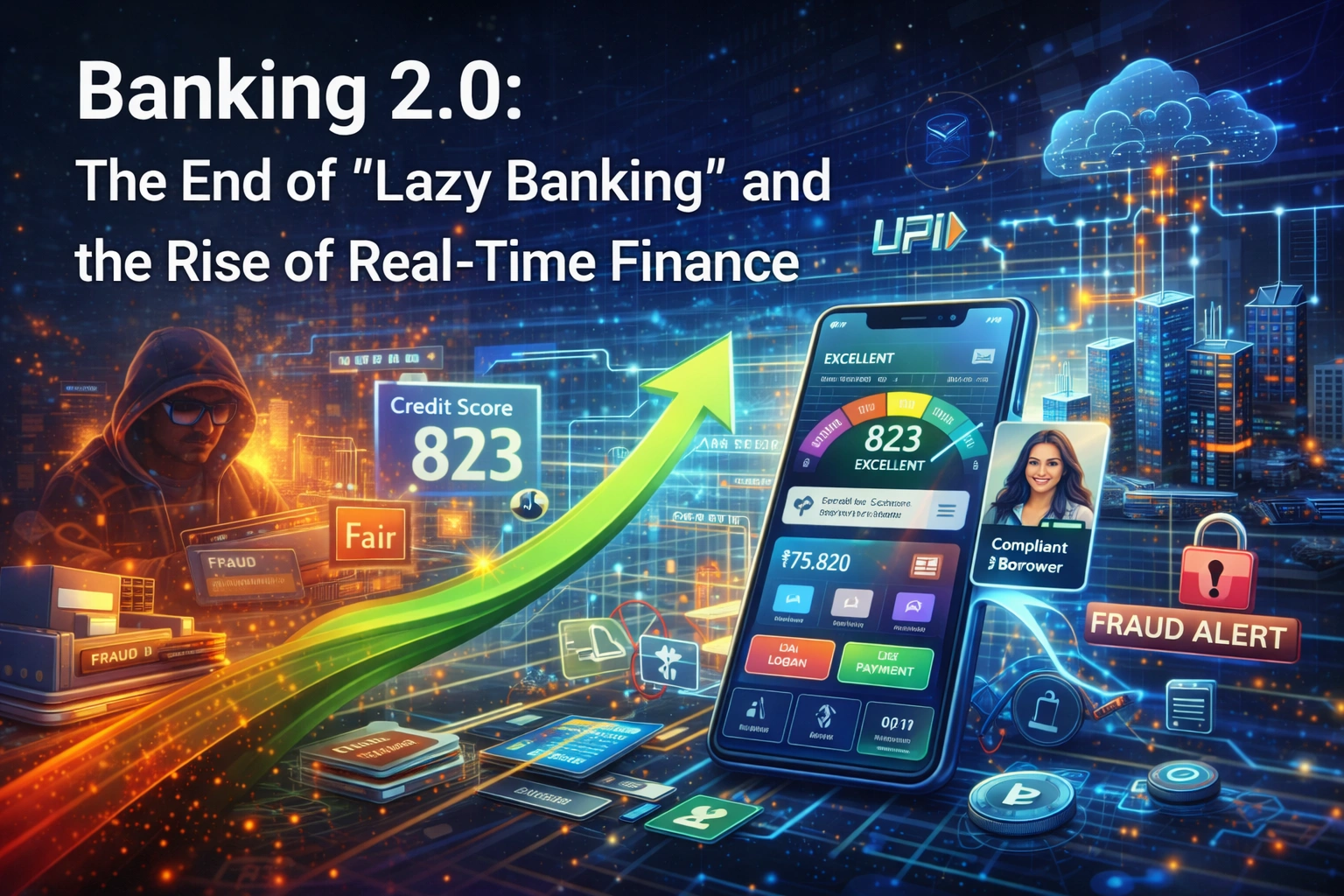
Banking 2.0: The End of “Lazy Banking” and the Rise of Real-Time Finance
India’s banking system is undergoing a quiet but irreversible transformation. There are no dramatic announcements, no sweeping slogans—but the implications are profound. With new rules tightening account activity norms, credit reporting timelines, and data-sharing requirements, Indian banking has entered what can only be described as Banking 2.0.
At the heart of this shift lies a simple message from the regulator:
In a digital economy, inactivity is no longer neutral.
From Inclusion at Any Cost to Accountability by Design
For nearly a decade, India’s financial strategy prioritised inclusion:
- Zero-balance accounts
- Mass account opening drives
- Simplified onboarding
This phase was essential. It brought millions into the formal financial system. But inclusion without engagement created new risks—dormant accounts, mule accounts, and data blind spots that were increasingly exploited for fraud.
The new regulatory posture signals a transition:
From access-first banking to activity-aware banking.
Why Dormant Accounts Are Now a Systemic Risk
Dormant and rarely used accounts are not just inefficient—they are dangerous.
They are frequently used for:
- Money laundering
- Fraudulent fund routing
- Synthetic identity creation
- UPI-linked scam networks
By tightening scrutiny around inactive and zero-balance accounts, the Reserve Bank of India is effectively forcing banks to clean their balance sheets of digital dead weight.
This is not exclusion.
It is system hygiene.
The Seismic Shift: Weekly Credit Reporting
One of the most underreported—but consequential—changes is the move from monthly to near-real-time credit reporting.
Banks and lenders are now required to update borrower data to credit bureaus four times a month—on the 7th, 14th, 21st, and 28th.
Why this matters:
- Credit scores will adjust faster
- Risk detection becomes proactive, not reactive
- Overleveraging is flagged early
- Fraud patterns surface in near real time
This fundamentally changes how credit risk is priced in India.
The Death of “Lazy Banking”
For decades, banking systems operated on lag:
- Delayed reporting
- Periodic reviews
- Static risk profiles
That era is ending.
In Banking 2.0:
- Creditworthiness is continuous
- Risk is dynamic
- Silence is a signal
Banks can no longer afford to ignore low-activity accounts or outdated borrower data. The system now rewards engagement, transparency, and consistency.
UPI, Credit, and the New Financial Layer
The real story is not just compliance—it’s credit layering.
As UPI becomes India’s default payment rail, lending is being embedded into:
- Daily transactions
- Merchant payments
- Consumption behaviour
Credit is no longer a separate event.
It is becoming ambient.
But ambient credit requires live data, not monthly snapshots. The new reporting regime makes this possible—turning India’s payment infrastructure into a real-time financial nervous system.
Who Benefits—and Who Feels the Pressure
Winners:
- Active, compliant borrowers
- Fintechs with strong data discipline
- Banks investing in analytics and AI
- Consumers building consistent digital footprints
Under Pressure:
- Dormant account holders
- Informal borrowers gaming the system
- Lenders dependent on lagging data
- Fraud networks exploiting opacity
Banking 2.0 is not softer.
It is sharper.
The Quantiq View
India’s financial evolution is no longer about expanding access—it is about deepening trust.
The new rules do not make banking harder.
They make it more honest.
In a system where payments are instant, data must be too. And in a world of real-time finance, there is no room for lazy banking—only responsible participation.