
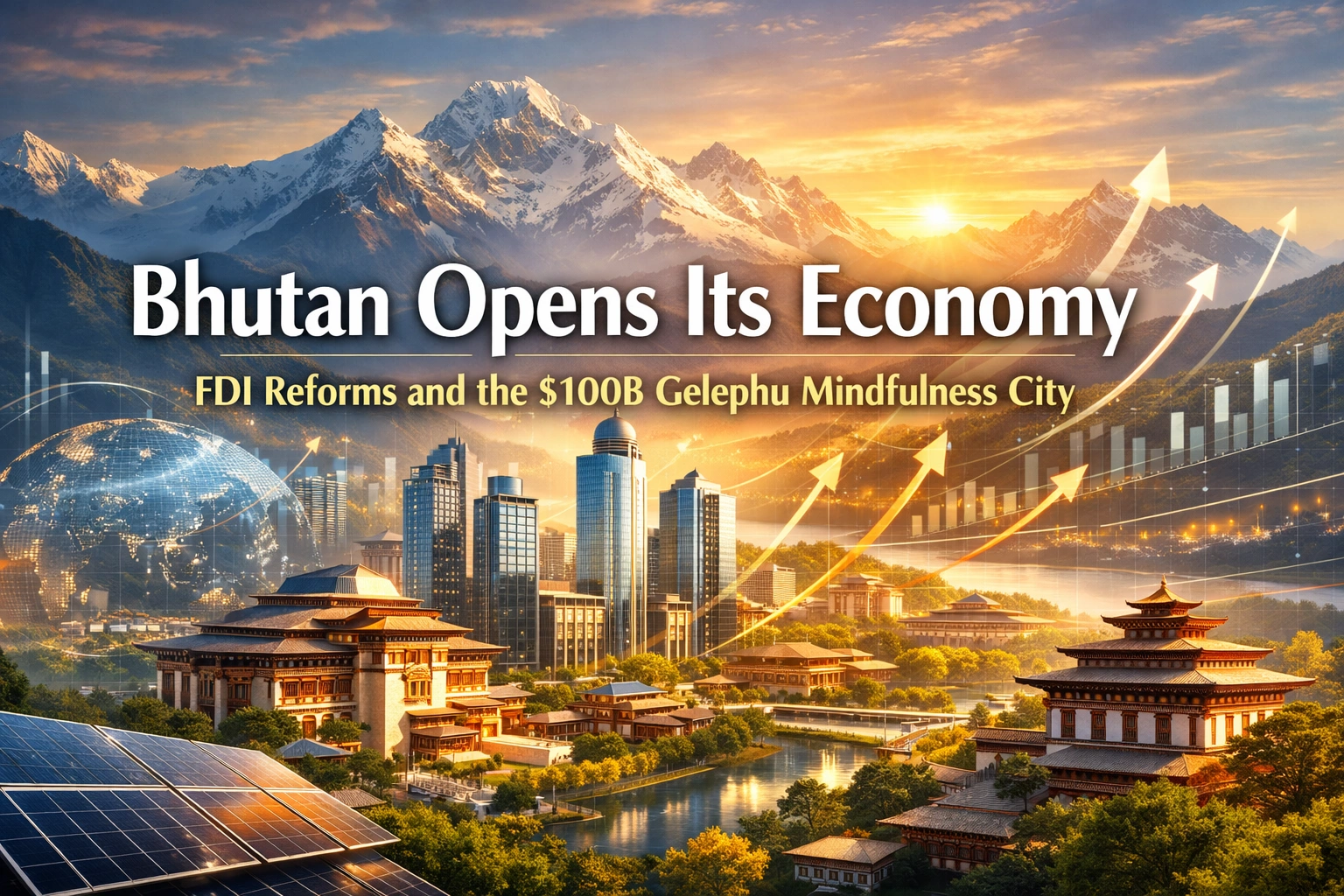
Bhutan’s FDI Revolution: Why the Himalayan Kingdom Is Opening Its Doors to Global Capital
For decades, Bhutan’s economic philosophy stood apart from the global race for capital. The Himalayan kingdom famously prioritised Gross National Happiness (GNH) over aggressive GDP growth, maintaining a cautious approach to foreign investment while protecting its cultural and environmental values.
That approach is now undergoing a historic shift.
Bhutan is embarking on what could become the most significant economic transformation in its modern history, marked by sweeping reforms to its foreign direct investment framework and the launch of a $100 billion special administrative region known as Gelephu Mindfulness City (GMC).
The twin initiatives signal a clear message: Bhutan is ready to engage more deeply with global capital markets while attempting to preserve the principles that have long defined its development model.
A Policy Shift Years in the Making
Bhutan’s relationship with foreign investment has evolved gradually since the early 2000s.
The country introduced its first FDI policy in 2002, which used a “positive list” approach allowing foreign investment only in specifically approved sectors. This cautious framework reflected Bhutan’s desire to protect domestic industries and maintain cultural and environmental integrity.
A major shift came in 2010, when the government adopted a negative list model, opening most sectors to foreign investors except those explicitly restricted.
Subsequent revisions in 2014 and 2019 gradually liberalised investment thresholds and streamlined approvals.
The FDI Policy 2019, which governed Bhutan’s investment environment for several years, introduced mechanisms such as:
- Maximum foreign equity limits in selected sectors
- Minimum project investment thresholds
- Creation of an FDI Division under the Ministry of Industry, Commerce and Employment (MoICE)
- Mandatory equity lock-in periods
- Restrictions on expatriate work permits
However, Bhutan’s leadership increasingly recognised that incremental reforms would not be enough to attract large-scale global capital.
In January 2024, Prime Minister Tshering Tobgay directed the Ministry of Industry, Commerce and Employment to undertake a comprehensive overhaul of Bhutan’s foreign investment regime.
This reform process culminated in the introduction of the Foreign Direct Investment Rules & Regulations 2025, which came into force in July 2025, replacing the earlier policy framework and consolidating Bhutan’s investment laws into a single, modern regulatory regime.
The 2025 Investment Framework: A More Investor-Friendly Regime
The FDI Rules & Regulations 2025 represent the most significant liberalisation of Bhutan’s investment regime since the country first opened its economy to foreign capital.
The new framework aims to make Bhutan a more attractive destination for international investors while aligning foreign investment with national development priorities.
Several structural reforms stand out.
Greater Freedom for Investors
One of the most notable changes is the removal of the earlier equity lock-in period, which previously required foreign investors to retain their full ownership stake for several years after commencing commercial operations.
Eliminating this requirement provides investors with greater flexibility in managing ownership structures and exit strategies.
Liberalised Dividend Repatriation
The new regulations also allow foreign investors to repatriate profits freely in their investment currency, eliminating earlier ceilings and restrictions.
This change addresses a major concern for international investors evaluating frontier markets.
Improved Access to Foreign Exchange
Foreign exchange availability has historically been a structural challenge for businesses operating in Bhutan.
Under the new framework, foreign companies are permitted to access convertible currencies and Indian Rupees through Bhutan’s Royal Monetary Authority for:
- importing capital equipment
- purchasing raw materials
- remitting employee salaries
This reform is particularly significant because around 85% of Bhutan’s goods imports originate from India, making the ability to transact in Indian Rupees essential for many businesses.
Greater Flexibility in Hiring Foreign Talent
Earlier regulations placed strict limits on expatriate employment, including caps on work permits and mandatory ratios between Bhutanese and foreign employees.
The new framework removes many of these restrictions, giving companies greater flexibility in hiring specialised managerial and technical talent during the early stages of their operations.
Investor Residency Incentives
Bhutan is also experimenting with modest investment-linked residency incentives.
Under the updated framework, foreign investors committing more than Nu 20 million (approximately $230,000) can obtain an Investor Card granting renewable one-year residency.
The card also allows:
- spouses to obtain work permits
- children to enrol in local schools
While relatively modest compared with global investment migration programs, the initiative signals Bhutan’s growing willingness to compete for international capital.
Sectoral Opportunities for Global Investors
Bhutan’s investment framework categorises sectors according to national development priorities, with different levels of foreign ownership permitted.
Several sectors have been significantly liberalised.
Agriculture and Agri-Technology
The new regulations allow 100% foreign ownership in agriculture, horticulture, and aquaculture, marking a major policy shift.
Bhutan’s organic farming policies, pristine environment, and carbon-negative economy create opportunities in:
- premium organic food exports
- agri-technology
- climate-smart farming
- high-value agro-processing
IT and IT-Enabled Services
The IT and digital services sector is emerging as one of Bhutan’s most promising investment destinations.
Foreign investors are now allowed 100% ownership in IT and IT-enabled services, reflecting the government’s ambition to build a knowledge-based economy.
IT and ITES projects already account for over 23% of FDI investments in Bhutan, making it one of the fastest-growing sectors in the country.
Hospitality and Wellness Tourism
Tourism remains Bhutan’s largest FDI destination.
The country’s unique “high value, low volume” tourism policy, reinforced by the $200 per night Sustainable Development Fee introduced in 2022, has encouraged investment in luxury hospitality and wellness tourism.
Currently:
- Hospitality accounts for 34.7% of total FDI value
- The sector generates 34.6% of FDI-linked employment
However, Bhutan continues to restrict foreign investment in three-star and lower-category hotels, reflecting its commitment to maintaining an exclusive tourism model.
The Numbers Behind Bhutan’s Investment Push
Despite its ambitious reforms, Bhutan’s investment base remains relatively small compared to regional economies.
In 2024, the country approved:
- 17 FDI projects
- Total investment value of Nu 15.96 billion
This represented a 110% increase in investment value compared to 2023, when only 12 projects were approved.
Since Bhutan introduced foreign investment policies in 2002, the country has approved:
- 121 FDI projects
- Total value of Nu 60.84 billion (approximately $692 million)
FDI projects generated 4,366 Bhutanese jobs in 2024, highlighting the growing role of foreign investment in employment creation.
However, most projects remain concentrated in the country’s key economic centres such as Thimphu, Paro, and Chukha, reflecting infrastructure and connectivity advantages.
Bhutan’s Ambitious Investment Targets
Bhutan has set an ambitious target of attracting Nu 500 billion in foreign investment during its 13th Five-Year Plan (2024–2029).
At current levels of investment inflows, the country would need to increase annual FDI approvals more than six-fold to meet this goal.
Economic growth projections remain positive.
According to international estimates:
- Bhutan’s GDP per capita is approximately $3,700
- Real GDP growth reached 4.8% in FY2024–25
- Growth is expected to rise to around 5.2% in FY2025–26
Hydropower exports to India remain the backbone of the economy, but policymakers increasingly recognise the need to diversify into technology, tourism, services, and manufacturing.
Who Is Investing in Bhutan?
Bhutan’s FDI landscape is still dominated by a few key regions.
India remains the largest source of foreign investment, accounting for around 55% of total FDI projects.
This dominance reflects deep structural ties between the two countries, including:
- a currency peg between the Ngultrum and the Indian Rupee
- an open border for citizens
- India’s position as Bhutan’s largest development partner
Other important investment sources include:
- Singapore — 15%
- Thailand — 11%
- Europe — 12.9%
- Americas — 23.5%
Singapore’s presence is particularly noteworthy because Bhutan’s upcoming special administrative region has adopted elements of Singapore’s legal framework.
The $100 Billion Wildcard: Gelephu Mindfulness City
No analysis of Bhutan’s economic transformation is complete without considering Gelephu Mindfulness City (GMC).
Announced by King Jigme Khesar Namgyel Wangchuck, the project aims to build a 2,600-square-kilometre special administrative region near Bhutan’s southern border with India.
The development is expected to involve up to $100 billion in long-term investment and could eventually house over one million residents.
The city is designed around eight strategic sectors:
- green energy and technology
- digital finance and fintech
- agri-technology and forestry
- health and wellness tourism
- education and research
- aviation and logistics
- spirituality and cultural tourism
- sustainable urban development
If successful, GMC could become the primary engine of Bhutan’s economic diversification and a major gateway connecting South Asia with Southeast Asian markets.
Structural Risks and Challenges
Despite the optimism surrounding Bhutan’s investment reforms, several structural challenges remain.
Youth Outmigration
A growing number of Bhutanese youth are migrating abroad for employment, creating labour shortages in the domestic economy.
Hydropower Dependence
Bhutan’s economy remains heavily dependent on hydropower exports to India, making diversification a critical policy priority.
Small Capital Markets
Bhutan’s domestic financial market remains extremely small, with fewer than 20 companies listed on the Royal Securities Exchange of Bhutan.
Regulatory Complexity
International institutions have also warned that the legal framework governing Gelephu Mindfulness City must be carefully coordinated with Bhutan’s national regulatory system to avoid inconsistencies.
A Frontier Market Opening Its Doors
Bhutan’s economic transformation represents a strategic recalibration rather than a radical departure from its development philosophy.
The government continues to emphasise sustainability, environmental protection, and cultural preservation even as it seeks to attract global capital.
For investors, Bhutan remains a frontier market offering both opportunity and complexity.
But for the first time in its modern economic history, the Himalayan kingdom appears determined to bridge its unique philosophy of development with the realities of global investment flows.
Whether this ambitious experiment succeeds will depend on how effectively Bhutan can convert policy reforms into tangible investment on the ground.https://thequantiq.com/when-the-strait-goes-silent-the-us-iran-war-the-world-economy-and-the-25-day-clock-india-cannot-afford-to-ignore/




One Comment