The ₹30 Billion River Leap
How Inland Waterways are Making Assam India’s New Logistics Gateway
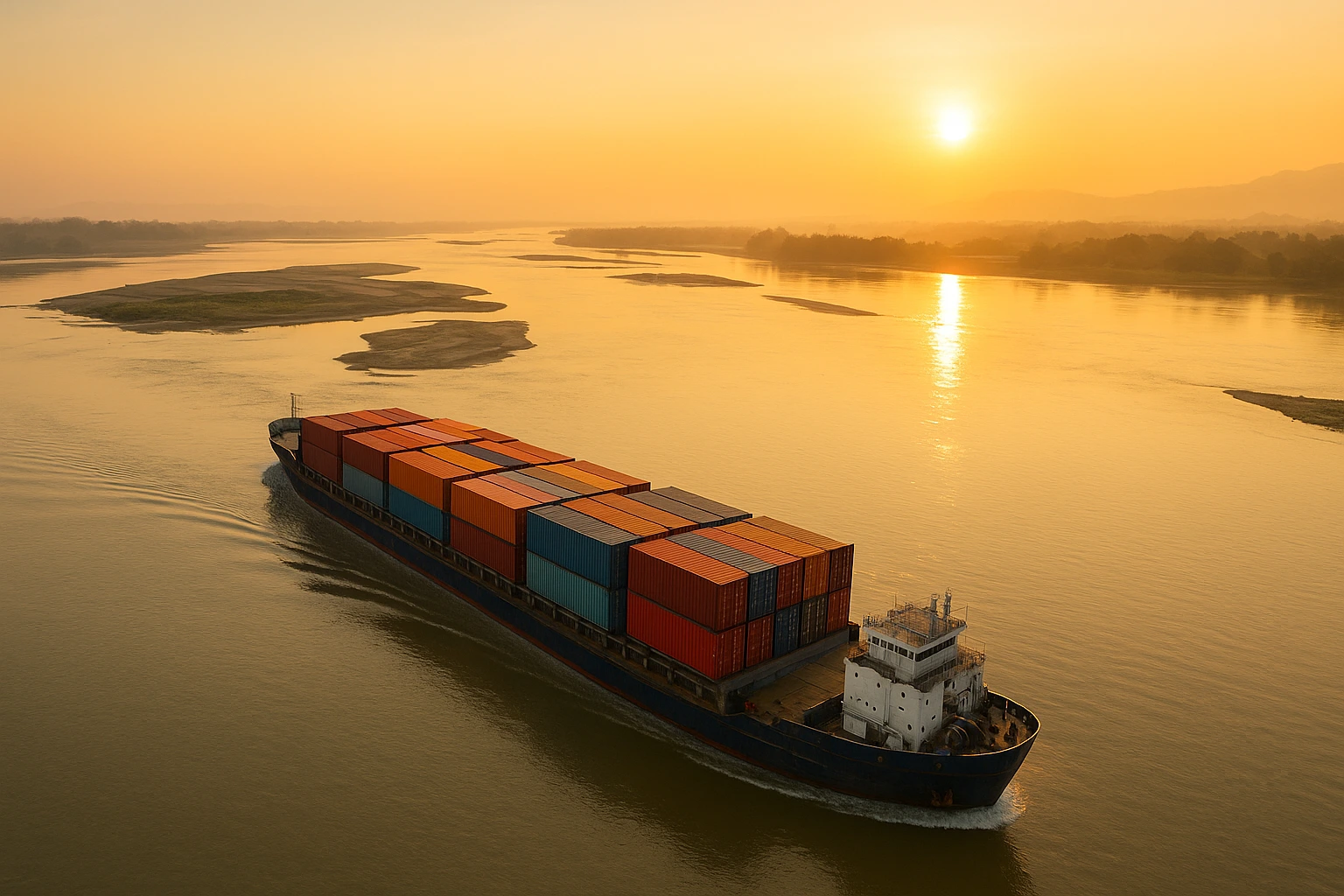
The North East has historically been India’s geographical periphery, but a massive infrastructure push is rewriting that narrative. The Brahmaputra (National Waterway-2) and the Barak (National Waterway-16) are transforming from scenic rivers into powerful, eco-friendly economic arteries, a shift driven by hard data and the urgent need to slash India’s high logistics costs.
At the North East Oil & Gas Conclave 2025, Union Minister Shri Sarbananda Sonowal delivered a hard data–loaded speech, laying out in unmistakable terms the major initiatives his ministry has undertaken and their growing impact.
India aims to cut its logistics costs from 13%-14% of GDP down to global benchmarks of 8%. The Inland Water Transport (IWT) network is the key to this ambition.
The Economic Case: Efficiency by the Tonne-Kilometre
The revival of Assam’s waterways is not an abstract policy; it is rooted in concrete economic efficiency. IWT is the most cost-effective mode of bulk transport, a crucial factor for the region’s energy and industrial supply chains.
- Fuel Efficiency: One litre of fuel can move a cargo of 215 Tonne-Km on IWT, compared to 95 Tonne-Km by rail and just 24 Tonne-Km by road. This extreme efficiency translates directly into lower operating costs for businesses.
- The Energy Backbone: Shri Sarbananda Sonowal highlighted that the IWT sector now stands as the “backbone of energy transportation for the Northeast.” This was demonstrated by the successful transportation of Over-Dimensional Cargo (ODC) for the expansion of the Numaligarh Refinery.
Cargo Data: The Surge is Real
The investment is yielding immediate returns in cargo volume. Annual movement on National Waterway-2 (Brahmaputra) is now rapidly approaching 6 lakh tonnes.
This surge is complemented by strategic infrastructure:
- Investment Tally: The government has undertaken ₹1,000 crore worth of inland waterway projects in the Northeast in the past two years.
- Strategic Facilities: A crucial ₹239 crore ship repair facility is under construction at Pandu, Guwahati. This will significantly reduce vessel downtime and maintenance costs, which otherwise require ships to travel to Kolkata via the Indo-Bangladesh Protocol Route (IBPR).
- Export Corridors: A ₹400 crore agreement between IWAI and Assam Petro-Chemicals Ltd. (APL) is leveraging the waterways to export methanol and formalin to Bangladesh and Southeast Asia, fundamentally repositioning Assam as an export hub.
The Green Dividend: Sustainability by the River
In an era demanding sustainable logistics, the environmental profile of IWT is its most compelling feature, especially for a region as ecologically sensitive as the Northeast.
- Lower Emissions: IWT is inherently the most eco-friendly mode, producing significantly fewer carbon emissions per tonne-km compared to road transport.
- Decongestion: By diverting bulk and hazardous cargo (like petroleum products) from congested national highways to the river, IWT dramatically reduces traffic congestion, wear-and-tear on roads, and air pollution in populated areas.
- Green Urban Transit: A ₹1,000 crore Water Metro project planned for Guwahati, Tezpur, and Dibrugarh will employ electric-hybrid boats, offering a clean, modern solution to urban transit issues.
The data—from the fuel efficiency metrics to the multi-billion rupee infrastructure investment and the surge in bulk cargo—shows that the revival of the Brahmaputra and Barak is more than just a regional project. It is a central plank of the ‘Act East’ policy and the PM Gati Shakti master plan.
By integrating the landlocked Northeast with global markets via the Indo-Bangladesh Protocol Route (IBPR), the government is successfully transforming Assam from the geographical periphery into India’s essential, cost-efficient, and green “logistics gateway” to Southeast Asia. This makes the region a ‘New Engine of Growth,’ ready to drive the next phase of India’s economic expansion.