
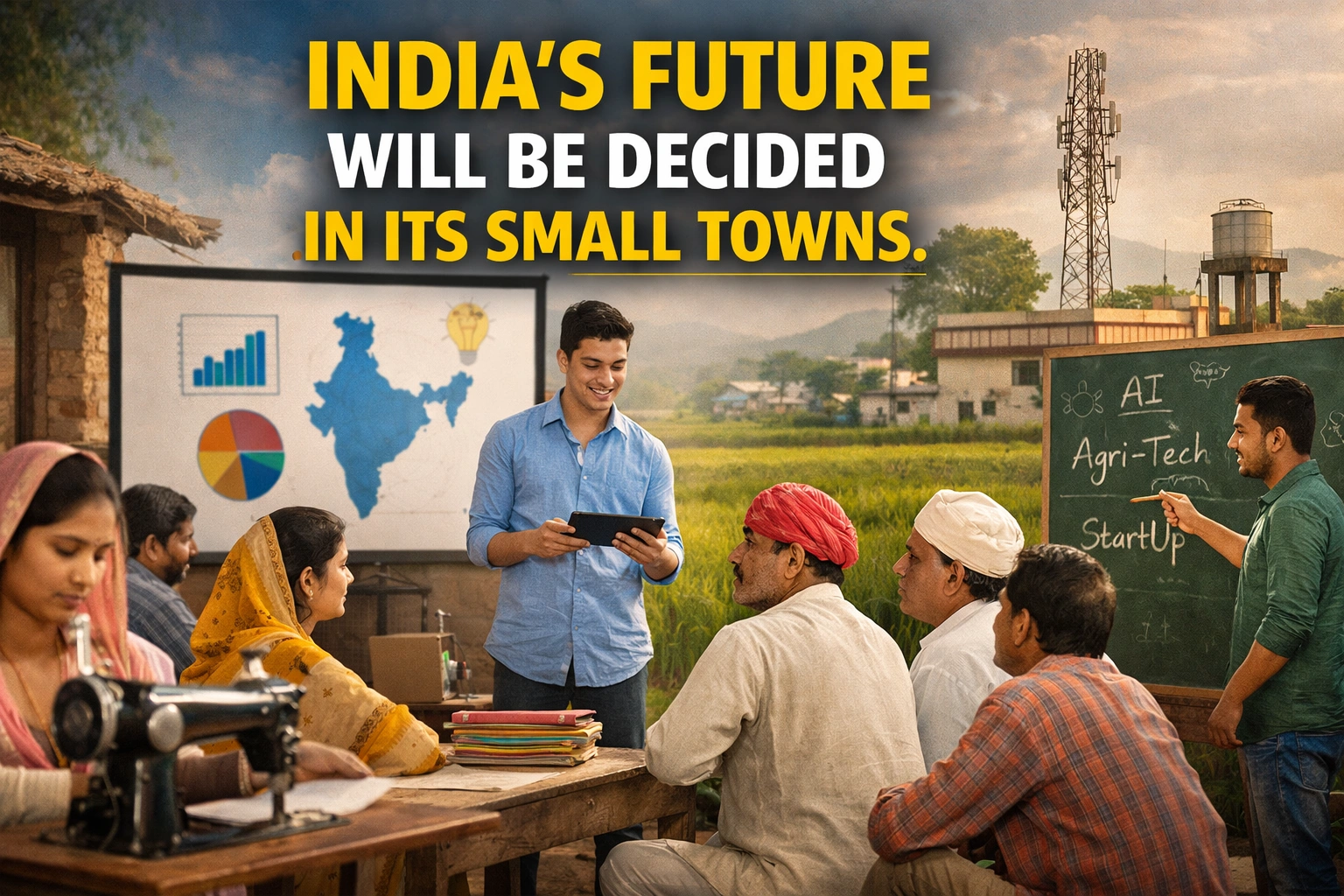
Frontier 50 and the Rise of Hyperlocal Intelligence: Why India’s Future Will Be Built in Its Districts
India’s Development Story Is Moving Closer to the Ground
For decades, India’s development narrative has been shaped by national policies, central budgets, and top-down governance frameworks. But something fundamental is changing.
A quiet yet powerful shift is underway—one that is moving decision-making, innovation, and economic momentum closer to the ground.
With the emergence of the Frontier 50 initiative led by NITI Aayog, India is beginning to reimagine development—not as a centralized process, but as a distributed intelligence system rooted in districts and blocks.
This is not just another government programme. It is a signal.
A signal that India’s next phase of growth will not be built in its metros—but in its districts, small towns, and rural clusters.
What Is the Frontier 50 Initiative?
The Frontier 50 initiative builds on the success of India’s Aspirational Districts Programme, which has already transformed governance across more than 100 districts by focusing on measurable outcomes in health, education, agriculture, and infrastructure.
According to updates from the Press Information Bureau, the new push aims to:
- Identify high-potential but underdeveloped regions
- Accelerate capacity building at the local level
- Promote entrepreneurship and livelihoods
- Strengthen data-driven governance systems
At its core, Frontier 50 represents a transition:
From aspiration tracking → to capability building and execution
If we read between the lines, three structural shifts emerge.
1. Districts as Economic Engines
India is no longer viewing districts merely as administrative units.
They are being repositioned as:
- Growth nodes
- Innovation clusters
- Execution hubs
This aligns with global development thinking, where localized economic ecosystems outperform centralized planning.
2. Data as the New Governance Layer
The Frontier 50 approach emphasizes:
- Real-time monitoring
- Outcome-based rankings
- Data dashboards
This marks a transition toward algorithm-assisted governance, where decisions are increasingly shaped by data signals rather than bureaucratic hierarchies.
3. Capacity Building as the Core Bottleneck
Perhaps the most important insight:
The infrastructure is evolving. The policy frameworks are in place.
But the human layer is lagging behind.
This gap is not about access.
It is about understanding, usability, and application.
The Missing Link: Intelligence Democratization
India today stands at a paradox.
On one hand:
- Digital infrastructure has expanded rapidly
- Internet penetration has crossed 50% nationally (various telecom estimates)
- Smartphones have reached deep into rural India
On the other:
- Digital literacy remains uneven
- AI awareness is minimal outside urban centers
- Application of technology in livelihoods is still nascent
This creates a three-layered gap:
Awareness Gap
People don’t know what is possible.
Skill Gap
They don’t know how to use available tools.
Application Gap
They cannot connect technology to real-world outcomes.
Why AI Literacy Could Be the Missing Multiplier
This is where the conversation moves beyond policy—and into possibility.
The Frontier 50 initiative is fundamentally about unlocking local potential.
But potential without intelligence remains dormant.
AI changes that equation.
It enables:
- Farmers to predict prices and weather patterns
- Small businesses to market digitally
- Students to access global knowledge systems
- Local entrepreneurs to scale ideas beyond geography
In essence:
AI is not just a technology layer—it is an economic multiplier for local ecosystems
A New Development Model: Hyperlocal Intelligence
What is emerging is a new model of development:
Hyperlocal Intelligence Systems
Where:
- Data flows from the ground up
- Decisions are made locally
- Technology amplifies human capability
- Communities become self-improving systems
This is not theoretical.
It is already visible in:
- Digital agriculture platforms
- Rural fintech adoption
- Women-led self-help group enterprises
- Local e-commerce ecosystems
The Strategic Opportunity: Convergence of Policy and People
The Frontier 50 initiative creates the framework.
But frameworks alone do not create transformation.
They require:
- Awareness
- Participation
- Capability
This is where community-led initiatives—especially around AI literacy and digital empowerment—become critical.
Because the future of India’s economy will depend on:
How quickly its people can understand, adapt, and apply intelligence tools
Why This Matters for India’s Economic Future
India’s ambition to become a $5 trillion economy and beyond will not be achieved by urban growth alone.
It will depend on:
- Productivity gains in rural and semi-urban regions
- Entrepreneurship in small towns
- Efficient resource utilization
- Market access for local producers
The Frontier 50 initiative signals that policymakers understand this.
The next step is execution.
India’s Next Leap Will Be Local
India is entering a new phase of development.
One where:
- Growth is decentralized
- Intelligence is democratized
- Technology is localized
The Frontier 50 initiative is not just a programme.
It is a blueprint.
A blueprint for an India where:
- every district becomes a growth story
- every citizen becomes a participant
- and every idea, no matter how small, has the potential to scale
Because in the end:
India’s future will not be built in boardrooms.
It will be built in classrooms, पंचायत halls, small businesses, and village networks.
And increasingly, it will be powered by intelligence—made accessible to all.https://thequantiq.com/why-india-msme-schemes-fail-last-mile/





One Comment