
Gelephu Mindfulness City: The $100 Billion Opportunity Northeast India Cannot Afford to Miss
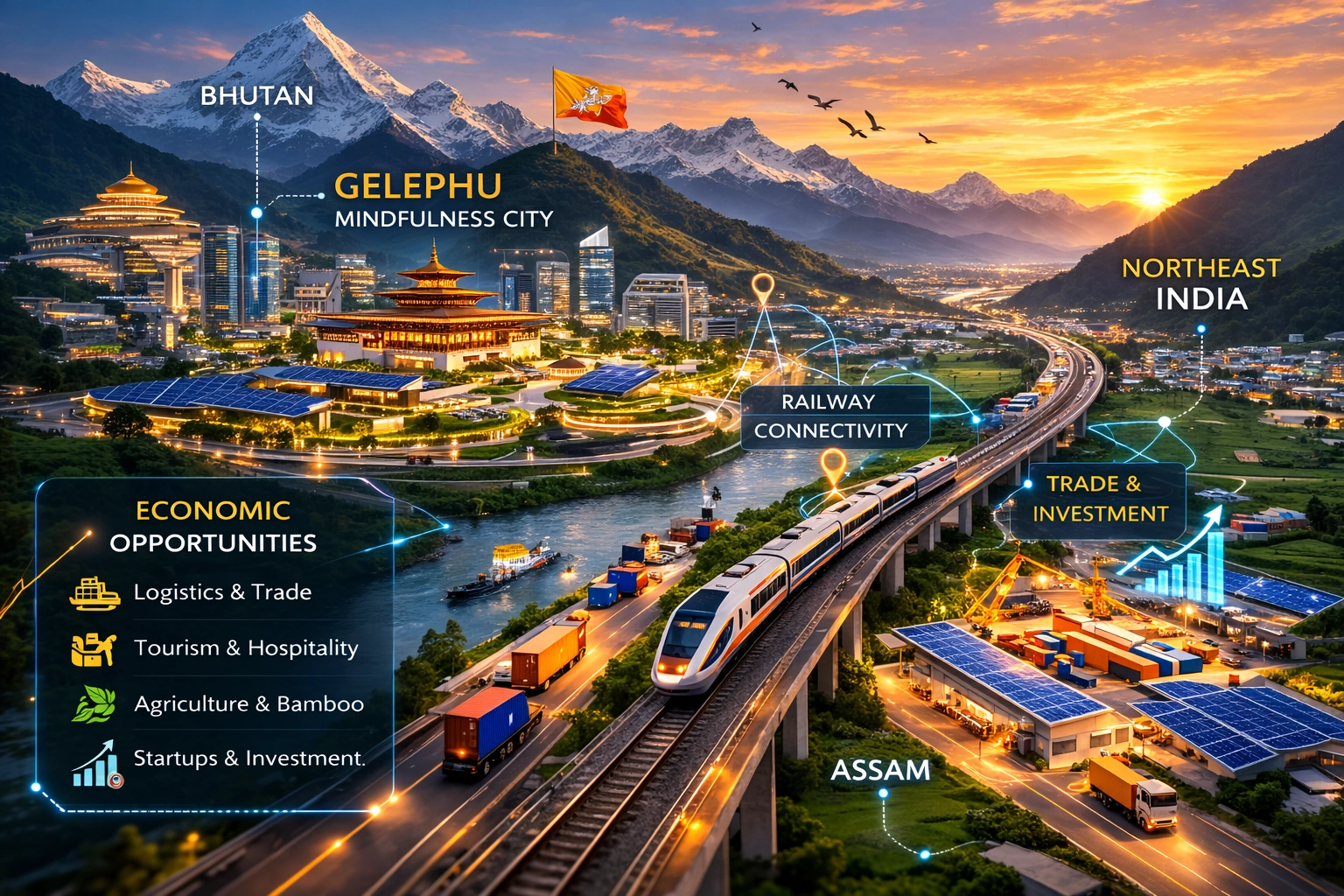
When Bhutan unveiled the vision for Gelephu Mindfulness City (GMC), it was widely seen as one of the most ambitious economic experiments in South Asia — a $100 billion sustainable smart city designed to transform the Himalayan kingdom’s economic future. But the story does not end at Bhutan’s border.
Just a few kilometres away from the project site lies Northeast India, a region that has long struggled to integrate fully with the country’s larger economic growth engines. The emergence of Gelephu Mindfulness City could change that dynamic dramatically.
Located near the India–Bhutan border in southern Bhutan, Gelephu sits barely 50 kilometres from Assam’s Kokrajhar district and within a few hours of major regional centres such as Guwahati and Siliguri. This proximity means the economic ripple effects of the project will almost certainly extend deep into Northeast India.
If approached strategically, Gelephu Mindfulness City could become the most significant economic opportunity for Northeast India in decades, creating new supply chains, tourism circuits, logistics networks, and entrepreneurial ecosystems across the border.
A New Economic Hub in the Eastern Himalayas
Gelephu Mindfulness City is envisioned as a 2,600-square-kilometre special administrative region focused on sustainability, innovation, and economic diversification.
The city is expected to attract global investment into sectors such as:
- green energy and climate technology
- digital finance and fintech
- agri-technology and forestry
- wellness tourism and healthcare
- education and knowledge industries
- aviation and logistics
Over time, the city could accommodate more than one million residents and create tens of thousands of jobs.
Urban design plans combine Bhutanese architectural traditions with futuristic sustainable infrastructure, including green corridors, pedestrian mobility systems, and mandala-inspired neighbourhood layouts.
Yet large urban economic hubs rarely operate in isolation.
Around the world, major cities generate powerful regional supply ecosystems that extend far beyond their administrative boundaries.
Shenzhen reshaped the industrial landscape of Guangdong. Dubai’s growth transformed the northern Emirates. Singapore’s economic gravity catalysed development in Johor.
Similarly, Gelephu’s rise could reshape the economic geography of Northeast India.
Why Northeast India Is Perfectly Positioned
Geography provides Northeast India with a unique advantage in benefiting from the Gelephu project.
Several key towns and cities lie within easy logistical reach of the proposed city:
- Kokrajhar: about 50 km
- Bongaigaon: about 60 km
- Guwahati: about 150 km
- Siliguri Corridor: about 200 km
These distances place Northeast India in an ideal position to serve as the natural economic hinterland for Gelephu Mindfulness City.
The region already possesses several structural strengths that complement GMC’s development goals.
Northeast India has abundant natural resources, including bamboo, timber, and agricultural produce. It also has a growing base of educational institutions, a young labour force, and expanding transport infrastructure.
For decades, economic development in the region has been constrained by geography and connectivity challenges. However, the emergence of a major economic hub just across the border could unlock entirely new possibilities.
The Railway That Could Transform the Region
One of the most important developments supporting cross-border economic integration is the first-ever railway connectivity project between India and Bhutan.
In 2025, India approved railway projects worth approximately ₹4,033 crore linking Bhutan to India’s rail network.
The most significant among them is the Kokrajhar–Gelephu railway line, a 69-kilometre rail corridor that will directly connect Assam’s Kokrajhar district with Gelephu.
A second line, Banarhat–Samtse, will connect western Bhutan with rail networks in West Bengal.
Together, these projects will establish nearly 89 kilometres of cross-border railway connectivity, dramatically improving logistics between the two countries.
For Gelephu Mindfulness City, the Kokrajhar–Gelephu railway could become a crucial economic artery. It will allow faster movement of construction materials, agricultural goods, industrial supplies, and passengers.
For towns such as Kokrajhar and Bongaigaon, the railway could transform them into important logistics hubs serving the emerging city.
Improved rail connectivity will also help reduce transportation costs and create new opportunities for businesses on both sides of the border.
Tourism Circuits Across Borders
Tourism could become one of the most visible areas of economic cooperation.
Bhutan’s tourism model focuses on high-value, low-volume travel, with visitors paying a Sustainable Development Fee that helps preserve the country’s environment and cultural heritage.
This policy naturally limits mass tourism within Bhutan itself.
As a result, neighbouring regions in Northeast India could benefit from tourism spillovers.
Visitors travelling to Bhutan may extend their journeys to nearby destinations such as:
- Kaziranga National Park
- Manas National Park
- the tea gardens of Assam
- the scenic landscapes of Meghalaya
Developing a Bhutan–Assam tourism circuit could significantly increase international visitor flows and stimulate hospitality industries across the region.
Construction Supply Chains: A Massive Opportunity
Large-scale urban development projects create enormous demand for construction materials.
The development of Gelephu Mindfulness City will require significant quantities of: cement, steel, tiles and glass, construction equipment, furniture, and interior materials.
Businesses in Assam and neighbouring states could play a major role in supplying these materials.
Entrepreneurs may find opportunities in creating construction supply chains specifically geared toward the GMC project.
Over the next decade, this demand alone could generate substantial economic activity across Northeast India.
The Bamboo Economy
Few regions in the world possess bamboo resources on the scale found in Northeast India.
The region accounts for nearly two-thirds of India’s bamboo reserves, making it a global centre for bamboo-based industries.
Given Gelephu Mindfulness City’s focus on sustainability and green architecture, bamboo could play an important role in construction and urban design.
Potential opportunities include: laminated bamboo panels, eco-friendly furniture, modular bamboo structures, interior decorative materials.
If developed strategically, bamboo industries linked to GMC could become a major new economic driver for the region.
Agricultural Supply Chains
Cities depend heavily on surrounding regions for food supplies.
As Gelephu’s population grows, the city will require consistent supplies of: vegetables and fruits, dairy products, poultry, organic herbs, and spices.
Farmers in Assam and neighbouring states could benefit from supplying fresh produce to hotels, restaurants, and retail outlets within GMC.
This could create new income opportunities for agricultural communities across the region.
Logistics and Startup Opportunities
Expanding cross-border trade will also create opportunities for new business models.
Entrepreneurs could develop logistics companies specialising in: cross-border trucking, freight aggregation, cold-chain transport, and digital supply-chain platforms.
Such services could significantly improve the efficiency of trade between Bhutan and Northeast India.
Guwahati, already the largest commercial centre in the region, could emerge as the primary logistics gateway supporting Gelephu Mindfulness City.
Hospitality and Accommodation Spillovers
Bhutan’s tourism strategy emphasises premium experiences, which naturally keeps accommodation costs relatively high.
This creates opportunities for neighbouring towns in India to cater to budget travellers and business visitors.
Cities such as Kokrajhar and Bongaigaon could see the emergence of: boutique hotels, eco-lodges, homestays, and travel services.
This hospitality ecosystem could generate employment and encourage small business development in border districts.
Digital Services and Creative Industries
The growth of knowledge industries within Gelephu will also generate demand for digital services.
Technology professionals and startups in Northeast India could provide services such as software development, digital marketing, fintech solutions, and cybersecurity services.
With its growing startup ecosystem, Guwahati is particularly well positioned to support such opportunities.
A Supplier Economy for a New City
Perhaps the most important insight for policymakers and entrepreneurs is that Northeast India does not need to replicate Gelephu’s economic model.
Instead, the region could focus on becoming the supplier economy that supports it.
Many successful global cities rely heavily on surrounding regions for manufacturing, logistics, and supply chains.
Dubai depends on Sharjah for industrial activity. Singapore relies on Johor for manufacturing. Shenzhen’s rise transformed the entire Guangdong region.
In a similar way, Gelephu Mindfulness City could catalyse economic development across Northeast India.
A Catalyst for Regional Transformation
For decades, Northeast India has searched for a development model capable of unlocking its economic potential.
The emergence of Gelephu Mindfulness City offers a rare opportunity to reshape the region’s economic trajectory.
With new railway connectivity, growing trade flows, and expanding tourism circuits, the economic integration between Bhutan and Northeast India is already beginning to take shape.
The city itself may be located within Bhutan’s borders, but its economic influence will inevitably extend far beyond them.
For entrepreneurs, businesses, and communities across Northeast India, the message is clear:
The Gelephu opportunity is already at the doorstep.
Those who recognise it early may help shape the next chapter of the region’s economic story.https://thequantiq.com/bhutans-fdi-revolution-why-the-himalayan-kingdom-is-opening-its-doors-to-global-capital/




2 Comments