India’s Clean Energy Wave Hits Historic High: Odisha Emerges as a Major Solar Leader | The Quantiq Analysis
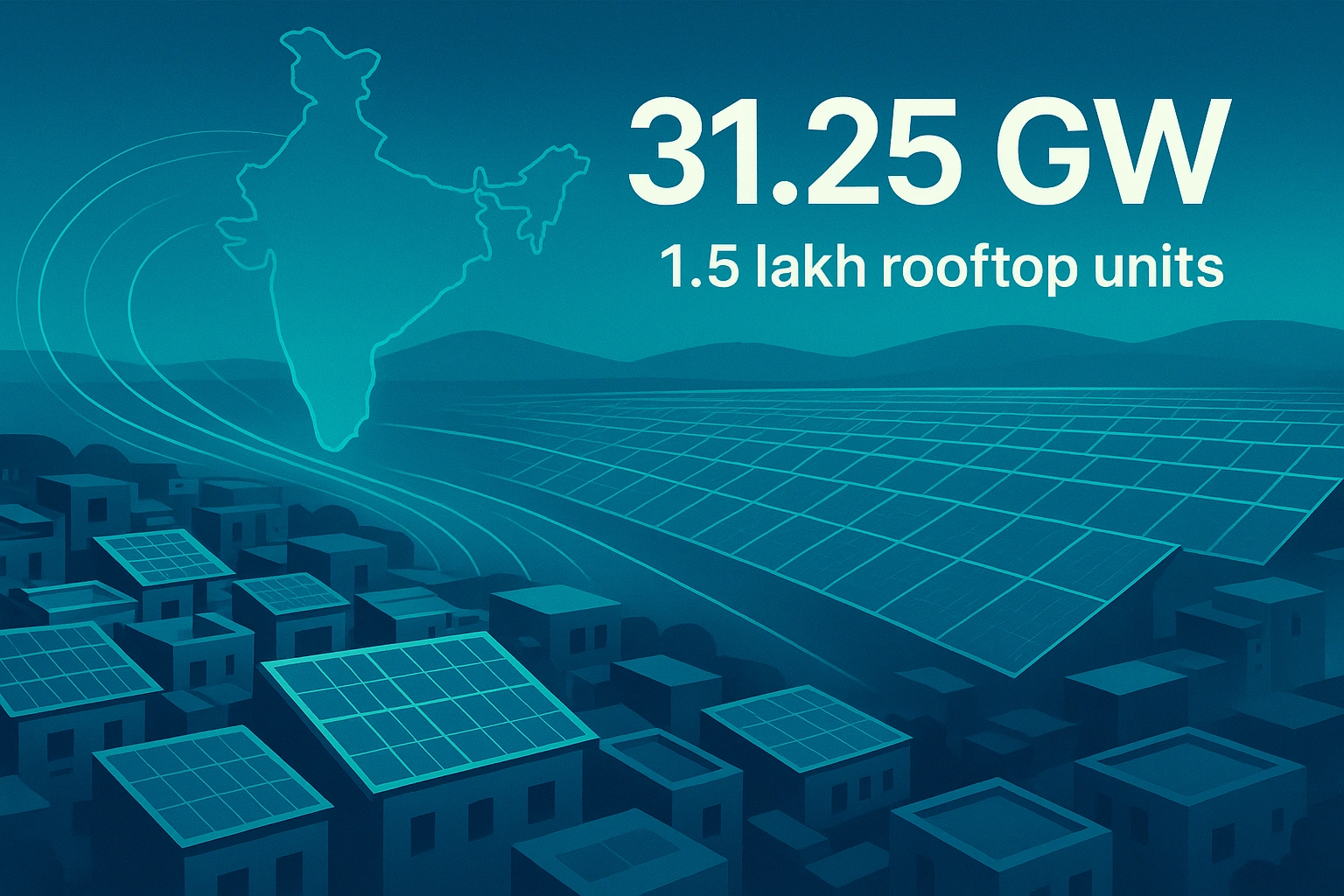
India’s renewable energy story reached a historic milestone this year, marking a period of unprecedented growth, record-breaking additions, and stronger state-level adoption—especially in Odisha. Speaking at the Global Energy Leaders’ Summit (GELS) 2025 in Puri, Union Minister for New and Renewable Energy Pralhad Joshi announced that India has achieved its highest-ever annual non-fossil capacity addition of 31.25 GW in FY 2025-26, with a massive 24.28 GW coming from solar energy alone.
The announcement positions India as a key driver of the global renewable surge, signaling a powerful acceleration in the country’s clean energy transition.
A Global Milestone—With India at the Centre
The Minister highlighted that the world took nearly seven decades to build its first 1 TW of renewable capacity (until 2022)—but only two more years to double it. India played a transformative role in this global growth curve.
- India’s solar capacity jumped from 2.8 GW to ~130 GW in 11 years, an extraordinary 4,500% expansion.
- Between 2022 and 2024 alone, India added 46 GW of solar, becoming the third-largest global contributor.
Despite holding the world’s fifth-largest coal reserves and being the second-largest consumer of coal, India continues to strike a strategic balance between coal and clean energy, driven by global competitiveness and sustainability priorities
Odisha: Fast-Tracking its Renewable Future
Odisha is emerging as one of India’s most promising clean energy adopters. At the summit, Minister Joshi unveiled a major initiative under PM Surya Ghar Yojana:
✔ 1.5 lakh rooftop solar systems (1 kW each) approved for Odisha
✔ Benefiting 7–8 lakh citizens—especially economically weaker families
This comes under the innovative Utility-Led Aggregation (ULA) model, which shifts the rooftop solar ecosystem toward a more structured, consumer-friendly, and scalable approach.
Current Snapshot of Odisha’s Renewable Progress
- Over 3.1 GW of installed renewable capacity
- Clean energy now forms 34% of the state’s total installed power mix
- 1.6 lakh households already applied for rooftop solar
- 23,000 installations completed
- Direct subsidies of ₹147+ crore transferred to 19,200+ families
This rapid adoption is backed by a strong ecosystem shaped by ease of doing business, investor confidence, demand-driven schemes, and robust Centre–State collaboration, according to the Minister.
He added that the coming years “will belong to Odisha”, crediting the leadership of Chief Minister Mohan Charan Majhi and Deputy CM Kanak Vardhan Singh Deo for pushing green technology and sustainable development goals forward.
GELS 2025: India’s New Stage for Global Energy Dialogue
he Global Energy Leaders’ Summit (GELS) 2025 in Puri is more than an event—it is India’s attempt to build a global “Community of Practice” for clean energy transformation.
From 5–7 December 2025, the summit brings together:
- Global innovators
- Energy industry leaders
- Union & State Energy Ministers
- Technology founders and sustainability strategists
The focus: shaping the future of energy through collaboration, innovation, and investment.
Why This Matters
India is entering a new era of renewable maturity. Three major signals define this moment:
1. Clean energy is scaling faster than ever
Record annual additions indicate strong demand, favorable policies, and accelerating investor participation.
2. States like Odisha are becoming solar-first economies
With ULA providing a structured deployment model, rooftop solar could transform household-level energy security.
3. India now influences global renewable patterns
The country’s solar contributions and rapid capacity additions make it a top global force in clean energy expansion.
The Quantiq View
India’s clean energy surge is no longer just a national aspiration—it is a global benchmark. Odisha’s progress reflects how decentralized solar adoption can create inclusive growth, especially for economically weaker households.
If implemented efficiently, the state’s 1.5 lakh rooftop mission could become a replicable model for other regions looking to democratize renewable energy access.
With the world transitioning faster than ever, India’s leadership—anchored in scale, innovation, and policy alignment—signals that the country is ready for the next big leap in energy transformation.