India’s New Trade Analytics Portal Promises Data Power for Exporters
The government’s new Trade Intelligence & Analytics (TIA) Portal offers real-time market insights, competitor analysis, and FTA advantages to help Indian exporters make smarter decisions.
India has taken a major step forward in empowering businesses, exporters, and policymakers by launching the Trade Intelligence & Analytics (TIA) Portal, unveiled by Union Minister of Commerce & Industry Piyush Goyal. At a time when global supply chains are shifting and India aims to expand its export footprint, the TIA Portal arrives as a powerful digital enabler that simplifies trade data, guides decision-making, and strengthens India’s position in global markets.
For years, access to high-quality trade intelligence was limited to large companies that could afford expensive market research or private databases. MSMEs, startups, and small exporters often struggled with limited information on pricing trends, competing countries, demand changes, or tariff advantages. The TIA Portal levels this playing field by giving every Indian exporter access to real-time dashboards, global trade datasets, competitive insights, and tariff analytics—all in one integrated platform.
A Centralised Hub for Global & Indian Trade Intelligence
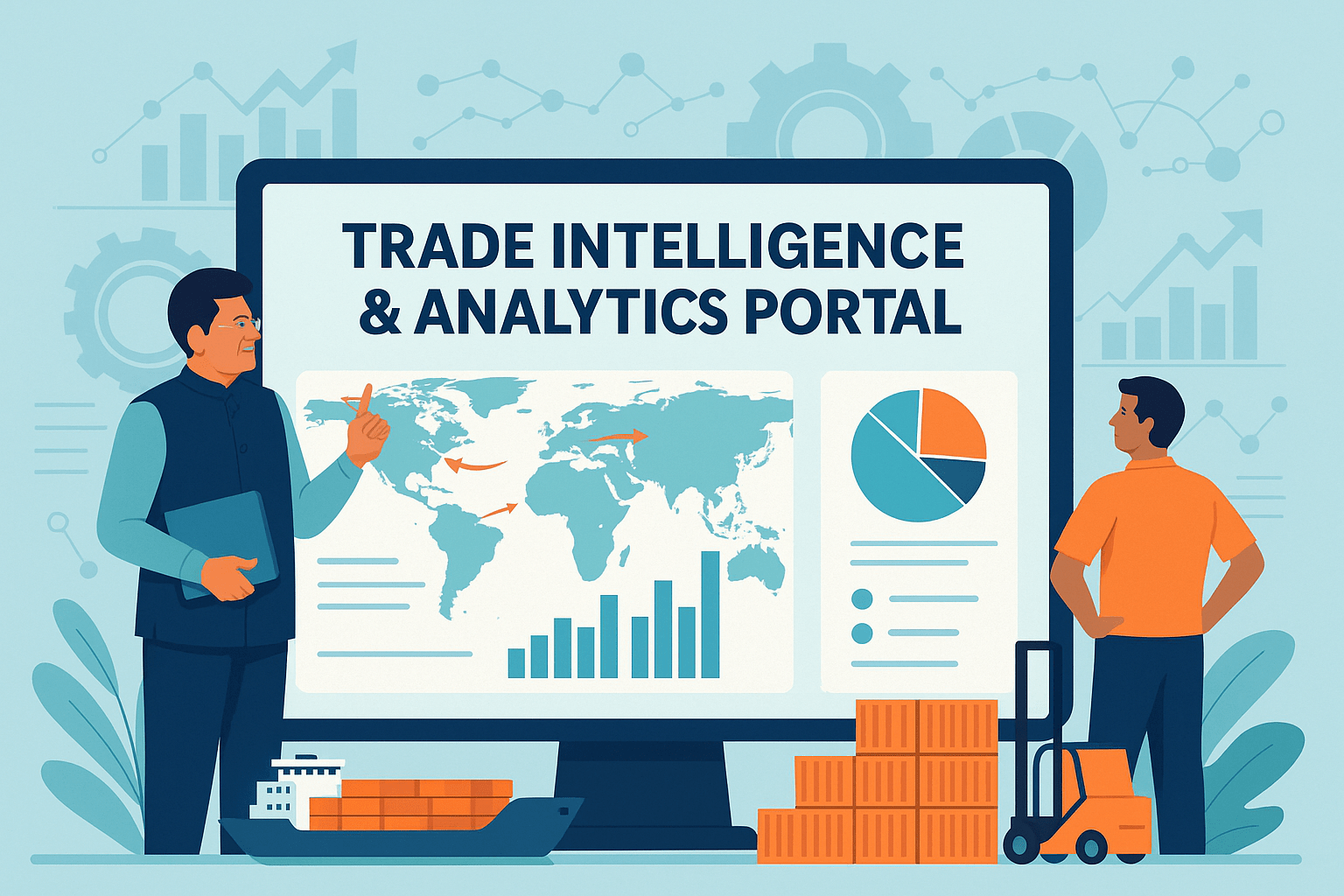
According to the Commerce Ministry, the portal consolidates multiple global and domestic databases into one interface. Users can now access more than 270 analytics tools across 28 interactive dashboards. These include:
- Country-wise and product-wise export/import trends
- Global demand shifts for specific HS codes
- Competitor analysis for India’s export products
- Commodity-level insights with historical data
- FTA-based tariff advantage comparison
- Insights on non-tariff barriers and market challenges
- Supply-chain tracking for raw material imports
For exporters who previously depended on fragmented sources of data, TIA acts as an all-in-one cockpit for trade intelligence.
How TIA Empowers Indian Exporters
1. Identifying High-Demand Global Markets
Exporters can enter their HS code and instantly see which countries are showing rising imports of that product. This helps businesses prioritise the most lucrative and fastest-growing markets instead of relying on guesswork or outdated information.
2. Benchmarking Global Competition
The portal’s competitor dashboard shows which countries dominate exports of a particular product, how prices have changed, and what volumes they are capturing. Indian exporters can use this insight to refine pricing strategies, product quality, or packaging to stay competitive.
3. Leveraging Free Trade Agreements (FTAs)
One of the biggest advantages of TIA is its ability to show tariff benefits available under India’s FTAs. Exporters can identify markets where their product enjoys preferential duty rates—giving them a clear edge over global competitors.
4. Supporting MSMEs and New-Age Startups
For first-time exporters or small manufacturers, TIA acts as a digital mentor. Instead of hiring expensive consultants, MSMEs can evaluate market potential, pricing, demand patterns, and competitor strength using free, government-verified datasets.
5. Strengthening Risk Management
With access to global price trends and supply-chain data, businesses can anticipate disruptions, raw material shortages, or price fluctuations well in advance. This reduces financial risk and improves decision-making.
6. Enabling Policy and FTA Negotiations
The portal will also help government officials use data-driven insights while negotiating trade agreements or resolving non-tariff barriers. Stronger policy support will, in turn, benefit exporters at the grassroots level.
Why This Launch Is a Turning Point
The launch of the TIA Portal reflects India’s rising ambition to become a major global export hub. With production-linked incentive schemes, infrastructure investments, and a thrust on manufacturing, India needs strong trade intelligence to support its global aspirations.
Piyush Goyal emphasised that the portal democratises information—making it accessible even to businesses in remote locations. This aligns perfectly with India’s vision of inclusive and sustainable economic growth.
Moreover, as globalisation evolves into a more complex, data-driven ecosystem, having access to verified, real-time information becomes essential. The TIA Portal positions Indian exporters to compete confidently with their counterparts in China, Vietnam, Bangladesh, and ASEAN nations.
How Exporters Can Start Using the Portal Today
Here is a simple 5-step workflow for exporters who want to immediately benefit from the TIA portal:
Step 1: Search for your product using the HS code.
Step 2: Identify top-growing importing countries in the last 12–24 months.
Step 3: Check tariff advantages under India’s FTAs for those markets.
Step 4: Evaluate competitor countries and average export prices.
Step 5: Prepare a targeted export pitch with data-backed pricing and market justification.
This data-first approach can dramatically improve export success rates, reduce marketing costs, and help businesses prioritise high-potential markets.
A Boost for The Quantiq’s Vision for MSMEs & Startups
At The Quantiq, our mission is to bring clarity, insights, and strategic thinking to the business, technology, and sustainability ecosystem of Northeast India, Bhutan, and emerging global markets. The TIA Portal complements this vision perfectly—empowering the region’s small businesses, agripreneurs, bamboo manufacturers, handicraft exporters, tea growers, and young startups to access world-class trade intelligence without cost barriers.
As India deepens its integration into global trade, tools like TIA will play a vital role in helping entrepreneurs scale their ambitions beyond local markets.
Conclusion
The Trade Intelligence & Analytics (TIA) Portal launched by Piyush Goyal is much more than a digital dashboard—it is a national infrastructure for data-driven export growth. By providing transparent, real-time, and actionable trade intelligence, India is giving its exporters the competitive edge needed to navigate global markets and expand their footprint.
For MSMEs, startups, traders, and policymakers, TIA is a milestone in India’s journey toward becoming a global export powerhouse.