
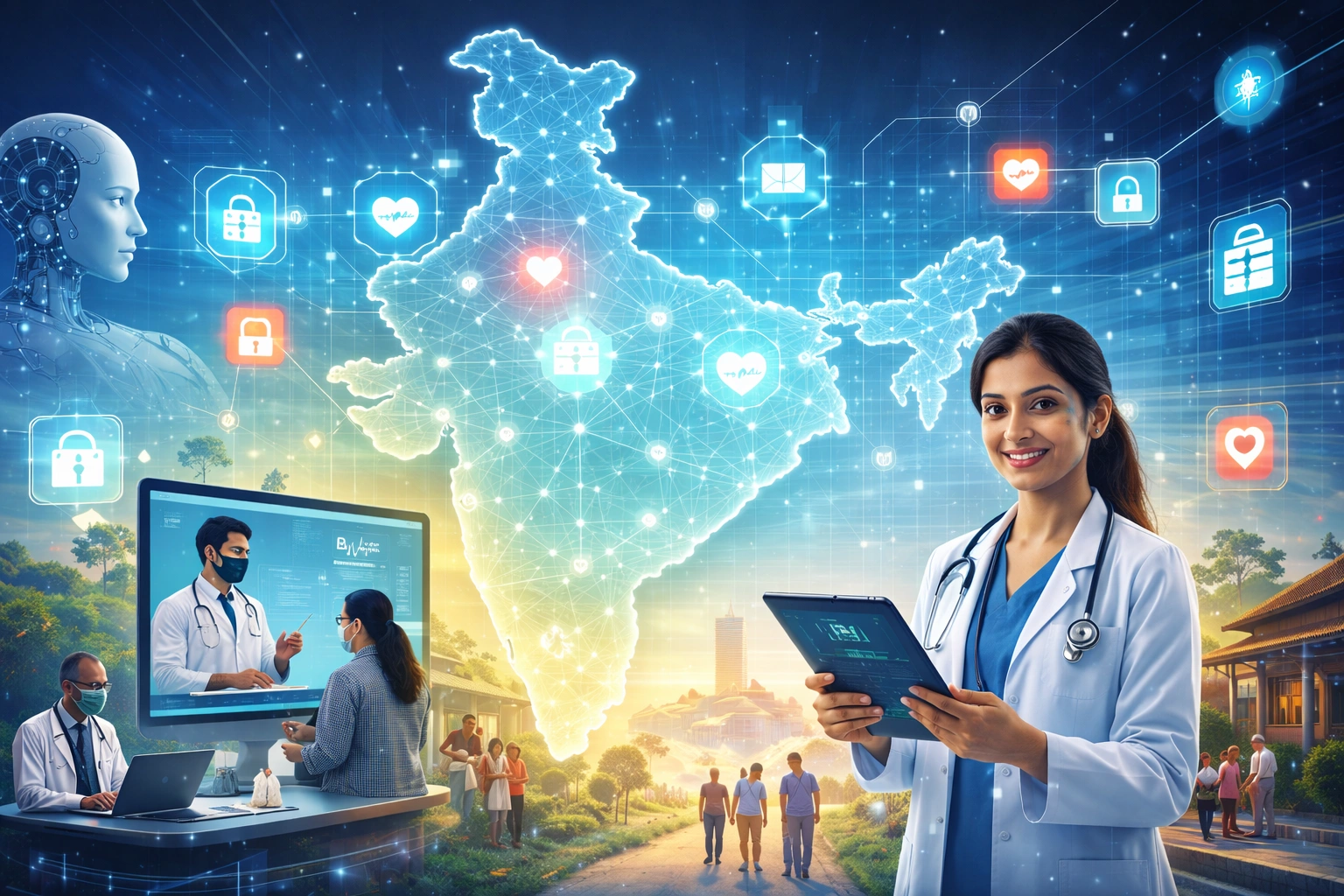
India’s Health-Tech Reset: From Pandemic Pop to Systemic Transformation
Why the next decade of digital healthcare will look very different from the last
India’s health-tech industry is no longer in its honeymoon phase. The easy applause that followed telemedicine apps, e-pharmacies and remote diagnostics during the pandemic has faded. In its place stands a more demanding audience — regulators, hospitals, investors and patients — asking harder questions: Does it improve outcomes? Does it integrate with public health systems? Does it work beyond metro India?
This moment is not a slowdown. It is a reset.
What India is witnessing today is the transition of health-tech from a consumer-tech mindset to a public-infrastructure mindset. And that shift will define both the short-term turbulence and the long-term promise of the sector.
The End of Growth-at-All-Costs
Between 2020 and 2022, health-tech startups grew at breakneck speed. Teleconsultations replaced OPDs overnight. Online pharmacies scaled logistics at unprecedented rates. Venture capital flowed freely, often rewarding user acquisition over clinical depth.
That era is over.
In the short term, funding has tightened and scrutiny has increased. Investors are no longer impressed by download numbers or monthly active users alone. They want proof of integration — with hospitals, insurers, diagnostic chains and, increasingly, government systems. Startups that operate as isolated apps are finding it harder to survive unless they pivot or consolidate.
This has triggered a wave of mergers, strategic acquisitions and quiet shutdowns. What remains are companies attempting to build full-stack or hybrid models — combining technology with physical infrastructure, clinician networks and supply chains.
Government Digital Health Is No Longer Optional
The single biggest structural change reshaping India’s health-tech landscape is the institutionalisation of digital public health infrastructure.
The rollout of interoperable digital health IDs, registries of doctors and facilities, and consent-based health data exchange is gradually changing the rules of the game. Health-tech companies can no longer operate in silos; they are expected to plug into national standards.
In the short term, this creates friction. Compliance costs rise. Product roadmaps need re-engineering. Some startups struggle with interoperability requirements.
But in the long term, this infrastructure is transformative.
For the first time, India is building the rails for longitudinal healthcare — where patient data travels with the individual across states, hospitals and platforms. This has profound implications for chronic disease management, insurance underwriting, public health analytics and medical research.
AI Moves From Demos to the Doctor’s Desk
Artificial intelligence remains the most discussed — and misunderstood — pillar of health-tech.
The early phase was dominated by impressive demos: AI reading X-rays, predicting diseases, triaging patients. The current phase is more grounded. Hospitals and regulators are asking whether these tools actually reduce clinician workload, improve diagnostic accuracy, and work reliably in Indian conditions.
Short term, many AI startups will fail this test.
Long term, the survivors will reshape care delivery.
AI tools that assist primary healthcare workers, enable early screening for non-communicable diseases, and support overburdened doctors — rather than replace them — will become indispensable. India’s scale, disease diversity and cost sensitivity uniquely position it to develop globally relevant medical AI, provided validation and ethics remain central.
Short-Term Impact: Friction, Focus and Recalibration
Over the next 12 to 24 months, four clear trends will dominate:
First, consolidation. Expect fewer but stronger players. Mid-sized health-tech firms with real revenues and hospital relationships will attract private equity interest, while weaker consumer-only apps will struggle.
Second, operational discipline. Startups will focus on unit economics, clinical outcomes and regulatory readiness rather than rapid expansion.
Third, workforce reshaping. Demand will rise for hybrid talent — professionals who understand medicine, data, regulation and product design simultaneously.
Fourth, rural and public-sector engagement. Growth will increasingly come from partnerships with state health missions, district hospitals and primary health centres, not just urban consumers.
Long-Term Impact: A Structural Shift in Indian Healthcare
Over the next decade, the implications are far more profound.
India’s health-tech evolution could enable a shift from episodic care to continuous care, particularly for chronic conditions like diabetes, cardiovascular disease and respiratory disorders. Digital records and remote monitoring can reduce avoidable hospitalisation and lower system-wide costs.
For the economy, this means new opportunities in medical research, health data analytics, clinical trials and domestic manufacturing of health technologies. India can emerge not just as a healthcare service provider, but as a health-tech innovation hub for the Global South.
However, risks remain.https://thequantiq.com/the-silent-health-crisis-of-modern-india-why-preventive-healthcare-can-no-longer-be-ignored/
Digital exclusion, data privacy concerns and uneven state-level adoption could widen healthcare disparities if governance does not keep pace with innovation. Technology is an amplifier — it magnifies both strengths and weaknesses of policy.
What This Moment Demands
For founders, the message is clear: build for systems, not shortcuts. Clinical validation, interoperability and trust are no longer optional.
For investors, the opportunity lies in patience — backing companies that may scale slower but build deeper moats.
For policymakers, the challenge is balance: encouraging innovation while safeguarding equity, privacy and patient rights.
Less Hype, More Health
India’s health-tech industry is entering its most important phase yet — one that values durability over disruption and outcomes over optics.
The easy wins are gone. What remains is harder, slower and infinitely more meaningful work.
If done right, the technologies being embedded today could quietly shape how a billion Indians experience healthcare for generations — not through flashy apps, but through systems that simply work.
And that, perhaps, is the most revolutionary outcome of all.https://thequantiq.com/is-guwahati-quietly-emerging-as-eastern-indias-next-medical-tourism-hub/

One Comment