
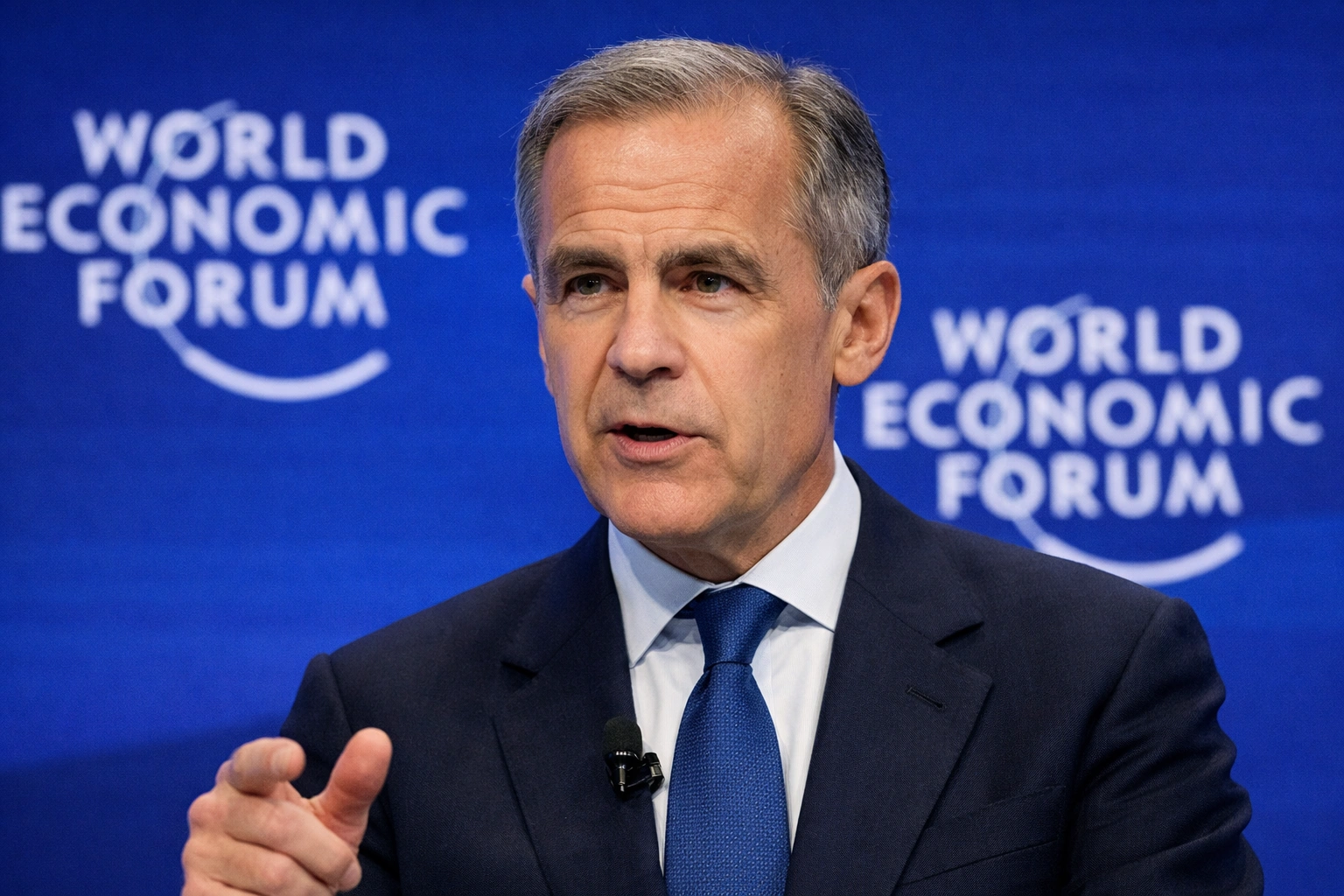
Mark Carney at Davos: An Erudite Wake-Up Call to a Fragmenting World Order
When history looks back at the 2026 annual meeting of the World Economic Forum in Davos, one speech is likely to be remembered not for rhetorical flourish or political grandstanding, but for its clarity, sobriety, and intellectual honesty. That speech came from Mark Carney.
In a forum often criticised for platitudes and safe consensus, Carney delivered something rare: an erudite, unsentimental assessment of the world as it is — not as policymakers wish it to be. His message was neither alarmist nor triumphalist. Instead, it was a carefully reasoned warning that the global order many still operate under has quietly but decisively changed.
The strong global reaction to the speech — from policymakers, markets, and commentators alike — suggests that Carney gave voice to a reality many sensed but few articulated so plainly.
A Speech That Refused Comfort
At the heart of Carney’s Davos address was a simple but unsettling assertion: the long-standing assumptions that governed global economic and political cooperation no longer hold. The post–Cold War equilibrium, underpinned by predictable alliances, relatively stable trade rules, and a broadly shared vision of economic globalisation, has fractured.
Carney did not announce the collapse of globalisation, nor did he call for a return to isolationism. Instead, he pointed to a more complex and uncomfortable truth — the world is entering a phase of managed fragmentation, where cooperation continues, but without the illusion of universal consensus.
This distinction mattered. Unlike populist critiques of the global system, Carney’s diagnosis was grounded in institutional experience and economic realism. He acknowledged that multilateralism remains essential, but warned that pretending old frameworks still function smoothly is now a liability, not a virtue.
Why the World Paid Attention
The significance of Carney’s speech lay not just in what he said, but who said it. As a former central banker and global economic steward, Carney is not a political outsider. His career has been built within the very institutions he now argues must adapt.
That credibility made his words harder to dismiss.
In Davos corridors and global capitals, the speech resonated because it reflected lived experience: supply chains weaponised by geopolitics, financial systems increasingly shaped by strategic competition, and climate and technology transitions unfolding amid growing mistrust between major powers.
The speech also stood out for what it avoided. There was no scapegoating, no moral posturing, and no simplistic blame. Instead, Carney framed the moment as a structural transition, requiring intellectual humility and strategic recalibration rather than ideological rigidity.https://thequantiq.com/ai-at-davos-2026-from-innovation-narrative-to-geopolitical-weapon/
Middle Powers and the End of Illusions
One of the most consequential elements of the address was Carney’s emphasis on middle powers. He argued that the emerging global order would not be shaped solely by superpowers, but by countries capable of balancing autonomy with cooperation.
This was not a call for confrontation. Rather, it was a recognition that many nations — economically significant, geopolitically aware, and institutionally mature — can no longer outsource strategic thinking to a binary world view.
In Carney’s framing, the future belongs to countries that can navigate complexity: cooperating where interests align, hedging where they do not, and investing in domestic resilience without retreating from global engagement.
What Carney’s Davos Message Means for India
For India, Carney’s analysis lands on familiar ground.
India has long practised what it terms strategic autonomy, resisting pressure to align exclusively with any one bloc. In a world still adjusting to multipolarity, India’s approach increasingly looks less like caution and more like foresight.
Carney’s speech implicitly validates this posture. The world he describes — fragmented yet interconnected, competitive yet interdependent — is one in which India is structurally well positioned. Its diversified partnerships, large domestic market, growing technological capabilities, and civilisational confidence allow it to engage without excessive dependence.
Crucially, Carney’s emphasis was not on power projection but on institutional capacity. For India, this reinforces the importance of deepening regulatory credibility, financial stability, manufacturing resilience, and climate leadership — areas where global influence increasingly flows from competence rather than coercion.
The Global South: From Margin to Mainstream
Perhaps the most underappreciated implication of Carney’s speech lies in what it signals for the Global South.
For decades, developing economies were expected to integrate into a system designed elsewhere, often with limited voice in its rule-making. Carney’s acknowledgement of fragmentation implicitly recognises that this era is over.
In the emerging order, countries across Africa, Latin America, South Asia, and Southeast Asia are not merely participants — they are co-creators of new economic arrangements. South–South trade, regional financial mechanisms, and alternative development pathways are no longer peripheral experiments; they are central to global stability.
Carney did not romanticise this shift. He was clear that opportunity comes with responsibility. The Global South must invest in governance, infrastructure, human capital, and credibility if it is to translate demographic and resource advantages into durable influence.
But the underlying message was unmistakable: the centre of gravity in global growth and innovation is moving, and institutions must evolve accordingly.
Markets, Business, and the New Rules of Engagement
Beyond geopolitics, Carney’s speech carried important signals for global business and investors. In a fragmented world, efficiency alone is no longer the dominant metric. Resilience, redundancy, and trust now matter as much as cost optimisation.
For businesses, this means adapting to a landscape where regulatory divergence, political risk, and climate transitions shape strategy as much as consumer demand. For investors, it means reassessing assumptions about stability and recalibrating risk models built for a more predictable era.
Carney’s realism offered neither reassurance nor alarm. Instead, it urged decision-makers to abandon nostalgia and prepare for a world where uncertainty is not an anomaly, but a structural feature.
A Speech That Respected the Intelligence of Its Audience
What ultimately sets Carney’s Davos address apart is its tone. It did not seek applause through provocation, nor relevance through sensationalism. It treated the audience — policymakers, business leaders, and citizens alike — as capable of grappling with complexity.
In doing so, it restored a quality often missing from global forums: intellectual seriousness.
The standing ovation the speech reportedly received was not merely for its content, but for its candour. In an age of over-simplified narratives, Carney offered nuance — and trusted the world to handle it.
Preparing, Not Posturing
Mark Carney’s Davos speech will not change the world overnight. But it may change how the world thinks about change itself.
By naming fragmentation without fear, and multipolarity without nostalgia, Carney provided a framework for adaptation rather than denial. For India and the Global South, his message is both affirmation and challenge: the space to shape the future is widening, but only for those prepared to build capacity, credibility, and coherence.
In a world searching for steady hands and clear thinking, Carney’s address was a reminder that leadership begins not with certainty, but with honesty.