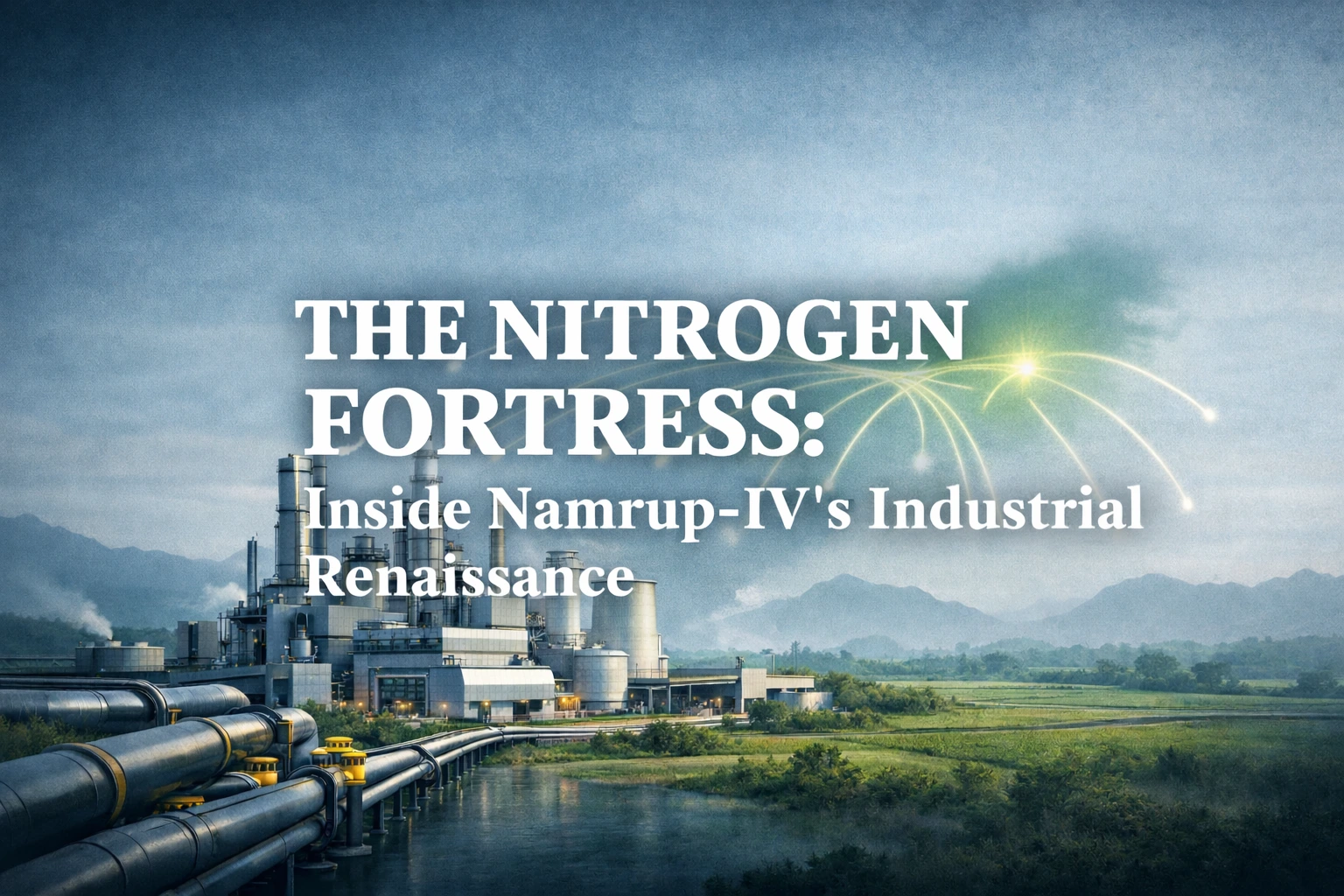
The Nitrogen Fortress: Inside Namrup-IV’s Industrial Renaissance
On a historic Sunday in Upper Assam, the steady flow of the Dilli River was joined by a louder current — the applause of thousands — as Prime Minister Narendra Modi laid the foundation stone for the Namrup-IV Ammonia–Urea Complex. Valued at approximately ₹10,600 crore, this brownfield expansion is not merely another fertiliser project. It represents a strategic recalibration of India’s food security, fiscal resilience, and regional industrial geography.
For Namrup — long known as Assam’s “fertiliser town” — the moment marks not revival, but reinvention.
Reducing India’s Nitrogen Vulnerability
Despite being one of the world’s largest agricultural producers, India has historically depended on imported urea to bridge the gap between domestic production and demand. This dependence has exposed the country to global price volatility, geopolitical shocks, and rising subsidy burdens during periods of international supply disruption.
Government policy over the last decade has therefore focused on import substitution through modern domestic capacity, especially via gas-based plants that are both efficient and scalable.
Namrup-IV fits squarely into this strategy.
With an annual production capacity of about 12.7 lakh metric tonnes, the project is expected to meaningfully reduce India’s urea import requirement once operational. While exact forex savings will ultimately depend on global prices and annual import volumes, policymakers have consistently highlighted such projects as tools to ease pressure on the current account and stabilise fertiliser subsidies over the long term.
In strategic terms, Namrup-IV strengthens India’s fertiliser sovereignty at a time when global supply chains remain fragile.
A Technological Reset: From Legacy Plants to Modern Systems
To appreciate the significance of Namrup-IV, one must understand what it replaces.
The older fertiliser units in the region — commissioned decades ago — were designed for an era of different energy economics. Limited gas availability, ageing equipment, and analogue controls constrained efficiency and output.
Namrup-IV represents a generational shift.
The new facility will be natural gas–based, drawing feedstock from Oil India Limited’s regional supply. Gas-based urea production is globally recognised as significantly more energy-efficient than legacy or coal-based routes. Beyond efficiency, local sourcing of feedstock also reduces logistical emissions and dependency on long-haul transportation.
Importantly, the project incorporates modern process automation and monitoring systems, bringing India’s northeastern fertiliser infrastructure in line with contemporary global standards.
A Pragmatic Green Transition
While fertilisers remain an energy-intensive industry, the shift from older technologies to modern gas-based plants marks a measurable environmental improvement.
Globally, gas-based ammonia and urea plants emit substantially less carbon dioxide per tonne of output compared to coal-based or obsolete facilities. Namrup-IV aligns with this transition, reinforcing India’s broader commitment to lowering the emissions intensity of its industrial growth.
Equally significant is the plant’s future readiness. As India advances its National Green Hydrogen Mission, newer fertiliser complexes are increasingly designed to adapt to hydrogen blending in ammonia synthesis when commercially viable — a pathway that could further decarbonise fertiliser production in the coming decade.
Namrup-IV is not a net-zero solution, but it is a decisive step away from high-carbon legacy systems.
Re-Anchoring the Northeast’s Industrial Economy
For Upper Assam, the project’s importance extends well beyond fertiliser output.
Namrup-IV secures the future of an industrial township that was facing uncertainty as older units approached the end of their operational life. The project is expected to generate hundreds of direct skilled jobs and support a much larger ecosystem of indirect employment — spanning logistics, transportation, maintenance services, and ancillary MSMEs.
There is also a strategic logistics dimension.
Historically, the Northeast has depended on fertiliser supplies transported over long rail corridors from plants in eastern and western India, often leading to seasonal shortages. Local production at scale improves supply reliability, reduces transit bottlenecks, and strengthens food security for the region’s farmers.
Perhaps most notably, Namrup-IV reflects a new federal partnership model. The Government of Assam holds a 40% equity stake in the joint venture, ensuring that the state is not merely a host, but a direct participant in the project’s long-term economic returns.
Strategic Industry, Regional Confidence
Namrup-IV is not just another fertiliser plant.
It is part of a wider national effort — alongside recent and ongoing projects in eastern India — to rebuild domestic urea capacity with modern, efficient infrastructure. Collectively, these investments are steadily pushing India closer to long-term self-reliance in a sector that directly underpins food security.
For the Northeast, the project signals something equally important: that large-scale, strategic industrial investments are no longer peripheral, but central to India’s growth narrative.
In a single complex, Namrup-IV combines fiscal prudence, industrial modernisation, environmental realism, and regional empowerment. It is, quite literally, sovereignty packed into a bag of urea.