Beyond the Battery: The Next Generation of Energy Storage Powering a Sustainable World
Solar farms now blanket deserts and wind turbines rise from coastlines, but the renewable revolution faces one stubborn truth: the sun sets, the wind calms, and clean energy supply is never constant. For a truly sustainable 24/7 grid, generation is only half the story. The other half is storage — long-duration, scalable, and reliable. Lithium-ion batteries have been the workhorse of the clean-tech transition, but their limits are becoming clear. The next wave of innovation in energy storage is poised to determine whether the world can truly decarbonize at speed and scale.
The Limits of Lithium-Ion
Lithium-ion transformed consumer electronics and jump-started the EV era. For short bursts of storage — balancing the grid over minutes or hours — they remain indispensable. But when it comes to multi-day, seasonal, or grid-scale backup, the model breaks down. High costs, short lifespans, reliance on scarce minerals like cobalt and nickel, and safety risks from overheating all constrain their role. In short: lithium-ion is a bridge, not the destination.
Long-Duration Energy Storage: The Missing Piece
Enter Long-Duration Energy Storage (LDES) — technologies designed to hold energy for 10 hours to several months and dispatch it when renewable supply falters. LDES is the grid’s insurance policy, turning intermittent solar and wind into dependable baseload power. The economics are moving fast: the LDES market, valued at $4.82 billion in 2024, is projected to reach $13.35 billion by 2032, growing at a robust 13.6% CAGR.
Gravity Storage: Energy from Weight
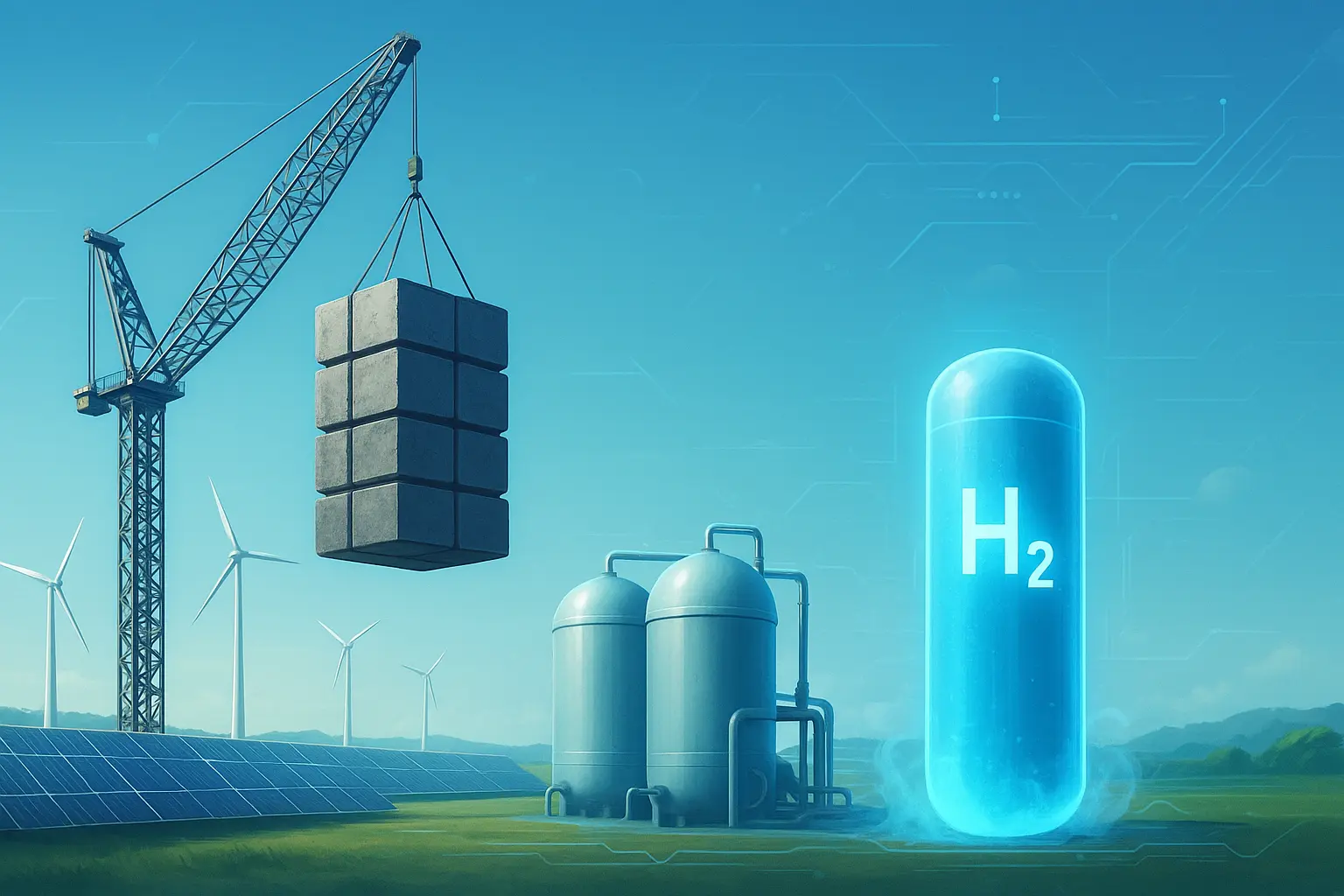
Think of it as a mechanical battery. Excess energy lifts massive blocks; when power is needed, they descend, releasing energy through generators. Companies like Energy Vault are deploying 110-meter towers stacked with multi-ton blocks, while the UK’s Gravitricity is converting abandoned mine shafts into energy storage assets. Gravity storage offers century-long lifespans and minimal material risks — a striking alternative to chemically intensive batteries.
Liquid Air: Power in the Cold
Another breakthrough is Liquid Air Energy Storage (LAES). Here, electricity cools ambient air to -196°C, compressing it into liquid form stored in insulated tanks. When demand spikes, the liquid is reheated, expands into gas, and drives turbines. Highview Power is leading the charge, building LAES plants with storage capacities in the hundreds of megawatt-hours. The appeal is obvious: abundant raw material (air), scalability, and near-zero emissions.
Beyond Gravity and Air: A Landscape of Innovation
Green Hydrogen: Produced via renewable electrolysis, stored for weeks or months, and converted back into electricity — ideal for seasonal balancing.
Compressed Air Energy Storage (CAES): Storing compressed air in caverns for large-scale release, particularly in geologically suitable regions.
Thermal Storage: Using molten salts or phase-change materials to capture and release heat — increasingly attractive for industrial decarbonization.
Policy Signals and Market Shifts
Technology is only part of the equation. Policy is catching up. In 2025, India’s Ministry of Power mandated that all future solar projects must integrate at least two hours of energy storage — a regulatory milestone that forces utilities to deliver not just clean energy, but reliable energy. Similar mandates are emerging in the U.S. and Europe, where LDES is recognized as critical infrastructure.
The investment case is equally compelling. Unlike lithium-ion, which depends on volatile global supply chains, LDES technologies often rely on abundant, low-cost materials. For investors, that means lower long-term risk. For policymakers, it means stronger energy sovereignty.
The race to net zero is not just about how much renewable capacity we build, but how reliably we can use it. Long-Duration Energy Storage is the linchpin of that equation. Gravity batteries, liquid air systems, hydrogen storage, and thermal innovations are no longer science projects — they are the foundation of a resilient, carbon-free grid.
The lesson is clear: lithium-ion got us started, but LDES will finish the job. The future of clean energy won’t be defined by generation alone, but by the invisible storage systems that make renewable power truly unstoppable.