North East Gas Grid Goes Live: Assam Powers India’s Next Industrial Shift
North East Gas Grid (NEGG) Phase 1 is now live, connecting Assam to India’s gas network. Here’s how this project will drive industrial growth, energy access, and economic transformation in the North East.
There are moments in a region’s economic history that arrive quietly. No spectacle. No noise. Yet they carry the power to reshape the future.
March 13, 2026, may become one such moment.
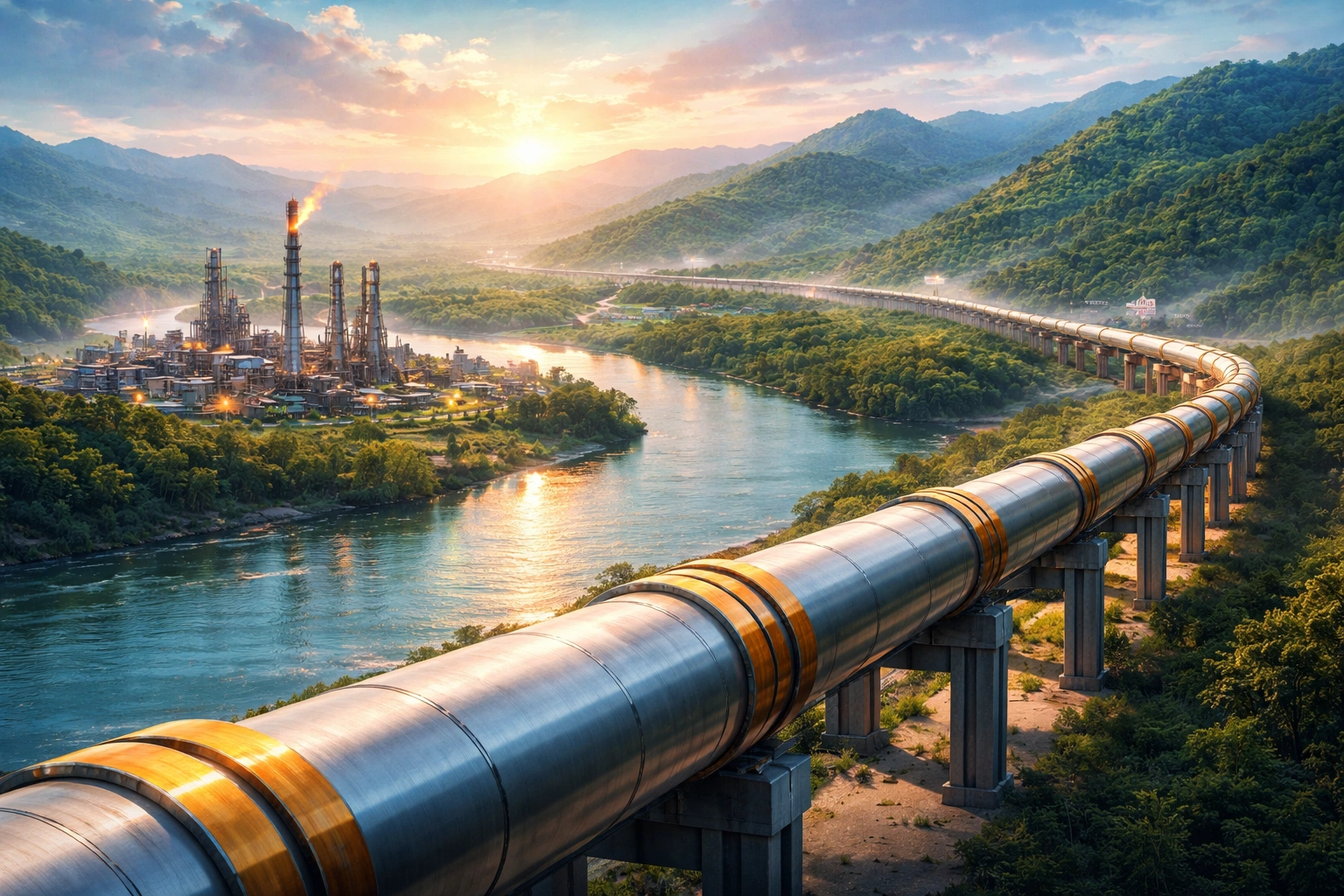
With the launch of Phase 1 of the North East Gas Grid (NEGG), the region has taken a decisive step toward integration with India’s national energy network. For the first time, large parts of the north bank of the Brahmaputra are connected to a wider gas grid ecosystem.
This is not just about pipelines. It is about industrialisation.
A 553 km Beginning: Connecting Growth
Phase 1 of the North East Gas Grid spans around 553 km. It connects Guwahati to Numaligarh, Gohpur, and extends to Itanagar. A key branch also links Dimapur.
At first glance, it looks like a linear project.
However, it is much more.
Each node along the North East Gas Grid can evolve into an industrial cluster. Guwahati brings urban demand. Numaligarh adds refining strength. Meanwhile, Itanagar and Dimapur represent emerging markets.
For decades, the North East had resources but lacked connectivity. Now, the equation is changing.
Numaligarh: The Anchor of the Gas Grid
At the heart of the North East Gas Grid lies the Numaligarh Refinery.
The expansion of the Numaligarh-Siliguri Product Pipeline (NSPL) from 1.72 MMTPA to 5.5 MMTPA is significant. At the same time, the refinery itself is scaling up to 9 MMTPA.
This is not just expansion. It is strategic positioning.
Strong infrastructure needs strong demand centres. Numaligarh provides that anchor. It connects upstream energy to downstream industry.
In many ways, it could become the North East’s version of Jamnagar.
Beyond Phase 1: Expansion with Purpose
The North East Gas Grid is already expanding.
In February 2026, IGGL received approval for a 175 km pipeline from Duliajan to Jorhat. While this may seem incremental, it signals something deeper.
India is now focusing on high-impact corridors.
Upper Assam is emerging as a key zone due to its oil legacy and industrial potential. Therefore, expansion is becoming more targeted and economically driven.
From Political Geography to Economic Geography
Here lies the real shift.
Earlier, infrastructure projects often followed political priorities. Everything had to be connected, regardless of cost.
Now, the approach is changing.
The North East Gas Grid reflects a move toward economic geography. High-demand, high-return corridors are being prioritised.
This is not exclusion. It is efficiency.
And efficiency ensures long-term success.
What the Gas Grid Means for Industry
The North East Gas Grid will transform the regional economy in multiple ways.
First, cleaner energy.
Industries can shift from diesel and coal to natural gas. This reduces costs and emissions.
Second, fertiliser revival.
Gas availability can support fertiliser plants and agro-processing units.
Third, city gas expansion.
Cities like Guwahati can expand PNG and CNG networks, improving urban energy access.
These changes will take time. However, they are inevitable.
The Act East Multiplier
The North East Gas Grid also has geopolitical importance.
As India strengthens its Act East Policy, the region is becoming a gateway—not a periphery.
Energy connectivity will improve trade with neighbours like Bangladesh. In this context, pipelines are more than infrastructure. They are tools of regional integration.
India’s Infrastructure Is Evolving
The North East Gas Grid reflects a broader national trend.
India is moving beyond announcements toward execution. Projects are being completed. Expansion is becoming more strategic.
In the North East, this shift is critical. The region has long seen delayed promises.
Now, progress is visible.
More Than a Pipeline
The North East Gas Grid is not just an infrastructure project.
It is a foundation.
A foundation for industry, investment, and long-term growth.
Gas has started flowing.
Opportunity will follow.https://thequantiq.com/india-tweaks-fdi-rules-for-land-border-countries-what-it-means-for-global-investors/