Sam Altman’s Message to Developers Isn’t What It Seems
A Thank You Note… or a Quiet Warning About the Future of Software?
Sam Altman’s message to developers signals a deeper shift—AI is redefining coding, jobs, and power. What it means for India’s tech future.
There are moments in technology when a statement feels ordinary—but history later reveals it as a turning point.
Sam Altman’s recent message to software developers appears, at first glance, to be one of gratitude. A respectful nod to the millions of engineers who built the modern digital world. But beneath the tone of appreciation lies something far more consequential.
It is not just a thank you.
It is a transition signal.
And perhaps, a quiet warning.
The Gratitude That Signals a Shift
Altman’s words recognize the painstaking work of developers—writing code line by line, building systems brick by brick. But in doing so, he subtly reframes that effort as something belonging to a different era.
This is how technological transitions often begin.
First, the old system is celebrated. Then it is abstracted. Eventually, it is automated.
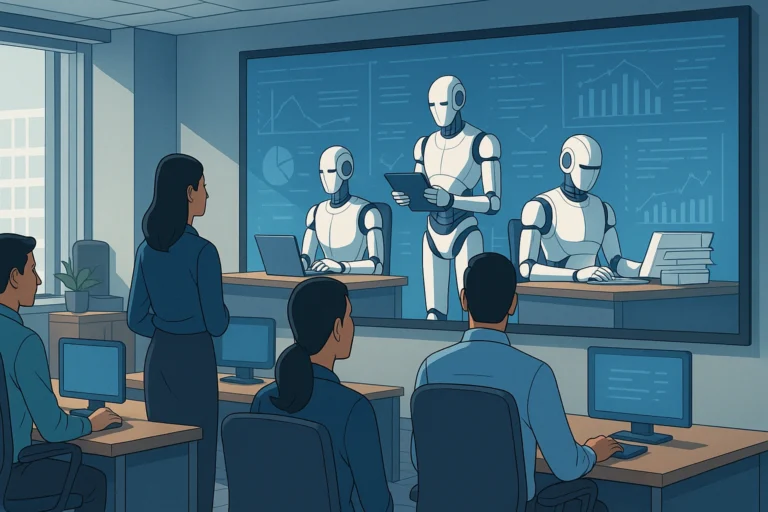
What developers once did manually, AI is now beginning to do autonomously. Code is no longer written—it is generated. Systems are no longer engineered—they are orchestrated.
The act of coding is slowly fading into the background.
Coding Is No Longer the Moat
For decades, coding was the ultimate leverage skill. It created careers, companies, and entire economies. In India, it powered the rise of IT services, outsourcing, and a generation of middle-class prosperity.
But that foundation is now shifting.
Altman has repeatedly emphasized that coding alone will not guarantee relevance in the future. The real value is moving elsewhere—from execution to judgment.
From writing code…
to deciding what should be built.
This changes the equation entirely.
Where once the developer held power through technical skill, the new advantage lies in problem selection, system thinking, and the ability to direct AI.
Coding is becoming a tool. Not a moat.
The Utility Model: Software Becomes Electricity
To understand the full weight of this transition, one must look at Altman’s broader vision.
He has hinted at a future where AI functions like a utility—similar to electricity or water. Accessible, metered, and consumed on demand.
This is not just a technological shift. It is an economic one.
When software becomes a utility:
- Developers stop building everything from scratch
- Startups stop owning intelligence
- Innovation becomes dependent on access to compute
The center of gravity moves—from creators to infrastructure providers.
Data Snapshot: The Changing Nature of Software Work
Here’s how the transformation is already unfolding globally:
| Metric | 2020 | 2025 (Est.) |
|---|---|---|
| % of code AI-assisted | ~5% | 40–60% |
| Developer productivity increase (AI tools) | — | 2x–5x |
| Demand for junior coders | High | Declining |
| Demand for AI orchestration skills | Low | Exploding |
This is not speculative. It is already visible across companies using AI copilots and agent-based systems.
India’s Moment: Risk and Reinvention
India stands at a unique crossroads in this transformation.
The Risk
India’s IT success has been built on scale—millions of engineers delivering coding and maintenance services globally. If AI reduces the need for human coding effort, that model faces structural pressure.
- Entry-level coding jobs may shrink
- Service-based outsourcing could weaken
- Wage growth may plateau in traditional roles
The Opportunity
But the same shift creates a far bigger opening.
India can leapfrog into an AI-native innovation economy.
Instead of exporting coding talent, it can build:
- AI-first startups
- Domain-specific intelligence platforms
- Solutions rooted in local problems with global relevance
India-Specific Data: Why This Shift Matters
Consider the scale:
- India produces 1.5 million engineers annually
- IT exports exceed $200 billion
- Over 5 million people work in the IT-BPM sector
Even a 20–30% disruption in entry-level roles would ripple across the economy.
But at the same time:
- India’s AI market is projected to reach $17 billion+ by 2027
- AI adoption in enterprises is growing at 25–35% annually
- Startup ecosystems are rapidly shifting toward AI-led models
This is not a decline. It is a reconfiguration.
The Psychological Shift: Identity Under Pressure
Beyond economics, there is a deeper transformation taking place—one that is rarely discussed.
For decades, developers saw themselves as builders of the future.
Now, they are confronted with a new reality:
They built the systems that are beginning to replace them.
This creates a silent identity crisis.
Some will evolve into AI-native architects—designing systems, guiding models, solving complex problems.
Others may become dependent on tools they do not fully control.
And a segment risks being left behind—anchored to a world that is rapidly disappearing.
The Hidden Layer: Control Over Intelligence
The most important part of Altman’s message is not about developers at all.
It is about control.
If AI becomes the primary interface for building software—and if access to AI is controlled by a few organizations—then power shifts dramatically.
From individuals…
to platforms…
to infrastructure owners.
The question is no longer:
Who can code?
But rather:
Who controls intelligence?
The North East Perspective: A Leapfrog Opportunity
For regions like North East India, this shift could be transformative.
Unlike traditional tech hubs, which are deeply tied to legacy systems, emerging ecosystems have the advantage of starting fresh.
This means:
- Building AI-native startups from day one
- Skipping outdated development models
- Focusing on high-impact, local problems
The next breakthrough from Assam or the North East may not come from a large coding workforce—but from a small, sharp team leveraging AI intelligently.
What Developers Must Do Now
The path forward is not about resisting AI. It is about repositioning.
The developers who thrive will:
- Think in systems, not just syntax
- Focus on problems, not tools
- Learn to orchestrate AI, not compete with it
The skill is no longer “how to code.”
It is “what to build—and why.”
The Final Decode
If one reads between the lines, Altman’s message says something far more profound than gratitude.
It signals the end of an era where writing code was the central act of creation.
And the beginning of one where intelligence itself is programmable.
A future where the builders are no longer defined by the code they write—but by the problems they choose to solve.
Conclusion: A Defining Inflection Point
This is not the end of developers.
But it is the end of development as we knew it.
And in that transition lies both disruption and possibility.
For India.
For its youth.
And for every ecosystem willing to adapt.https://thequantiq.com/the-next-billion-dollar-startups-may-not-use-ai-at-all/