SUNDAY BRIEF
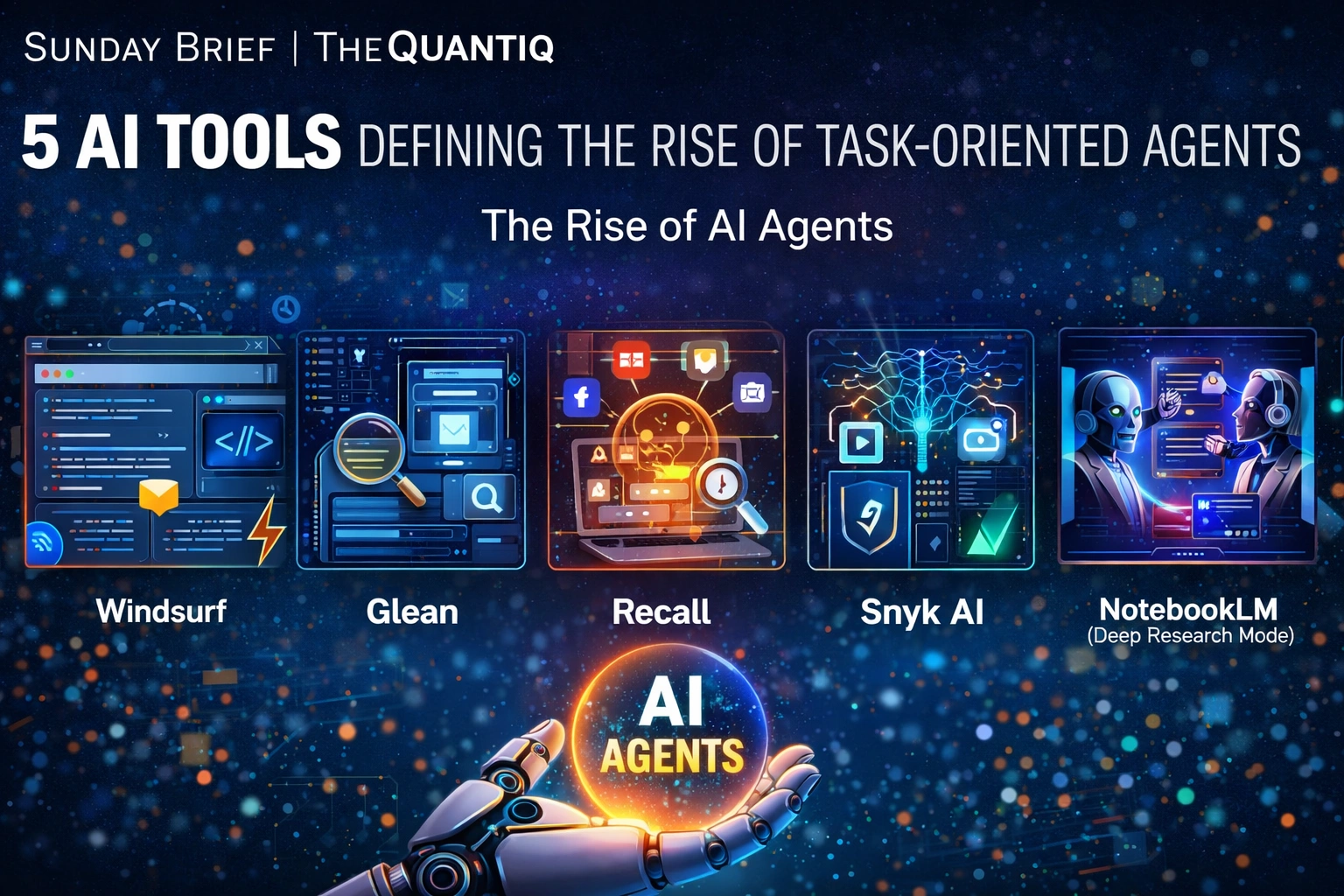
5 AI Tools Defining the Rise of Task-Oriented Agents
While the world is still debating models, the real frontier has already moved forward.
The next phase of artificial intelligence is not about better chat—it is about execution.
A new class of tools is emerging: Task-Oriented Agents.
These systems do not just assist; they act, execute, and deliver outcomes.
This week, The Quantiq highlights five platforms shaping this deep-tech shift from intelligence to action.
Windsurf — The Agentic IDE
What it does:
An AI-native development environment that operates in a “Flow” state—understanding entire codebases and executing multi-file changes autonomously.
Why it matters:
Software development is shifting from writing code to orchestrating systems.
Best for:
Developers, startups, lean engineering teams.
Quiet advantage:
Moves coding from auto-complete to auto-execution, enabling small teams to build at scale.
Glean — Enterprise Intelligence Layer
What it does:
AI-powered enterprise search that connects internal tools like Slack, Jira, and Google Drive into a unified knowledge system.
Why it matters:
Most organisations suffer from fragmented internal intelligence.
Best for:
Enterprises, startups, knowledge-driven teams.
Quiet advantage:
Transforms scattered data into structured organisational intelligence.
Recall — The Personal Knowledge Engine
What it does:
Builds a dynamic knowledge graph from everything you consume—articles, videos, and podcasts—turning it into a searchable “personal encyclopedia.”
Why it matters:
Information consumption without retention creates zero long-term value.
Best for:
Researchers, creators, analysts, students.
Quiet advantage:
Eliminates the forgetting curve by converting passive content into structured memory.
Snyk AI — Security as an Autonomous Layer
What it does:
AI-driven platform that identifies vulnerabilities in code and generates ready-to-deploy fixes.
Why it matters:
Security can no longer be an afterthought in fast-moving tech ecosystems.
Best for:
Developers, startups, enterprise engineering teams.
Quiet advantage:
Enables security-by-design, a critical pillar for deep-tech ecosystems.
NotebookLM (Deep Research Mode) — Structured Intelligence Engine
What it does:
Transforms large sets of documents into coherent outputs—summaries, reports, and even podcast-style conversations.
Why it matters:
Raw data is abundant. Structured intelligence is scarce.
Best for:
Researchers, analysts, content strategists, policy professionals.
Quiet advantage:
Produces high-fidelity, source-grounded intelligence at scale.
The Quantiq View
AI is entering its most important phase.
Not intelligence.
Not creativity.
But execution.
The winners in this cycle will not be those who use AI to generate content—
but those who use AI to:
• execute complex tasks
• structure knowledge
• automate decision workflows
• build systems that scale
This is the transition from:
AI as a tool → AI as infrastructure
And that is where the real advantage lies.https://thequantiq.com/mid-week-brief/