Sunday Brief
5 AI Tools Quietly Transforming Healthcare — From Diagnostics to Drug Discovery
Artificial Intelligence is rapidly redefining how healthcare systems operate across the world. From detecting life-threatening conditions in seconds to accelerating drug discovery, AI-powered platforms are becoming indispensable tools for doctors, hospitals, and researchers.
While much of the global conversation focuses on futuristic AI breakthroughs, a quieter transformation is already underway inside hospitals and research labs. A new generation of AI tools is helping healthcare professionals improve diagnostics, automate administrative tasks, and discover new medicines faster than ever before.
In this week’s Sunday Brief, The Quantiq highlights five AI tools that are quietly reshaping modern healthcare systems.
Aidoc
AI That Flags Life-Threatening Conditions in Medical Scans
Radiologists often need to review hundreds of imaging scans every day, making it challenging to immediately identify life-threatening conditions.
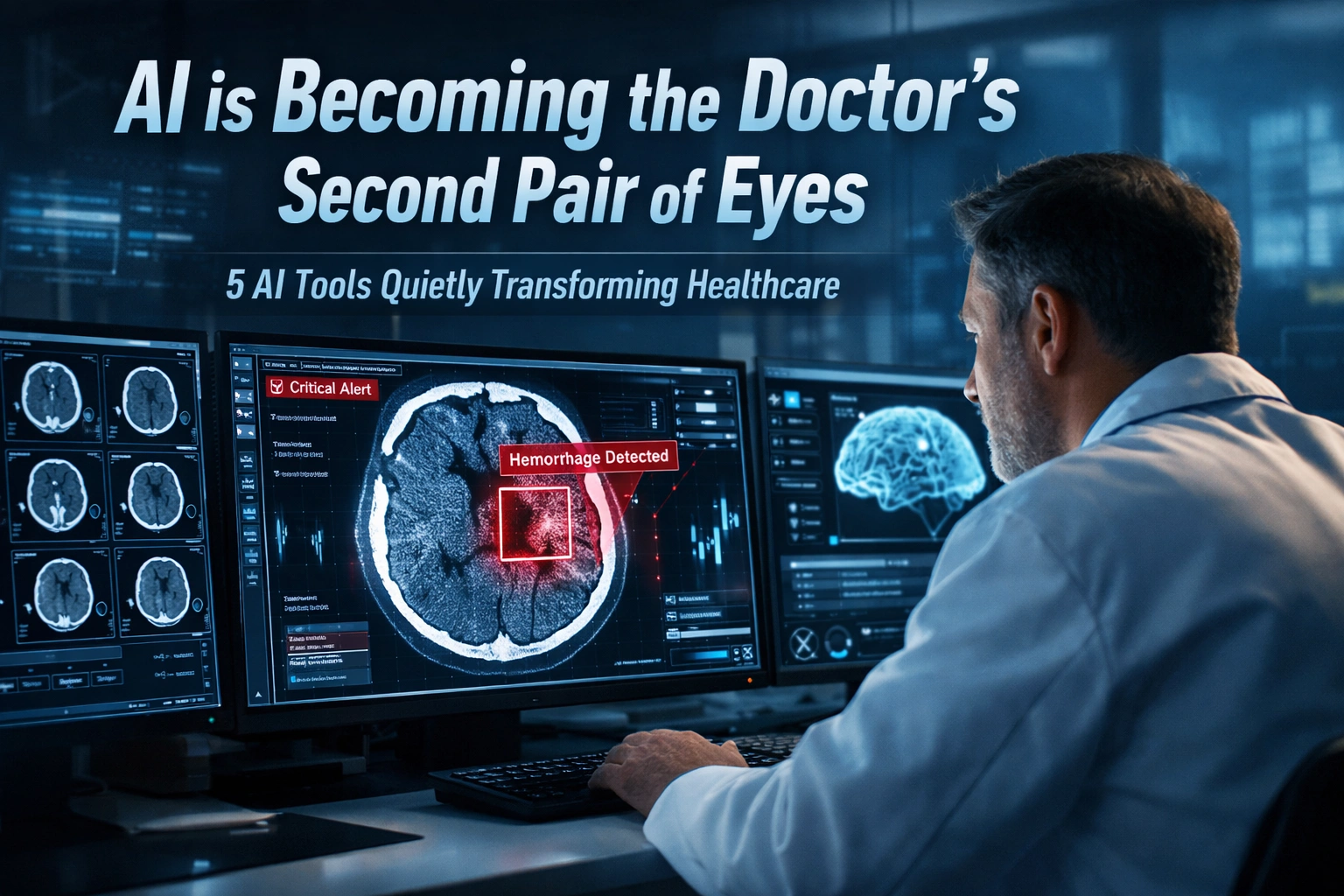
Aidoc addresses this challenge using AI algorithms that analyze CT scans, MRIs, and X-rays in real time. The system automatically flags potential abnormalities such as brain hemorrhage, pulmonary embolism, and spinal fractures.
By prioritizing urgent cases, Aidoc helps doctors respond faster during medical emergencies. Hospitals using the platform have reported significantly improved diagnostic turnaround times.
Why it matters
- Detects critical abnormalities within seconds
- Enables faster emergency response
- Improves radiology workflow efficiency
Ada Health
AI-Powered Symptom Checker Used by Millions
Ada Health is an AI-based digital health platform designed to help individuals assess their symptoms before consulting a doctor.
Users answer a series of guided medical questions, after which the AI system analyzes the information against an extensive medical database to generate possible health conditions and recommended next steps.
The platform functions as a digital triage assistant, helping users determine whether they need immediate medical attention, a routine consultation, or self-care.
Why it matters
- Encourages early detection of health conditions
- Reduces unnecessary hospital visits
- Improves access to healthcare guidance
Rad AI
AI That Automatically Drafts Radiology Reports
Radiologists spend a large amount of time writing detailed diagnostic reports after reviewing medical images.
Rad AI uses artificial intelligence to automatically generate structured radiology reports by analyzing imaging data and clinical notes. Doctors can review and finalize these AI-generated drafts within minutes.
This significantly reduces administrative workload and allows radiologists to focus more on clinical decision-making rather than documentation.
Why it matters
- Saves valuable time for doctors
- Reduces physician burnout
- Improves consistency in medical reporting
BioMorph
AI Accelerating the Search for New Medicines
Developing a new drug traditionally takes more than a decade and billions of dollars in research investments.
BioMorph leverages AI models to analyze how chemical compounds interact with biological systems. The platform predicts which molecules are most likely to become effective drugs, allowing researchers to focus on promising candidates.
By dramatically reducing the number of experimental trials required, AI tools like BioMorph are helping pharmaceutical companies accelerate the drug discovery process.
Why it matters
- Speeds up pharmaceutical research
- Reduces the cost of drug development
- Enables targeted therapies for complex diseases
CARPL.ai
A Marketplace for Medical AI Algorithms
Unlike conventional healthcare software platforms, CARPL.ai operates as an AI marketplace for radiology applications.
Hospitals can access and deploy multiple AI models for medical imaging through a single interface. This allows radiologists to experiment with different AI algorithms without complex integrations.
The platform approach is helping healthcare providers adopt AI technologies more quickly while reducing operational barriers.
Why it matters
- Simplifies AI adoption in hospitals
- Provides access to multiple diagnostic algorithms
- Accelerates digital transformation in healthcare
The Bigger Picture
AI is steadily becoming an integral part of healthcare infrastructure worldwide.
Rather than replacing doctors, these technologies are acting as clinical copilots, assisting healthcare professionals in analyzing medical data, identifying patterns, and making faster decisions.
As AI continues to evolve, the next phase of innovation will likely integrate medical imaging, electronic health records, wearable devices, and genomic data into unified AI platforms.
For patients, this could mean earlier diagnoses, faster treatments, and more personalized healthcare. For the global healthcare industry, it marks the beginning of a new era where AI enhances both medical precision and operational efficiency.https://thequantiq.com/indias-health-tech-reset-from-pandemic-pop-to-systemic-transformation/