
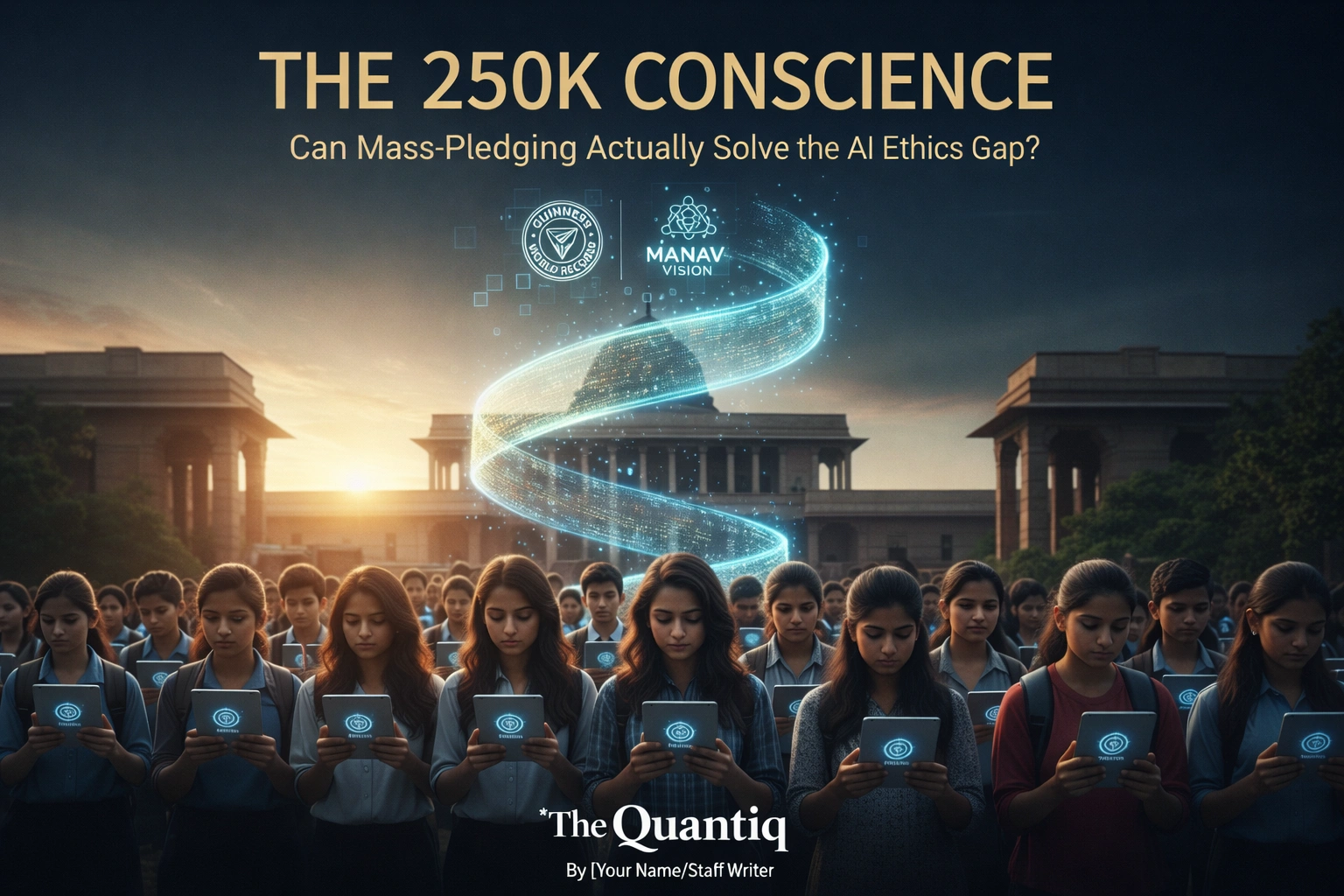
The 250K Conscience: Can India’s AI Record Bridge the Ethics Gap?
The cavernous halls of Bharat Mandapam are used to diplomatic applause and carefully worded policy announcements. But this week, the India AI Impact Summit 2026 produced something far more unusual — a mass civic gesture.
Within 24 hours, organisers reported that over 250,000 citizens, largely students, completed a digital pledge committing to the responsible use of Artificial Intelligence. The initiative, run under the IndiaAI Mission in collaboration with industry partners including Intel India, quickly evolved from a modest awareness drive into what officials described as a Guinness World Record attempt for the largest AI ethics pledge.
The headline number is impressive. Yet the deeper story is not about records or certificates. It is about how India is trying to shape the social foundations of its AI future.
From Policy Circles to Public Participation
For much of the last decade, conversations about AI ethics have lived in academic journals, global think tanks, and regulatory panels in Washington, Brussels, or London. India’s approach appears to be different — less theoretical, more participatory.
Participants in the pledge were not merely asked to click “agree.” Many were guided through short scenario-based modules touching on issues such as deepfakes, data privacy, algorithmic bias, and responsible content use before signing.
The intention, as described at the summit, is to embed ethical awareness before AI tools become deeply embedded in everyday work, education, and governance.
In speeches surrounding the initiative, the effort was framed as part of a broader “MANAV” vision for AI development — one that stresses accountability, human-centric innovation, and national technological confidence. Whether the acronym survives beyond the summit is secondary; the message is clear: India wants AI literacy to be societal, not just technical.
AI as the Next Digital Public Infrastructure
The summit’s philosophical anchor — Sarvajan Hitaya, Sarvajan Sukhaya (for the welfare of all, for the happiness of all) — hints at how policymakers increasingly view AI.
India’s digital transformation has historically leaned on public infrastructure models. Aadhaar created identity rails. UPI democratized payments. Open digital networks expanded access to services.
Now, the ambition seems to be extending that logic into AI.
If UPI moved digital payments from privilege to default, this pledge signals an attempt to build a shared ethical baseline for AI usage across millions of first-time users. It also carries a subtle geopolitical message: the next billion AI users will not inherit technology passively. They will be introduced to it through locally shaped norms about misinformation, privacy, and fairness.
Symbolism vs. Structural Change
Still, numbers alone do not build ethical systems.
A digital pledge is inherently a low-friction act. Critics could argue that such initiatives risk becoming symbolic — an easy way for governments and corporations to showcase responsibility while the harder work of regulation, audits, and institutional safeguards continues slowly in the background.
A student in Pune or Guwahati signing a pledge today will not immediately prevent a biased hiring algorithm or flawed credit model tomorrow.
But dismissing the effort entirely would miss its potential long-term effect.
What the initiative may actually be creating is a large early cohort of AI-aware citizens — individuals who have at least been introduced to questions of bias, verification, and responsible use. If even a fraction of them carry that awareness into careers in coding, design, policymaking, or media, the cumulative influence could be substantial.
Linked learning pathways and follow-up skilling programmes, hinted at during the summit, will determine whether this becomes a one-day campaign or the beginning of a sustained literacy pipeline.
The Quantiq Verdict
So, is the record worth the hype?
Yes — but not for the reason being celebrated.
The real significance is not the six-figure pledge count. It is the precedent that AI safety can be framed as civic participation rather than regulatory compliance. India is experimenting with turning ethics into a social conversation, not just a legal framework.
If the initiative evolves into continuous education, institutional transparency, and stronger governance, this “Delhi record” may be remembered as more than a symbolic milestone.
It could mark the moment when India decided that becoming an AI superpower also required becoming an AI-literate society.https://thequantiq.com/ai-is-not-your-meme-generator-its-the-great-capability-equalizer/