
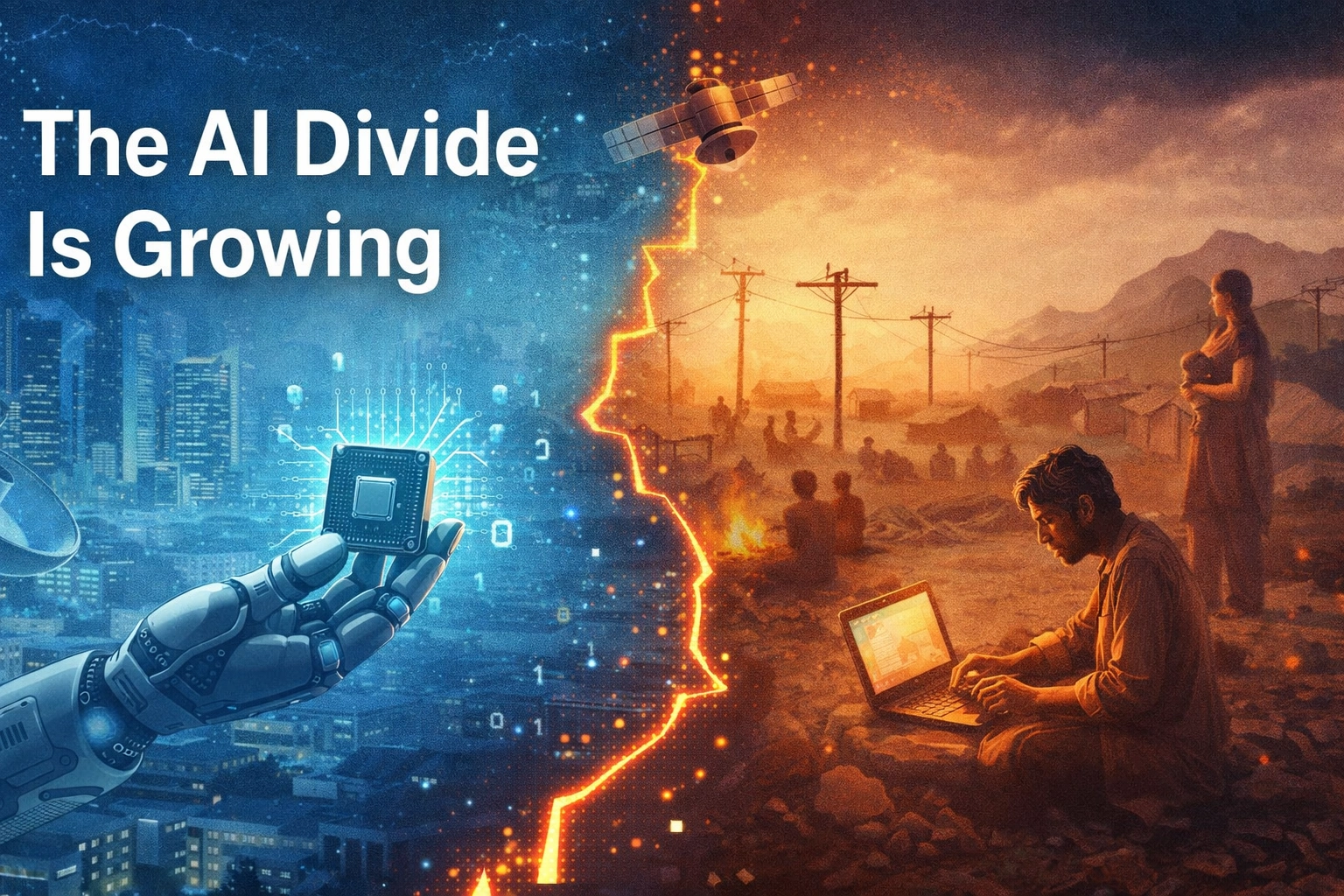
The AI Divide Is Widening—and the Global South Is at Risk of Falling Permanently Behind
Based on insights from the World Bank’s Digital Progress and Trends Report 2025
Artificial Intelligence is often described as a great equaliser—an unprecedented technology that can democratise access to knowledge, productivity, and opportunity. But a closer look at global AI trends tells a more uncomfortable story: AI is widening existing inequalities faster than it is closing them.
According to the World Bank’s Digital Progress and Trends Report 2025, the world is entering an AI era defined not by universal opportunity, but by a growing divide between countries that can build and scale AI, and those that can only consume it—if at all.
This divide is not theoretical. It is measurable, structural, and accelerating.
AI’s Uneven Global Reality
AI innovation today is overwhelmingly concentrated in a handful of high-income countries. The report highlights that high-income economies account for the vast majority of notable AI models, AI start-ups, venture capital funding, and advanced research outputs. In contrast, low- and middle-income countries—despite representing nearly half of the world’s population—remain marginal players in AI creation.
What makes this imbalance particularly concerning is the speed at which AI is diffusing. Generative AI tools such as ChatGPT have reached hundreds of millions of users in just two years, making AI one of the fastest-adopted technologies in history. Yet usage patterns reveal stark disparities. While middle-income countries now contribute a significant share of global AI tool usage, low-income countries remain almost invisible in global AI traffic data.
his creates a dangerous illusion: AI appears global, but meaningful participation is not.
The Rise of “Small AI”: A Missed or Misunderstood Opportunity?
One of the report’s most important insights is the emergence of what it calls “small AI”—lightweight, affordable, task-specific AI solutions designed for everyday devices and local needs. In sectors such as agriculture, education, healthcare, and public services, small AI is already delivering tangible benefits in developing countries.
Teachers are using AI for lesson planning, farmers for crop advisory, nurses for patient monitoring, and service workers for productivity support. In these contexts, AI is not replacing humans—it is acting as a co-worker or coach.
However, small AI alone is not enough.
The World Bank warns that without deeper investment in AI foundations, small AI risks becoming a dead end rather than a stepping stone. Countries may see short-term efficiency gains but remain locked out of higher-value AI development, innovation, and export opportunities.
The Four Foundations of AI Readiness
At the heart of the report is a powerful framework: the 4Cs of AI foundations—Connectivity, Compute, Context, and Competency. Together, they determine whether countries can merely use AI or truly benefit from it at scale.
1. Connectivity: The Gateway That Still Excludes Millions
Internet access has expanded globally, but affordability, speed, reliability, and electricity access remain deeply unequal. High-income countries enjoy near-universal, high-speed connectivity, while large portions of low-income populations remain offline or severely constrained. AI, which is data- and bandwidth-intensive, magnifies these gaps rather than neutralising them.
2. Compute: The New Electricity
AI’s most critical bottleneck today is compute—AI chips, servers, data centres, and cloud infrastructure. The report describes compute as the “new electricity” of the AI era. Yet compute capacity is among the most concentrated resources globally. Developing countries rely heavily on imported cloud services, raising concerns about cost, dependency, data sovereignty, and long-term competitiveness.
3. Context: Data, Language, and Local Relevance
AI systems are only as good as the data they are trained on. English dominates global training datasets, leaving vast populations underrepresented. Without local-language data, culturally relevant content, and region-specific datasets, AI systems risk being inaccurate, biased, or simply unusable for local realities.
4. Competency: Skills Before Sophistication
AI participation ultimately depends on people. While demand for AI and digital skills is rising fastest in middle-income countries, supply is not keeping pace. Many developing economies face a double challenge: weak education and training systems on one hand, and accelerating brain drain on the other.
The Risk of a New Form of Inequality
The most sobering warning in the report is that AI could trigger “premature de-professionalisation” in developing economies. Just as automation contributed to premature deindustrialisation in some regions, AI may shrink opportunities for high-skilled services before these economies fully benefit from them.
If AI allows firms in advanced economies to automate or reshore high-value services, developing countries may lose one of their most promising growth pathways—digitally deliverable services and knowledge exports.https://thequantiq.com/made-for-india-ai-tools/
A Narrow but Powerful Window of Opportunity
Despite these risks, the report is not pessimistic. It argues that the AI moment is still fluid, and outcomes are not predetermined. Strategic investment in the 4Cs—tailored to each country’s readiness—can allow developing economies to leapfrog, localise, and compete.
Crucially, the report urges governments to resist chasing hype. Building sovereign large language models or competing head-on with Big Tech is neither realistic nor necessary for most countries. Instead, the focus should be on adaptation, localisation, skills, and foundational infrastructure.
Why This Moment Matters
AI is reshaping global comparative advantage. Countries that act now—deliberately and strategically—can redefine their place in the global economy. Those that delay risk becoming perpetual AI consumers in a world increasingly shaped by AI producers.
The AI divide is widening. But it is not yet locked in.
For policymakers, businesses, educators, and innovators across the Global South, the message is clear:
AI is no longer a future concern. It is a present-day development imperative.https://thequantiq.com/ai-tools-daily-autonomy-ai-infrastructure-latest-updates/