
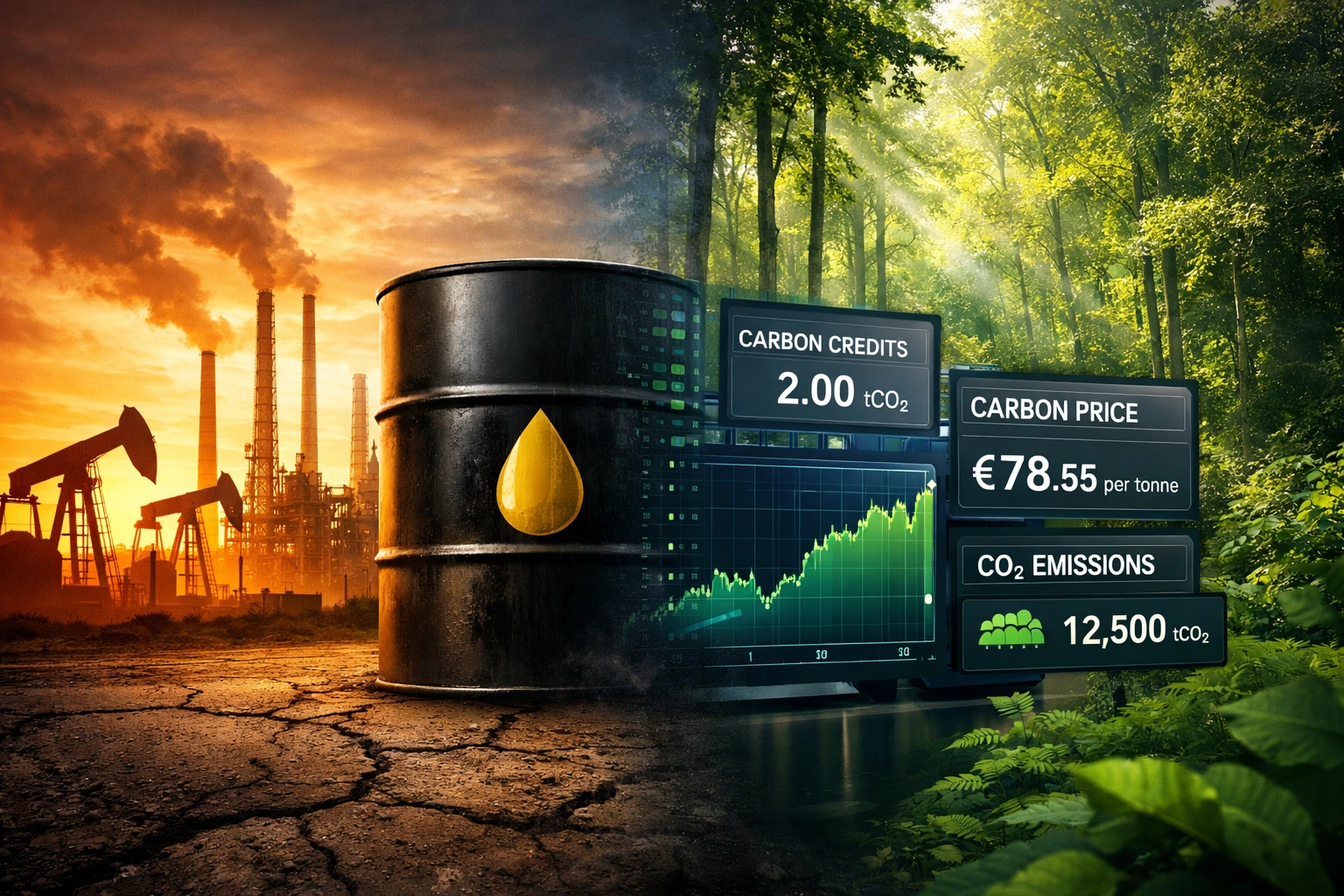
The Carbon Economy: The New Oil of the 21st Century?
The 21st Century’s New Economic Variable
The 20th century was shaped by oil. Currencies were built around it. Wars were fought over it. Entire industries depended on it.
Today, however, something quieter is beginning to influence global trade and finance.
Carbon. Not fossil fuels themselves — but the right to emit them.
In fact, the world is not just decarbonising. It is financialising carbon. And that shift could redefine economic systems in the decades ahead.
From Pollution to Price
For years, carbon emissions were treated as an environmental externality. Companies emitted. Governments regulated. Markets moved on.
That is no longer the case.
Under frameworks developed by the United Nations Framework Convention on Climate Change and strengthened through agreements such as the Paris Agreement, emissions are now being priced.
Today, more than 70 carbon pricing instruments operate globally. According to the World Bank, carbon pricing mechanisms generate tens of billions of dollars annually.
As a result, carbon is no longer abstract. It has a measurable economic value.
Understanding Carbon Markets
At present, the carbon economy operates through two main systems.
1. Compliance Markets
Governments cap emissions and issue allowances. Companies that exceed their limits must purchase additional credits.
2. Voluntary Markets
Corporations buy carbon credits to offset emissions and meet net-zero commitments.
While compliance markets are regulation-driven, voluntary markets are reputation-driven. Nevertheless, both systems rely on one principle:
Carbon has a price. And once something has a price, markets evolve around it.
Carbon and Global Trade
The shift becomes clearer when we examine trade policy.
The Carbon Border Adjustment Mechanism introduced by the European Union requires importers to report embedded carbon emissions in certain products.
These include steel, cement, aluminium, fertilizers, electricity, and hydrogen.
Consequently, trade competitiveness is no longer based solely on cost efficiency. It increasingly depends on carbon efficiency.
For export-oriented economies like India, this development carries serious implications.
India’s Carbon Transition
India has notified its Carbon Credit Trading Scheme under the Government of India. This marks the beginning of a structured domestic carbon market.
At the same time, ESG reporting requirements are expanding. Sustainability disclosures are becoming more formalised for listed entities.
Although many small businesses may not feel immediate pressure, carbon accounting is gradually entering supply chains.
Therefore, preparation matters.
Is Carbon the New Oil?
Not exactly.
Oil is a physical commodity. Carbon, on the other hand, is a regulatory and financial instrument.
Its price fluctuates based on policy decisions, verification standards, and market confidence.
Nevertheless, volatility does not diminish relevance.
On the contrary, tightening climate commitments suggest that carbon pricing mechanisms are likely to expand rather than contract.
Financialising the Atmosphere
Perhaps the most significant shift is conceptual.
For the first time in economic history, the atmosphere is entering financial accounting systems.
Emissions are measured.
Reductions are verified.
Offsets are traded.
As climate risk increasingly becomes financial risk, investors and banks incorporate carbon exposure into decision-making.
In this sense, carbon is becoming part of economic infrastructure.
Why This Matters
The carbon economy intersects with:
- Trade policy
- Industrial strategy
- Infrastructure planning
- Agriculture and forestry
- Capital markets
In other words, it is environmental in language but economic in consequence.
The 20th century was powered by fossil fuels.
The 21st century may be organised around how we measure and regulate them.
What Comes Next?
In the upcoming parts of The Carbon Ledger, The Quantiq will explore:
- What Indian MSMEs must understand before 2030
- Whether North East India holds carbon advantage
- How AI strengthens carbon verification
- Whether bamboo can become climate infrastructure
Carbon is no longer a side narrative.
It is becoming an economic variable.
And economies that understand variables early often shape outcomes later.https://thequantiq.com/energy-wall-ai-power-grid-2025/



One Comment