
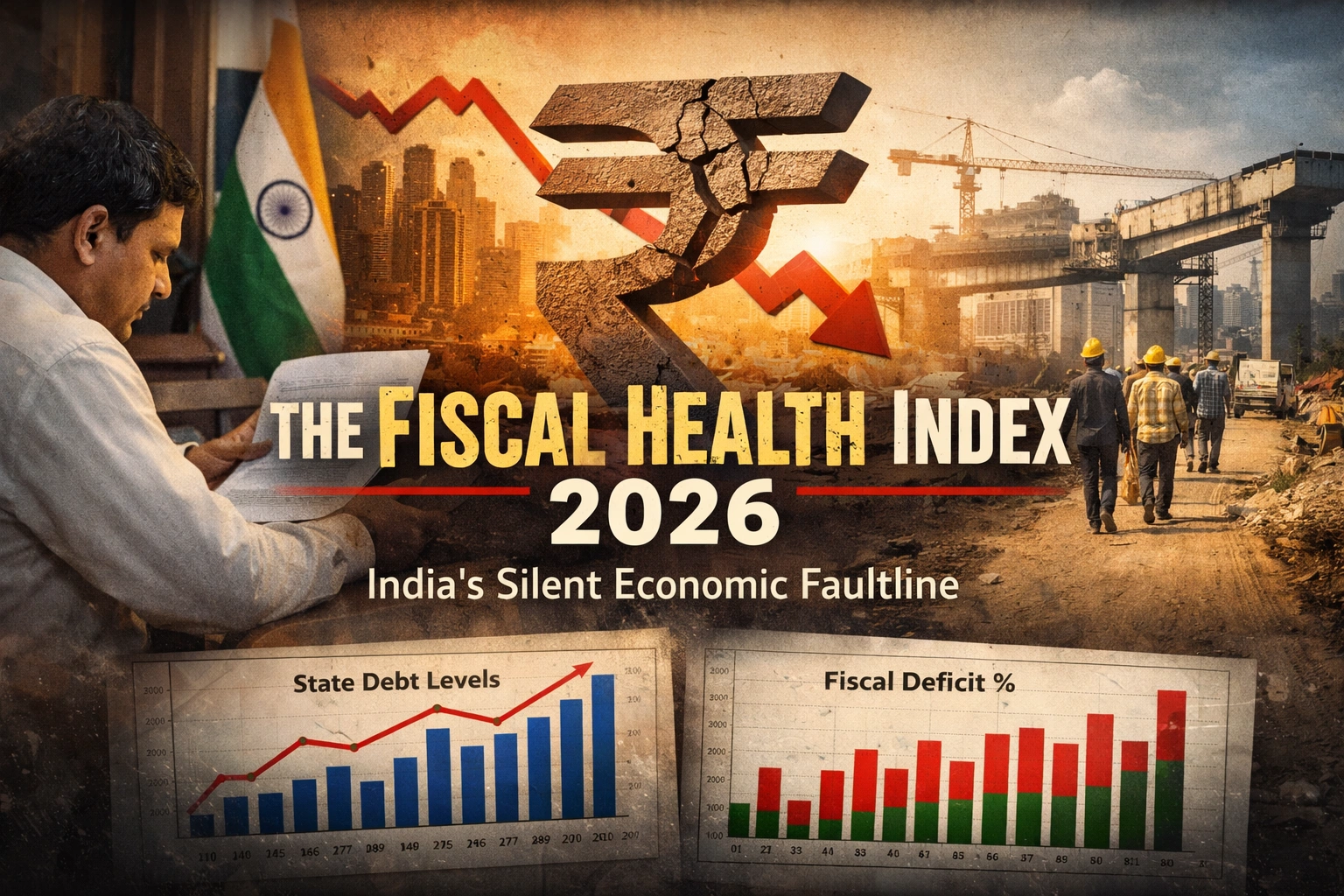
The Fiscal Health Index 2026 — India’s Silent Economic Faultline
The Crisis Beneath the Celebration
India today stands at a moment of visible economic confidence.
The headlines speak of growth rates, global positioning, manufacturing ambitions, and digital transformation. The narrative is expansive, almost triumphant. But beneath this surface lies a quieter, more structural reality—one that does not lend itself easily to headlines.
It is the story of how India’s states are managing their finances.
The Fiscal Health Index 2026 released by NITI Aayog, with insights disseminated through the Press Information Bureau, does more than rank states. It reveals patterns—patterns that suggest India’s growth story may be resting on uneven fiscal foundations.
This is not a crisis. Not yet.
But it is, unmistakably, a faultline.
Understanding the Index: Beyond Rankings and Scores
At first glance, the Fiscal Health Index appears to be another comparative tool—an attempt to measure how efficiently states manage deficits, debt, and expenditure.
But to read it merely as a ranking exercise would be to miss its deeper significance.
What the index truly captures is the capacity of states to sustain growth.
It looks at whether states are generating enough revenue, whether they are borrowing responsibly, and whether their spending is creating assets or merely servicing immediate pressures. In essence, it asks a simple but profound question:
Are India’s states building the future—or borrowing against it?
A Nation Dividing Quietly: The Emergence of Fiscal Asymmetry
One of the most revealing insights from the index is the growing divergence among states.
Some states are demonstrating remarkable fiscal discipline. Their revenues are stable, their deficits controlled, and their investments increasingly directed toward infrastructure and long-term assets. These states are not merely managing finances; they are engineering future growth.
Others, however, are caught in a more fragile cycle. Their fiscal structures are strained by rising debt, limited revenue generation, and increasing dependence on external support. For them, financial management is less about strategy and more about survival.
This divergence is subtle, but significant.
It suggests that India is not moving forward as a single economic entity. Instead, it is advancing at multiple speeds, shaped by the fiscal strength—or weakness—of its constituent states.
The Deeper Concern: Not How Much We Spend, But How We Spend
The conversation around public finance often revolves around numbers—how large the deficit is, how high the debt has climbed.
But the Fiscal Health Index nudges us toward a more nuanced question:
What is the nature of this spending?
There is a fundamental difference between expenditure that builds capacity and expenditure that merely sustains consumption.
When states invest in infrastructure, industry, and skills, they are laying the groundwork for future revenue streams. Such spending multiplies over time, creating economic momentum that eventually strengthens the very fiscal position from which it emerged.
But when spending is directed primarily toward short-term relief—however necessary or well-intentioned—it rarely generates lasting economic returns. It addresses immediate needs but often leaves structural gaps untouched.
This is where the tension lies.
Not between spending and saving, but between investment and consumption.
Politics and Fiscal Choices: An Uneasy Relationship
To understand this tension, one must step beyond economics and into politics.
State governments do not operate in a vacuum. They are accountable to voters, responsive to public sentiment, and shaped by electoral cycles. In such an environment, the pressure to deliver immediate, visible benefits is immense.
Long-term investments, by contrast, are slower to show results. They demand patience—something electoral politics rarely affords.
This creates an inherent dilemma.
Fiscal prudence, while economically sound, often lacks political immediacy. Expansionary spending, on the other hand, offers quick visibility and tangible short-term gains.
The result is a delicate balancing act—one where economic logic and political necessity do not always align.
Debt: A Tool, a Trap, and a Tipping Point
Debt, in itself, is not the problem.
In fact, it is an essential instrument of development. Every modern economy has relied on borrowing to finance growth, build infrastructure, and catalyse transformation.
The problem arises when borrowing begins to outpace the capacity to repay.
The Fiscal Health Index suggests that in several cases, this balance is becoming fragile. Interest payments are consuming larger portions of state budgets. Fiscal flexibility is narrowing. And the space for fresh investment is gradually shrinking.
This is not an immediate collapse. It is something more insidious—a slow tightening of financial space.
A point may eventually be reached where states are no longer borrowing to grow, but borrowing to sustain past commitments.
That is the tipping point policymakers must avoid.
Why State Finances Matter More Than We Think
India’s economic ambitions are ambitious by any standard.
From manufacturing expansion to infrastructure development, from digital transformation to global supply chain integration—the roadmap is expansive and demanding.
But much of this ambition rests on the shoulders of states.
It is at the state level that land is allocated, infrastructure is built, industries are facilitated, and local economies are nurtured. In many ways, states are not just participants in India’s growth story—they are its primary drivers.
Which means that fiscal stress at the state level is not a peripheral issue.
It is central.
If states struggle financially, the ripple effects will be felt across investment flows, project execution, and overall economic momentum.
The Emerging Reality: A New Era of Fiscal Competition
What the Fiscal Health Index ultimately points toward is a new kind of competition among states.
Not just for investment or talent—but for fiscal credibility.
States that manage their finances well will find it easier to attract investment, execute projects, and sustain growth. Those that do not may find themselves constrained, not by lack of ambition, but by lack of financial capacity.
This could lead to a new phase in India’s federal structure—one where fiscal discipline becomes a defining factor in economic success.
A kind of silent competition, playing out not in political rhetoric, but in balance sheets.
The Way Forward: Rebalancing the Equation
If the Fiscal Health Index is a warning, it is also a guide.
It suggests that the path forward lies not in reducing ambition, but in refining strategy.
States must begin to view expenditure not merely as an obligation, but as an investment decision. Revenue systems must be strengthened, not just expanded. Transparency must improve, enabling better decision-making and accountability.
Most importantly, there must be a gradual alignment between political incentives and economic sustainability.
This will not happen overnight. But it is essential.
The Faultline That Will Shape the Future
India’s growth story is real. Its momentum is undeniable.
But like all large systems, it carries within it certain vulnerabilities—faultlines that, if left unaddressed, can shape outcomes in unexpected ways.
The Fiscal Health Index 2026 brings one such faultline into view.
It does not predict failure. It does not signal crisis.
But it asks us to pay attention.
Because the future of India’s economy will depend not just on how fast it grows, but on how sustainably that growth is financed.
And in that story, the balance sheets of its states may matter more than we have so far acknowledged.https://thequantiq.com/frontier-50-and-the-rise-of-hyperlocal-intelligence-why-indias-future-will-be-built-in-its-districts/





One Comment