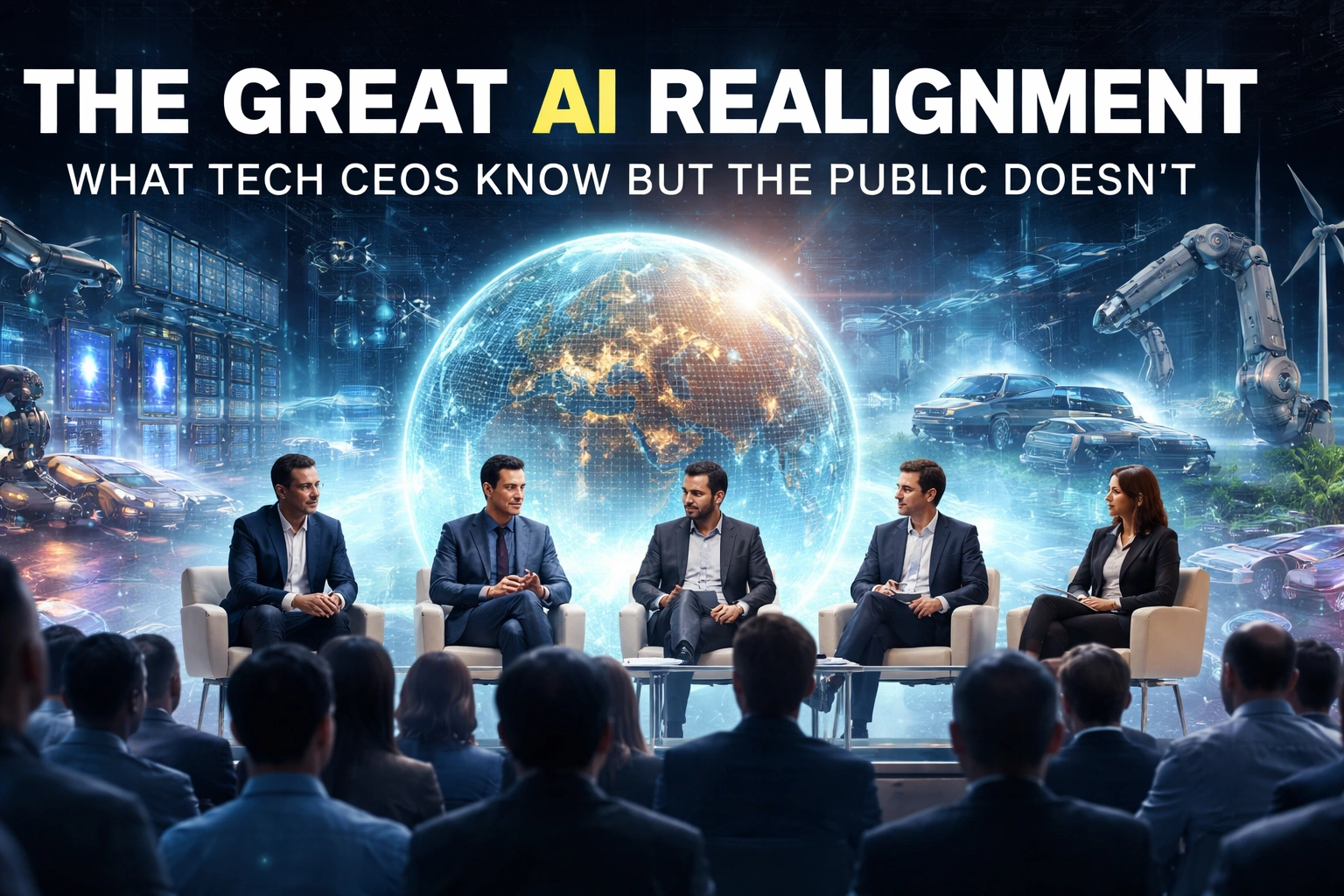
The Great Realignment: What Tech CEOs Know About AI That the Public Doesn’t
For the past three years, Artificial Intelligence has dominated headlines with a mix of awe and anxiety. From viral chatbots to predictions of mass job loss, the public conversation around AI has often swung between utopian promise and dystopian fear. But inside boardrooms, investment summits, and global technology forums, a more grounded narrative has quietly taken shape.
In 2026, the AI story is no longer about novelty. It is about infrastructure, economics, and long-term transformation. The breathless hype of the generative AI boom hasn’t disappeared — but it has matured into something deeper and far more consequential. Listening closely to what leading technology CEOs are actually saying reveals a striking truth: the future of AI is not unfolding the way the public imagines.
This is the Great Realignment — and it is reshaping how businesses, governments, and innovators should think about AI.
The Productivity Paradox: AI Is Expensive Before It Is Efficient
Public perception still paints AI as a magical cost-cutting machine. The assumption is simple: automation replaces people, and profits rise quickly.
Yet executives across the tech industry increasingly acknowledge a more complicated reality. Deploying AI at scale demands massive upfront investment — in data pipelines, specialised talent, energy-hungry compute infrastructure, cybersecurity, and integration into legacy systems.
Google CEO Sundar Pichai has repeatedly highlighted the unprecedented demand for computing power required to train and run advanced AI models. Similarly, security leader Nikesh Arora has emphasised that companies adopting AI often see costs rise first, not fall.
The reason is structural. AI isn’t just another software upgrade; it’s a foundational shift in how organisations operate. Businesses must redesign workflows, retrain employees, and rethink decision-making systems. Returns tend to arrive gradually — through new capabilities, better insights, and improved innovation cycles — rather than immediate payroll reductions.
In other words, AI is proving less like a cost-cutting tool and more like electricity during the industrial revolution: expensive to build, but transformative once embedded.
From Digital AI to Physical AI: The Real Next Frontier
For many people, AI still means chatbots, text generators, and digital assistants. But industry leaders increasingly point to a different frontier: AI interacting with the physical world.
NVIDIA CEO Jensen Huang has consistently argued that the next wave of AI will power robotics, autonomous systems, industrial automation, and smart manufacturing. This includes AI models capable of reasoning about motion, materials, spatial environments, and real-world constraints — not just language.
This shift is already visible. Automotive firms are embedding AI reasoning systems into vehicles. Logistics companies are scaling warehouse robotics. Manufacturers are investing in AI-driven quality inspection and predictive maintenance. Healthcare innovators are applying AI to diagnostics equipment and drug discovery pipelines.
The implication is enormous: the future of AI will not live solely in the cloud. It will live in factories, farms, hospitals, vehicles, and infrastructure.
The real AI revolution may be less about what appears on your screen — and more about what quietly moves in the world around you.
The Rise of “AI Washing”: When Marketing Runs Ahead of Technology
As AI enthusiasm surged, so did something else: AI branding.
Executives and regulators alike have begun warning about “AI washing” — the practice of labelling conventional automation or analytics systems as AI to boost valuations, attract investors, or justify restructuring decisions.
OpenAI CEO Sam Altman has suggested in interviews that some layoffs attributed to AI adoption are actually part of broader corporate efficiency drives. Regulators in the US and Europe have also started scrutinising companies for exaggerated AI claims in investor communications.
For investors and entrepreneurs, the signal is clear. The question is no longer “Do you use AI?” but “What exactly is the AI doing?”
Serious AI adoption now demands transparency: training data sources, model capabilities, risk safeguards, and measurable performance improvements. The era of vague AI buzzwords is fading, replaced by a demand for proof.
The Sustainability Reckoning: AI’s Hidden Energy Problem
AI is often presented as a solution to climate change — optimising energy grids, predicting weather patterns, and improving resource efficiency. All of that is true.
But another truth is emerging: AI itself consumes enormous energy.
Training large AI models requires vast data centres, specialised chips, and continuous cooling systems. As AI adoption accelerates globally, analysts estimate that data-centre electricity consumption could rise significantly over the next decade.
This has triggered a deeper industry conversation about sustainable AI infrastructure. Governments and corporations are now exploring renewable-powered data centres, advanced cooling technologies, and even nuclear energy partnerships to support future compute demand.
The geopolitical dimension is also growing. Nations are increasingly investing in domestic AI infrastructure — sometimes described as “sovereign AI” — not only to protect data independence, but to secure the energy capacity needed for future technological competitiveness.
AI may help solve climate challenges, but it is also becoming one of the world’s most energy-intensive industries.
The AGI Narrative Is Quietly Evolving
Public imagination often jumps straight to Artificial General Intelligence (AGI) — machines matching or surpassing human intelligence across all domains.
Inside the industry, however, the conversation has become more nuanced.
Leaders including Sam Altman and major research organisations increasingly frame the near-term goal not as omniscient machine intelligence, but as highly capable multi-domain systems — sometimes described as polymathic AI. These systems can perform diverse tasks across writing, coding, reasoning, and analysis, but remain tools rather than conscious entities.
This shift matters. It reframes AI not as a replacement for human intelligence, but as a multiplier of it. The emphasis is moving toward collaborative systems where humans remain in the loop — guiding, verifying, and applying AI outputs.
The future, according to many industry insiders, looks less like machine domination and more like augmented human capability.
Perception vs Reality: The 2026 AI Gap
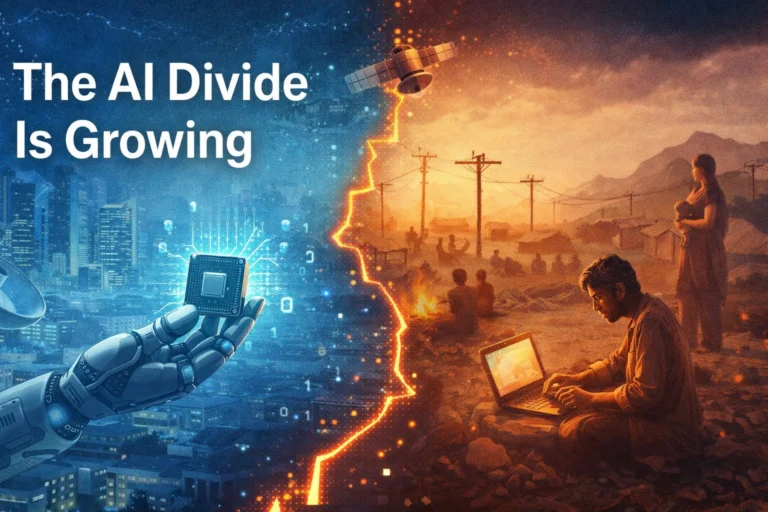
Across these themes, one pattern stands out: the distance between public narrative and industry reality.
The public fears instant job collapse; CEOs discuss workflow redesign and new skill demands.
The public sees AI as lightweight software; industry sees trillion-dollar infrastructure.
The public worries about runaway intelligence; developers focus on reliability, safety, and deployment costs.
This gap is not accidental. Technological revolutions rarely unfold the way they are imagined in their early years. Electricity, the internet, and smartphones all followed similar arcs — from hype to recalibration to deep integration.
AI is now entering that integration phase.
Why This Realignment Matters
For entrepreneurs, policymakers, and investors — especially in emerging innovation regions like India and Southeast Asia — understanding this shift is critical.
The next opportunities in AI will not lie merely in launching another chatbot or app. They will lie in infrastructure, specialised industry solutions, robotics, energy-efficient compute, trustworthy data ecosystems, and human-AI collaboration platforms.
The AI race is no longer about novelty. It is about execution.
And as tech CEOs quietly acknowledge, the real AI transformation will be slower, costlier, and more physical than the public expected — but also far more profound.
For readers of The Quantiq, recognising this Great Realignment is the difference between chasing headlines and building the future.https://thequantiq.com/the-new-delhi-declaration-indias-vision-for-an-ai-commons-and-a-human-centric-digital-future/