The Great Recalibration: Beyond India’s 2011 Statistical Horizon
For over a decade, India’s economy has transformed at a pace rarely seen in modern history. Payments moved from cash to QR codes, consumption shifted from physical goods to digital services, and infrastructure expanded from highways to data centres.
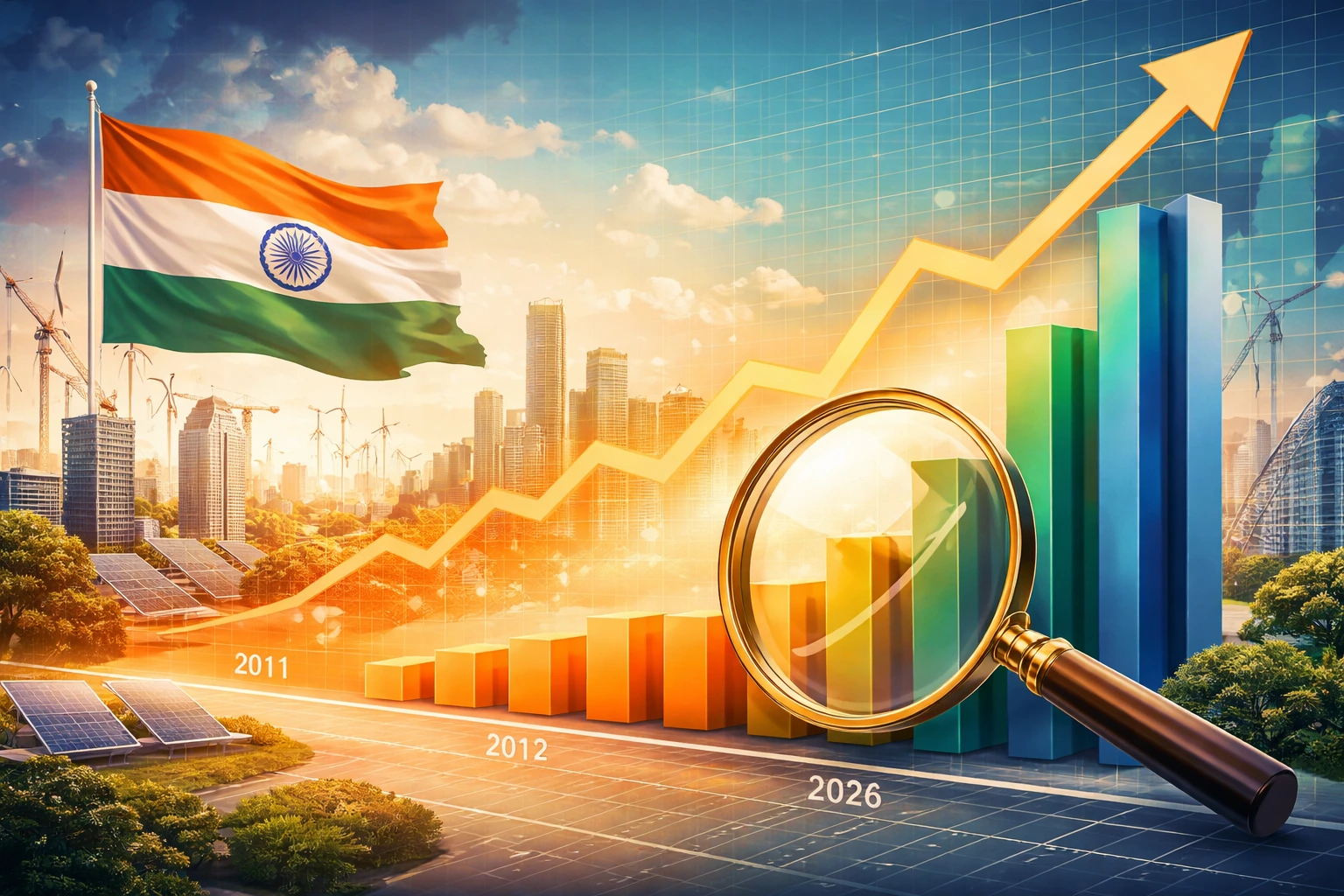
Yet, for much of this period, India’s official economic mirror—the National Accounts—remained anchored to a much older reality: 2011–12.
As the Ministry of Statistics and Programme Implementation prepares to transition India’s GDP base year to 2022–23, the moment marks far more than a routine statistical update. It represents a long-overdue recalibration of how India measures itself—and how the world interprets its economic story.
This is not a political moment. It is a methodological one. And its implications are significant.
Why Base Years Matter More Than Most People Realise
In macroeconomics, a base year acts as an anchor. It defines how inflation is adjusted, how real growth is calculated, and how sectoral weights are assigned. When that anchor becomes outdated, the data may remain mathematically correct—but economically misleading.
Globally, most major economies revise their base years every five years. India’s unusually long gap meant that a rapidly changing economy was being measured using assumptions from a very different era.
The result was not “wrong” data—but increasingly incomplete data.
I. The Ghost of 2011: Where the Old Series Fell Short
1. The Consumption Mismatch
India’s consumption basket in 2011 reflected an economy dominated by food, fuel, and basic manufacturing.
By contrast, India in the mid-2020s is shaped by:
- Digital payments and platform services
- App-based transport and delivery
- Online education, streaming, and cloud services
- A rapidly expanding gig and creator economy
Industry and policy estimates now place the platform-driven and gig economy in the several-hundred-billion-dollar range, employing tens of millions of Indians directly or indirectly. Yet much of this activity remained under-represented in older national accounts.
The economy moved online. The data did not.
2. The Proxy Problem: Formal vs Informal India
India has long relied on formal-sector indicators—corporate filings, GST data, organised manufacturing—as proxies for informal-sector performance.
This approach worked reasonably well when both sectors moved broadly together.
The post-pandemic recovery changed that.
The now-well-documented K-shaped recovery revealed a divergence:
- Large, formal firms recovered quickly
- Smaller, informal enterprises faced longer disruptions
Using one as a proxy for the other became statistically fragile.
3. The Deflator Dilemma
A more technical, but critical issue lay in how real growth was calculated.
The older series relied heavily on single deflation, where nominal output was adjusted using broad price indices. Economists—including former Chief Economic Advisors—have pointed out that this approach can distort real growth when:
- Input prices (like energy) fall sharply
- Output prices do not adjust at the same pace
In such cases, real manufacturing growth may appear stronger than underlying activity suggests.
II. The 2026 Pivot: What Changes with the 2022–23 Base
The move to a 2022–23 base year is not cosmetic. It is structural.
1. The “Statistical Pop” and the Denominator Effect
When base years are updated, GDP levels typically rise—not because the economy suddenly grows overnight, but because more of it is finally counted.
Newer sectors now better captured include:
- Digital platforms and fintech
- Renewable energy and green infrastructure
- Logistics, warehousing, and data services
- Expanded physical infrastructure
For investors and policymakers, this has an important implication:
India’s Debt-to-GDP ratio may improve mechanically, offering greater fiscal flexibility without any change in borrowing.
This is arithmetic, not politics.
2. A Possible Shift Toward Double Deflation
Technical discussions within academic and statistical circles suggest the new series may experiment—at least selectively—with double deflation.
In simple terms:
- Output and input prices are deflated separately
- Value added reflects real economic margins, not just volumes
This approach can introduce more short-term volatility—but delivers greater honesty in sectoral data, particularly manufacturing.
III. What This Means for Markets and Policy
For Growth Numbers
Reported growth rates may appear more moderate, not because India is slowing, but because the denominator is now more realistic.
Lower percentages on a larger, more accurate base can still represent strong absolute expansion.
For Monetary Policy
For the Reserve Bank of India, the recalibration improves:
- Inflation targeting
- Consumption tracking
- Policy transmission assessment
When data reflects what Indians actually spend on—mobility, data, services—policy precision improves.
For Global Investors
International comparisons become cleaner. India’s data aligns more closely with global statistical standards, improving credibility across:
- Sovereign risk assessment
- Long-term capital allocation
- Multilateral engagement
The Quantiq View
The critique of the 2011–12 base year was valid—but it belongs to the past.
By moving directly to a 2022–23 base, India avoids anchoring its statistics to years distorted by GST rollout shocks or pandemic disruptions. Instead, it chooses a more representative, more contemporary mirror.
This recalibration is not about revising history.
It is about measuring the present accurately.
For the first time in over a decade, India’s statistical reflection may finally resemble the economy that citizens, businesses, and investors experience every day.
And that, quietly, is a declaration of institutional maturity.