
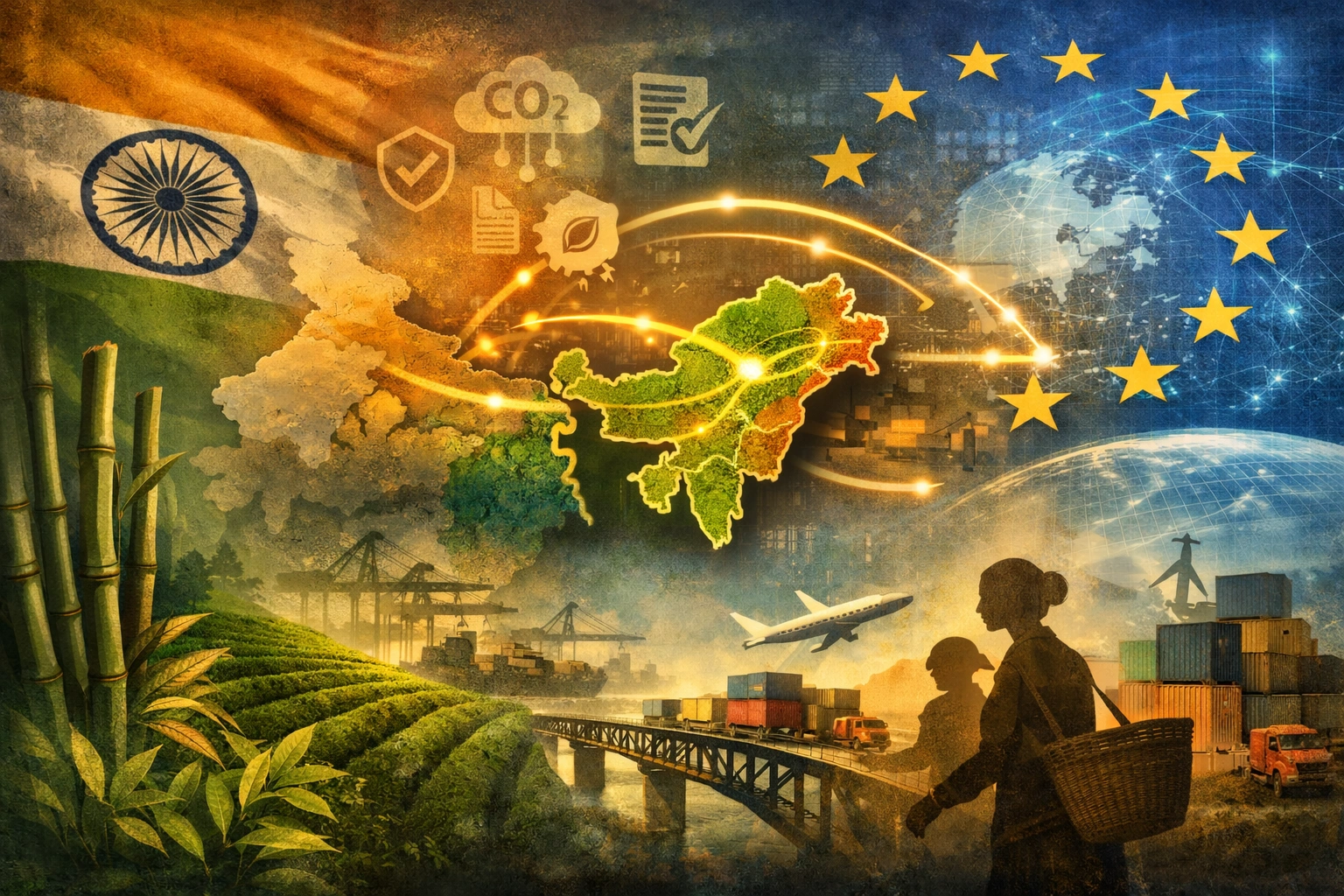
The India–EU Trade Deal and North East India: Strategic Asset or Strategic Blind Spot?
As New Delhi negotiates what is being billed as the “mother of all trade deals” with Europe, a quieter and more uncomfortable question remains unanswered: where does North East India fit into this grand economic reset?
A Deal That Will Reshape India — Unevenly
The proposed India–European Union Free Trade Agreement (FTA) is no ordinary trade pact. It aims to redraw the rules governing goods, services, investments, digital trade, sustainability standards, and supply-chain security between India and the European Union.
For Europe, the agreement is strategic insurance — a way to reduce dependence on China, secure trusted partners, and export its climate and regulatory standards beyond its borders.
For India, it promises access to a vast market, investment inflows, and global stature.
But trade agreements of this scale are never neutral. They don’t just open markets — they reorder domestic economic hierarchies.
And history shows that regions which are not trade-ready on Day One rarely catch up later.
What Indian Media Is Celebrating — and What It Isn’t Asking
A scan of Indian media coverage reveals a familiar pattern:
- “Historic breakthrough”
- “Win-win partnership”
- “Boost for exports”
- “Strategic counter to China”
What’s largely missing is impact analysis.
Very few reports ask:
- Who can actually meet EU compliance standards?
- Which Indian regions are export-ready — and which aren’t?
- Who absorbs the cost of sustainability, certification, and traceability?
Tariffs make headlines.
Standards decide outcomes.
Europe Is Not Just Buying Products — It’s Buying Proof
One critical reality glossed over in most coverage is that Europe’s trade regime has fundamentally changed.
Market access today depends on:
- Carbon accounting
- Supply-chain traceability
- Labour and environmental audits
- Consistency and scale
Sustainability is no longer a moral badge.
It is a technical requirement.
This is where the India–EU deal quietly separates potential winners from structural losers.
North East India: Perfectly Positioned, Structurally Unprepared
On paper, North East India should be central to this conversation.
The region:
- Sits at the gateway to ASEAN
- Aligns with India’s Act East Policy
- Possesses abundant green resources
- Has low industrial carbon intensity
Yet it remains almost invisible in trade negotiations and media narratives.
Why?
Because global trade rewards systems, not just resources.
A Farmer’s Reality, a Trade Deal’s Silence
Consider a small bamboo grower or organic producer in Assam or Tripura.
Their product may be:
- Environmentally sound
- Naturally renewable
- Globally relevant
But without:
- EU-recognised certification
- Aggregation mechanisms
- Processing infrastructure
- Reliable export logistics
They don’t exist in Europe’s trade universe.
This is not a failure of sustainability.
It is a failure of trade architecture.
Carbon Rules as Economic Filters
Much has been said about Europe’s climate ambitions, but little about their economic consequences.
Carbon-linked trade measures don’t impact “India” as a whole.
They impact specific regions, sectors, and livelihoods.
Large industrial hubs may absorb compliance costs.
Frontier regions cannot.
For North East India, the risk is clear:
exclusion not by policy, but by complexity.
Bamboo and the Bioeconomy: A Missed Strategic Alignment
Few examples are as stark as bamboo.
Europe is actively seeking:
- Alternatives to timber and plastic
- Bio-based construction materials
- Circular-economy inputs
North East India holds India’s richest bamboo reserves — yet lacks:
- Industrial-scale processing
- EU-compliant treatment facilities
- Long-term buyer linkages
The result is a paradox:
global demand meets local abundance — but no market bridge exists.
Act East Meets Look West — Without the North East
India’s trade strategy today looks westward while rhetorically embracing Act East.
The North East should have been the bridge:
- Feeding green materials into EU value chains
- Linking ASEAN manufacturing with European markets
Instead, trade corridors are being designed around established coastal ecosystems, leaving the region strategically relevant but economically peripheral.
The Risk of a Two-Speed India
Large trade deals accelerate regions already integrated into global markets.
Without deliberate correction, they:
- Deepen regional inequality
- Concentrate capital and capability
- Leave frontier regions further behind
The India–EU trade deal carries this exact risk.
If North East India is not explicitly integrated into export strategy, infrastructure planning, and compliance support, the deal may widen the very gaps India claims to be closing.
What an Inclusive Trade Strategy Would Actually Require
If policymakers want the India–EU deal to be transformational rather than selective, the roadmap is clear:
- Region-specific export clusters in the North East
- Public investment in certification and testing infrastructure
- Aggregation models for small producers
- Trade diplomacy that recognises regional value chains
This is not subsidy politics.
It is strategic economics.
Europe wants green, resilient, diversified supply chains.
North East India fits that vision — if enabled.
The Question That Will Define the Deal’s Legacy
As negotiations move toward closure, one question will determine how this deal is remembered:
Will North East India be treated as a strategic asset — or as collateral damage of fast-track liberalisation?
Trade agreements encode priorities.
They reveal what — and who — a nation chooses to invest in.
For North East India, the India–EU deal could be a gateway to global value chains — or another missed opportunity hidden behind celebratory headlines.
History will decide.
But the choice is being made now.
The Quantiq Editorial Position
The success of the India–EU trade deal should not be measured by export numbers alone, but by who gets to participate in those exports.
A truly global India cannot afford regions that remain globally invisible.https://thequantiq.com/u-s-eu-trade-tensions-and-the-india-eu-fta-why-a-global-reset-is-creating-a-major-opportunity-for-india/





One Comment