
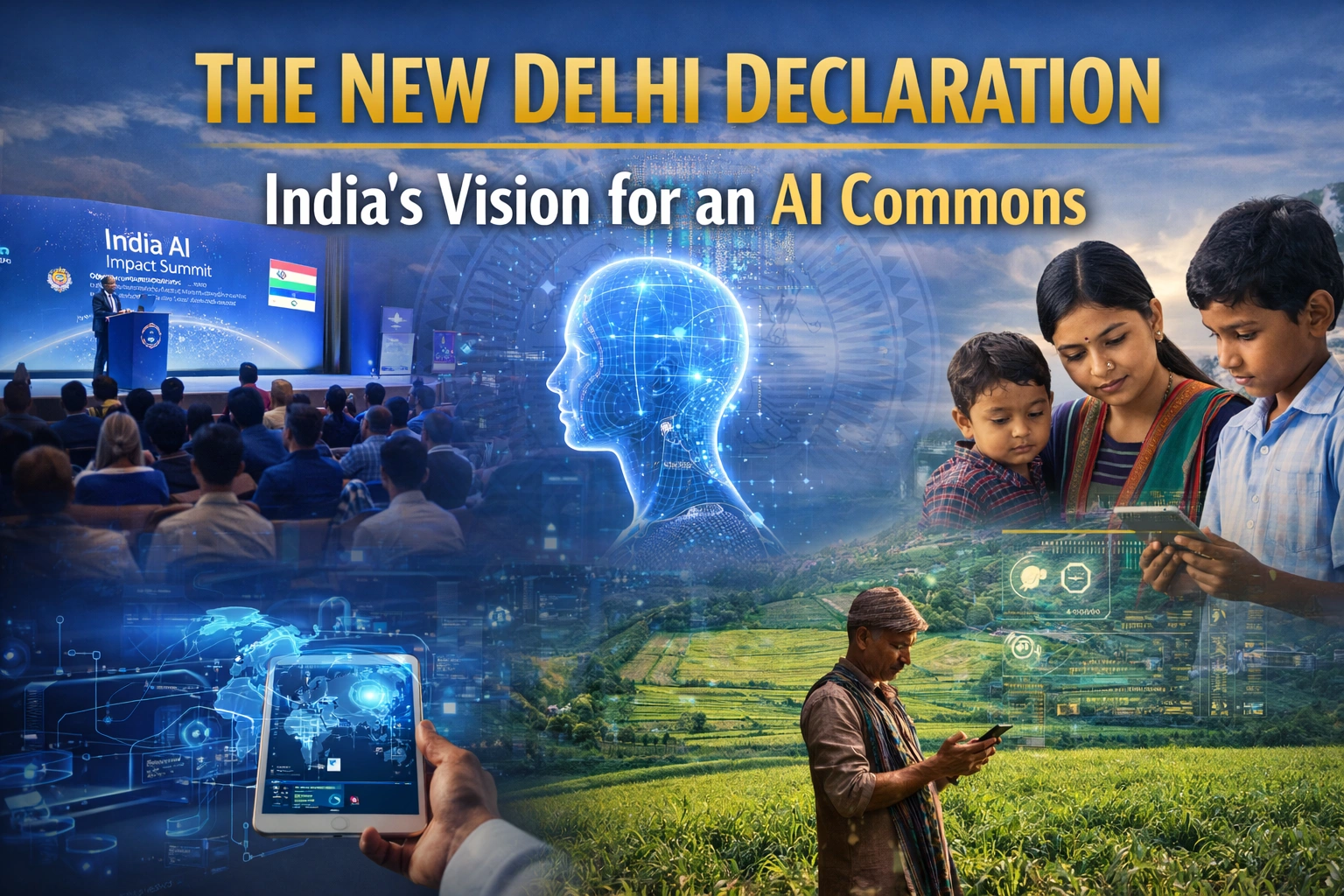
The New Delhi Declaration: India’s Vision for an AI Commons and a Human-Centric Digital Future
The conversations at the India AI Impact Summit 2026 may have ended, but their implications are only beginning to unfold.
At the centre of the discussions was what participants referred to as the New Delhi Declaration — a framework that signals India’s push to shape a more inclusive global AI order. While previous industrial eras rewarded those who controlled physical resources, the AI age will likely reward those who can scale intelligence responsibly and distribute its benefits widely.
If implemented meaningfully, the declaration could mark a shift away from technological concentration toward what policymakers increasingly call an AI Commons — a shared ecosystem where digital innovation supports public welfare, development, and global cooperation.
From Digital Divide to AI Divide
For decades, the world spoke about the digital divide — the gap between those with internet access and those without. In the AI era, the risk is deeper: a divide between countries that can build advanced AI systems and those that cannot.
Discussions at the summit reflected growing concern that unchecked AI concentration could create what analysts describe as “algorithmic inequality” — where innovation, productivity gains, and decision-making power remain limited to a handful of nations or corporations.
The New Delhi Declaration emphasizes the opposite direction:
AI development should support equitable access, transparency, and interoperability, especially for developing economies.
Digital Public Infrastructure as Global Public Good
India highlighted its own experience with Digital Public Infrastructure (DPI) — platforms such as:
- Aadhaar-enabled identity systems
- UPI digital payments architecture
- multilingual AI initiatives like Bhashini
- sectoral digital platforms in agriculture, health, and governance
These systems are increasingly presented internationally as replicable public digital models, rather than proprietary technological silos.
The underlying message: future AI ecosystems should build on open, interoperable foundations that allow countries to adapt solutions locally instead of importing closed systems.
The Quantiq Take:
If scalable AI platforms are treated like digital utilities rather than exclusive assets, innovations developed in one region could be adapted quickly in another — from healthcare delivery in India to agricultural advisory systems in Africa or Latin America.
AI for Real-World Impact: Healthcare and Education
A notable shift at the summit was the emphasis on deployment over theory. Instead of focusing only on ethics principles, sessions showcased real-world applications designed for large populations.
AI in Healthcare: From Reactive Care to Predictive Systems
India presented ongoing work integrating AI into public health systems through the Ayushman Bharat Digital Mission and other health data platforms.
Emerging use cases include:
- AI-assisted diagnostics in primary healthcare centres
- remote interpretation of X-rays and scans
- predictive health analytics for disease surveillance
- digital health records enabling continuity of care
The long-term ambition is to move from treating illness after onset toward early detection and preventive care, especially in rural and underserved regions.
Rather than replacing doctors, these systems aim to extend medical expertise digitally, making specialist-level support accessible beyond major cities.
AI in Education: Language Inclusion and Personalized Learning
Education discussions focused heavily on language accessibility — a critical issue in multilingual societies.
AI-driven translation and adaptive learning tools are being developed to:
- translate complex subjects into local languages
- personalize lesson difficulty based on student progress
- support teachers with automated assessment insights
- expand digital learning access in remote areas
The broader policy direction suggests that language should no longer determine educational opportunity. AI, if deployed inclusively, could help bridge learning gaps caused by geography, language, or income.
Agriculture and Climate Resilience: Scaling Precision Intelligence
Food security and climate resilience formed another major pillar of the summit’s discussions.
India showcased AI-driven agricultural tools combining:
- satellite imagery
- weather forecasting
- soil health databases
- mobile-based advisory systems
These systems already provide farmers with localized crop guidance, irrigation alerts, and pest warnings, often delivered through voice interfaces in regional languages.
Studies across various pilot programs suggest that precision advisory systems can help:
- reduce water use
- optimize fertilizer application
- improve yields
- cut input costs
The focus is not simply on producing more food, but on producing it more sustainably and predictably in a climate-uncertain world.
Data Sovereignty and Responsible AI Governance
Perhaps the most politically significant theme of the summit was data governance.
Countries across the Global South increasingly argue that citizens’ data should not be treated as a free raw material for global tech ecosystems. Instead, the New Delhi discussions emphasized:
- national data protection frameworks
- transparent AI training practices
- cross-border data governance standards
- accountability mechanisms for automated systems
This reflects a broader global trend toward data sovereignty — ensuring individuals and nations retain meaningful control over how data is collected, processed, and monetized.
At the infrastructure level, the summit also touched on supply-chain resilience for semiconductors and computing hardware, recognizing that AI independence depends not only on software but also on secure hardware ecosystems.
Beyond Technology: The Politics of the AI Era
The India AI Impact Summit did more than showcase innovation. It highlighted a strategic idea: AI governance will shape the geopolitical order of the 21st century.
By emphasizing:
- open digital infrastructure
- inclusive AI deployment
- responsible data governance
- cross-border collaboration
the New Delhi Declaration attempts to position AI not just as a commercial race, but as a developmental and humanitarian tool.
Whether this vision translates into measurable global policy change will depend on implementation, funding, and international cooperation. Still, the direction is clear: the debate is shifting from who owns AI to who benefits from it.
Conclusion: Toward an AI Commons
The AI age will not be judged only by computational power or model size. It will be judged by outcomes: improved healthcare access, stronger education systems, resilient agriculture, and inclusive economic growth.
The New Delhi Declaration signals an ambition to move toward an AI Commons — a world where intelligence infrastructure serves public needs, not just private advantage.
If that ambition holds, the real legacy of this summit may not lie in announcements or agreements, but in whether AI becomes the most powerful tool for global inclusion ever built.https://thequantiq.com/made-for-india-5-ai-tools-solving-indian-problems/




2 Comments