U.S.–EU Trade Tensions and the India–EU FTA: Why a Global Reset Is Creating a Major Opportunity for India
Editor’s Note: This article reflects global trade developments and policy signals as of January 22, 2026.
A Quiet Shift in the Global Trade Order
The global trade system is changing—slowly, but decisively.
For decades, the U.S.–EU partnership has been one of the most stable anchors of the world economy. Today, that certainty is giving way to recalibration.
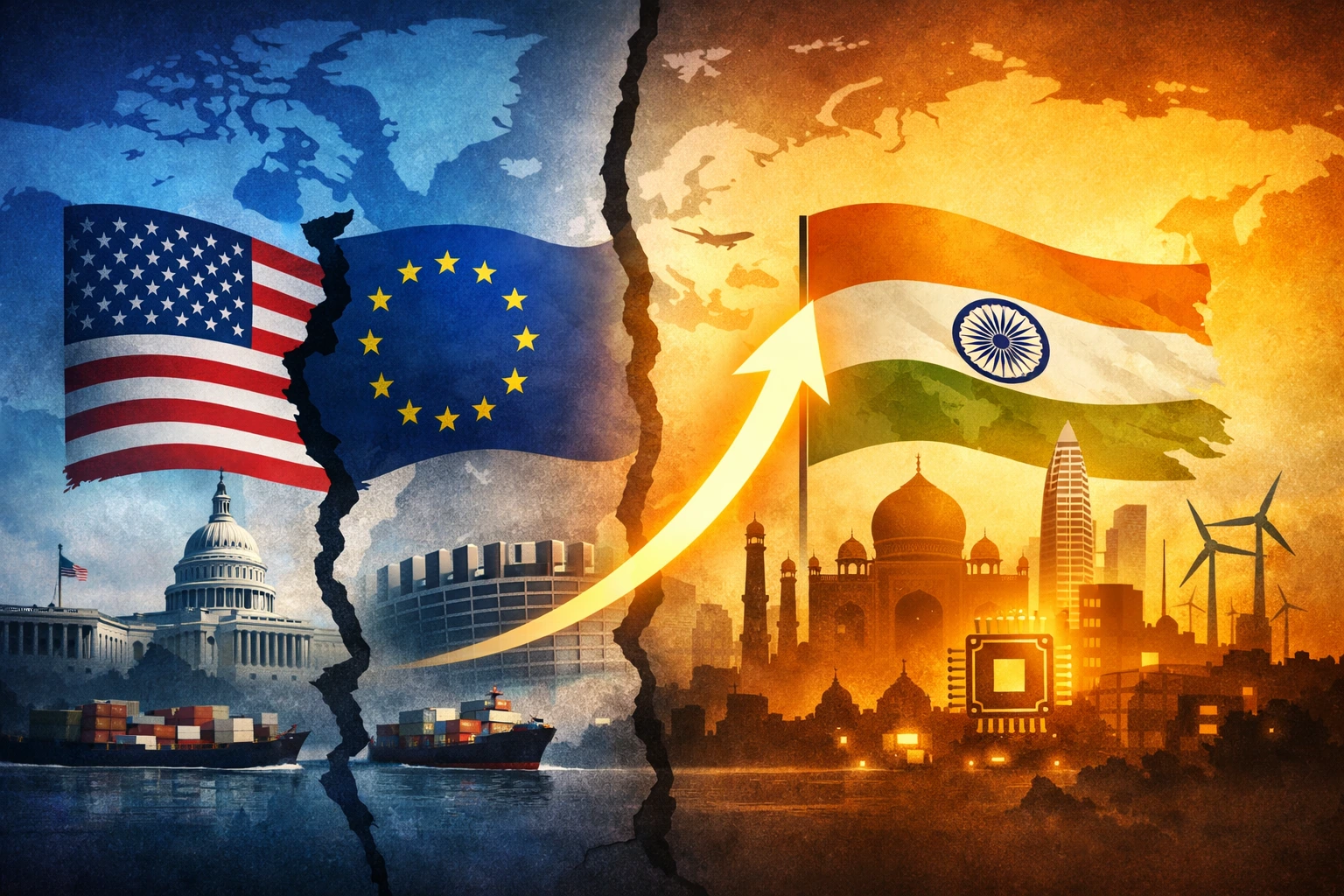
On January 21, 2026, the European Parliament voted to pause progress on a proposed U.S.–EU trade framework. While this does not signal a breakdown in relations, it clearly indicates growing differences in trade philosophy, policy predictability, and strategic priorities.
For India, this shift matters more than it may first appear.
Why U.S.–EU Trade Relations Are Under Strain
The core issue is not conflict—it is uncertainty.
European policymakers have become increasingly uncomfortable with the use of tariffs and trade threats as political tools. From Brussels’ perspective, long-term economic planning depends on clear rules, stable commitments, and predictable behaviour.
Recent trade-related signalling by the U.S., combined with broader strategic rhetoric, has reinforced Europe’s push for greater economic autonomy and defensive preparedness.
As a result, transatlantic trade discussions have entered a pause-and-review phase.
Europe Prepares Its Trade Defence Playbook
The European Union’s response has been measured, not reactive.
Rather than escalating immediately, Brussels has focused on strengthening its institutional trade defences. Several tools are now being prepared should negotiations deteriorate further.
These include:
- The Anti-Coercion Instrument (ACI): Designed to respond proportionately to economic pressure
- Digital Trade Measures: Potential regulatory and fiscal actions affecting large technology platforms
- Automatic “Snap-Back” Tariffs: Pre-approved duties that can be triggered if talks fail
- Anti-Dumping Reviews: Renewed scrutiny of pricing practices in select sectors
Importantly, none of these measures have been activated yet. Europe continues to signal a preference for dialogue over confrontation.
India–EU Free Trade Agreement Gains New Momentum
While U.S.–EU trade talks slow down, India–EU engagement is accelerating.
After years of stop-start negotiations, the India–EU Free Trade Agreement (FTA) is now widely expected to be concluded later this month. High-level diplomatic engagement has added urgency and political backing to the process.
The timing is critical.
European companies are actively reassessing their global supply chains due to ongoing U.S.–China tensions, rising geopolitical risk, and regulatory uncertainty.
India fits neatly into this new calculation.
Why Europe Is Increasingly Looking at India
India’s appeal is not based on short-term incentives. It is rooted in long-term fundamentals.
Key Reasons Driving European Interest
- Manufacturing and Semiconductors: India is emerging as a serious alternative for “China+1” and “China+2” strategies
- Green Energy and Climate Tech: Strong EU interest in renewables, green hydrogen, and electric mobility
- Textiles and Light Manufacturing: Competitive costs, improving quality, and potential tariff advantages
- Financial and Currency Stability: The Indian Rupee is increasingly viewed as resilient amid dollar volatility and euro-zone pressures
For European businesses, India offers scale, growth, and policy continuity.
Global Supply Chains Are Being Rewritten
The bigger story is not fragmentation—it is diversification.
Companies across sectors are now prioritising:
- Supply chain resilience over lowest cost
- Multiple production bases over single-country dependence
- Predictability over aggressive incentives
In this environment, countries that can work across geopolitical blocs gain a clear advantage.
India’s strategic autonomy allows it to do exactly that.
The Quantiq Take: India as a Key Swing Economy
The evolving U.S.–EU dynamic does not mark the end of Western cooperation. Instead, it reflects a shift toward a more interest-driven, multipolar global system.
In such a system, influence flows to economies that offer:
- Stability
- Scale
- Policy consistency
- Strategic balance
India stands out on all four counts.
The India–EU Free Trade Agreement is more than a trade deal. It represents a long-term alignment between two economies seeking stability in an uncertain world.
Why This Matters Now
For investors, policymakers, and entrepreneurs, the takeaway is clear:
The future of global trade will be shaped less by rigid alliances and more by reliable partnerships.
As traditional trade relationships adjust, India is well positioned to emerge as one of the biggest beneficiaries of this global reset.https://thequantiq.com/davos-2026-signals-the-end-of-the-old-global-order-and-no-one-has-a-replacement/


One Comment