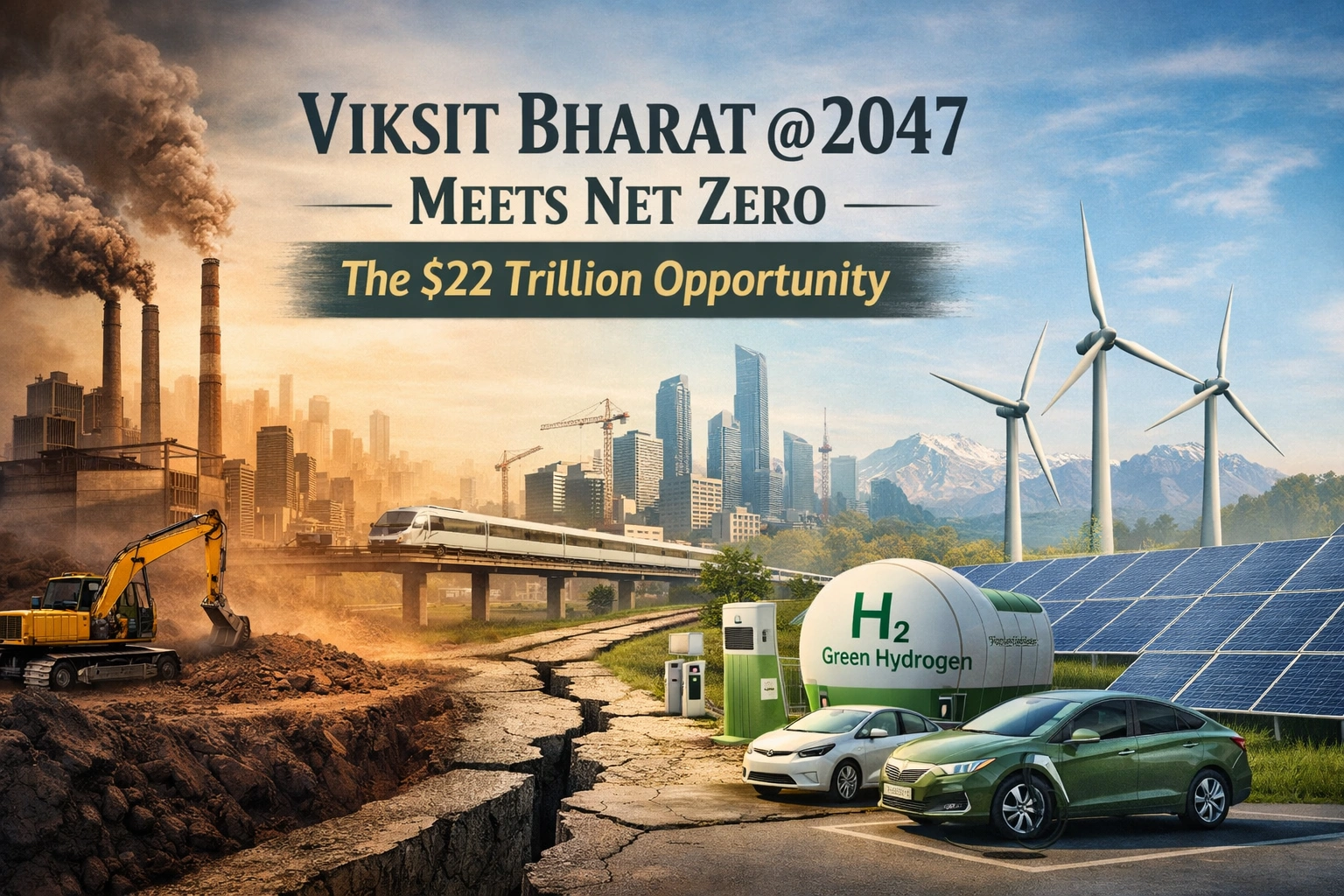
Viksit Bharat @2047 Meets Net Zero — The $22 Trillion Question
Not a Transition, But a Reinvention
There are moments in a nation’s journey when change is not incremental but foundational. India appears to be entering such a phase.
With the release of multiple scenario reports by NITI Aayog, aligned with the twin ambitions of Viksit Bharat by 2047 and Net Zero by 2070, the country has done more than outline a climate roadmap. It has quietly articulated a vision for rebuilding its economic architecture.
The number attached to this ambition—an estimated $22.7 trillion in investments—is staggering. Yet, to interpret it merely as a cost would be to misunderstand its meaning.
This is not the price of compliance.
It is the scale of transformation.
The Meaning of $22 Trillion: Capital as a Signal of Intent
When a nation speaks in trillions, it is not just talking about money. It is revealing intent.
The projected investment requirement translates into hundreds of billions of dollars flowing annually into energy systems, transport networks, industrial processes, and urban infrastructure. But beyond the arithmetic lies a deeper implication.
India is not attempting to repair an existing system. It is constructing a new one—parallel to, and eventually replacing, the old.
This is what makes India’s Net Zero journey fundamentally different from that of developed economies. While others are engaged in retrofitting legacy infrastructure, India is engaged in first-time creation at scale.
The Infrastructure Opportunity: Building the Future Before It Exists
One of the most under-discussed realities of India’s growth story is that a significant portion of the infrastructure that will define 2047 has yet to be built.
This is not a limitation. It is a rare strategic advantage.
Every new highway, industrial corridor, logistics network, and power system represents a choice. It can replicate the inefficiencies of the past, or it can embed the efficiencies of the future.
In this context, infrastructure is no longer just an economic multiplier. It becomes a climate decision.
The roads India builds today will determine not just mobility, but emissions. The factories it establishes will define not just output, but energy intensity. The cities it expands will shape not just living standards, but sustainability.
In other words, India is not merely expanding infrastructure. It is defining the environmental character of its future economy.
The Coal Paradox: Growth and Sustainability in Tension
No serious conversation about India’s Net Zero pathway can avoid its most uncomfortable truth: coal remains central to its energy system.
Even as renewable energy capacity expands rapidly, coal continues to power the bulk of India’s electricity needs. And for a country still in the midst of industrialisation, this reliance is not easily reversible.
This creates a dual reality.
On one hand, India must accelerate clean energy adoption, scale solar and wind capacity, and invest in storage technologies. On the other, it must ensure that industries remain powered, cities remain lit, and growth remains uninterrupted.
This is not a contradiction. It is a balancing act.
India is effectively running two energy systems simultaneously—one rooted in the past, the other designed for the future. The success of its transition will depend not on eliminating this duality overnight, but on managing it intelligently over time.
The Financing Challenge: Where Ambition Meets Reality
Ambition, however, is only as strong as the capital that supports it.
Of the total investment required, a significant portion cannot be met through domestic resources alone. This introduces a critical dimension to India’s Net Zero journey—it becomes not just an economic project, but a financial and geopolitical one.
Global capital will have to play a decisive role.
This means India must position itself as:
- a credible investment destination,
- a stable policy environment,
- and a trusted partner in climate action.
The transition, therefore, extends beyond technology and infrastructure. It enters the realm of diplomacy, finance, and global cooperation.
India’s success will depend not only on what it builds internally, but also on how effectively it integrates into the global climate finance ecosystem.
The Industrial Reset: Reimagining the Foundations of Production
Beneath the surface of climate targets lies a far more profound transformation—the reshaping of industry itself.
Sectors such as steel, cement, transport, and energy are not just being asked to reduce emissions. They are being compelled to rethink their processes, technologies, and business models.
What emerges is not a gradual shift, but a structural reset.
Industries that once defined efficiency purely in terms of cost must now factor in carbon. Production systems that prioritised scale must now balance sustainability. Supply chains that optimised for speed must now account for environmental impact.
This is not an adjustment.
It is the beginning of a new industrial era—one where competitiveness will increasingly be defined by carbon efficiency as much as cost efficiency.
The Startup Moment: Where Innovation Meets Necessity
Every major economic transformation creates space for new ideas, new enterprises, and new leaders.
India’s Net Zero journey is likely to trigger one such wave.
This will not be limited to digital platforms or software innovation. It will extend into the physical economy—into energy systems, agricultural practices, waste management, and materials science.
Entrepreneurs will find opportunities not just in solving problems, but in redefining how entire sectors operate.
The startups that emerge from this phase may not resemble the unicorns of the past decade. They may be more grounded, more capital-intensive, and more deeply connected to real-world systems.
But they will also be more consequential.
Because they will operate at the intersection of economy, ecology, and infrastructure.
The Quantiq Lens: Where Sustainability Meets Local Intelligence
For The Quantiq, the most compelling aspect of this transition lies in its ability to connect the global with the local.
Sustainability is often framed in terms of high technology—hydrogen fuels, advanced batteries, and smart grids. But it is equally rooted in natural systems and traditional knowledge.
Consider bamboo.
Often overlooked as a rural resource, bamboo represents a powerful convergence of ecology and economy. It captures carbon, supports sustainable construction, enables textile alternatives, and generates livelihoods.
In a Net Zero world, such resources are not peripheral. They are central.
They offer a pathway for India to build a model of sustainability that is not imported, but inherently its own—one that blends innovation with tradition, and technology with nature.
India and the Global South: A Leadership Moment
India’s Net Zero journey carries implications far beyond its borders.
As one of the largest developing economies, its choices will shape how other nations approach the climate challenge. If India succeeds in balancing growth with sustainability, it will offer a model that many in the Global South can emulate.
This is where India’s role evolves—from participant to leader.
It is no longer just responding to global climate expectations. It is helping redefine them.
The Real Question Behind the $22 Trillion
At its core, the $22 trillion question is not about affordability.
It is about vision.
It is about whether India chooses to see this moment as a burden to be managed or an opportunity to be seized.
Because what lies ahead is not simply a transition to cleaner energy. It is a chance to redefine how an economy grows, how industries evolve, and how a nation positions itself in a changing world.
India is not just moving toward Net Zero.
It is attempting something far more ambitious:
To build a developed, sustainable, and globally influential economy—at the same time.
And in that journey, the real question is not whether India can mobilise $22 trillion.
It is whether it can align its systems, its institutions, and its imagination to match the scale of that ambition.https://thequantiq.com/the-fiscal-health-index-2026-indias-silent-economic-faultline/