Physical AI & the Rise of Embodied Intelligence
From industrial robots to cognitive machines — how AI with a body is reshaping the future of work, industry, and human-robot collaboration.
For years, Artificial Intelligence has lived mostly in the digital world — powering chatbots, language models, and algorithms behind screens. But a deeper shift is unfolding: AI is now stepping into the physical world.
This movement, often called Physical AI or Embodied Intelligence, merges intelligent software with hardware like sensors, actuators, and robotics. It’s where AI doesn’t just think — it senses, acts, and adapts.
According to the World Economic Forum (WEF), Physical AI is becoming essential to address complex global challenges such as supply chain disruptions, labor shortages, and industrial resilience. We’re witnessing robots moving from labs to factory floors, logistics hubs, and service industries.
🧠 What Is Physical AI?
Physical AI (also known as embodied intelligence) refers to AI systems that interact with the real world — combining perception, planning, and action in one loop.
Unlike software-only AI, Physical AI integrates:
- 🧭 Sensors and perception systems
- 🤖 Robotic hardware and actuators
- 🧠 Intelligent decision models
- 🔁 Real-time feedback and adaptation
“The next wave of AI won’t just live in code — it will live in our physical spaces.” – WEF Report, 2025
This is the technology behind autonomous robots, smart warehouses, medical robotic assistants, and humanoid systems entering mainstream industries.
⚡ Why 2025 Is a Turning Point
🏭 Industrial Transformation
- Industries worldwide face labor shortages, rising costs, and demand volatility.
- Physical AI enables adaptive automation, not just repetitive task execution.
- Factories are deploying AI-powered agents that reroute tasks, assist workers, and self-correct operations in real time.
💰 Market Acceleration
- The humanoid robotics market is projected to grow rapidly as embodied systems move from pilot programs to commercial deployment.
- Leading initiatives include:
- Gemini Robotics (Google DeepMind) integrating AI models with robot control.
- Skild AI, backed by Amazon and SoftBank Group, unveiling its general-purpose robotics platform.
- NVIDIA advancing simulation and real-time robotics.
These developments mark a shift from lab experiments to scalable industrial applications.
🧰 Real-World Use Cases
| Domain | Example | Impact |
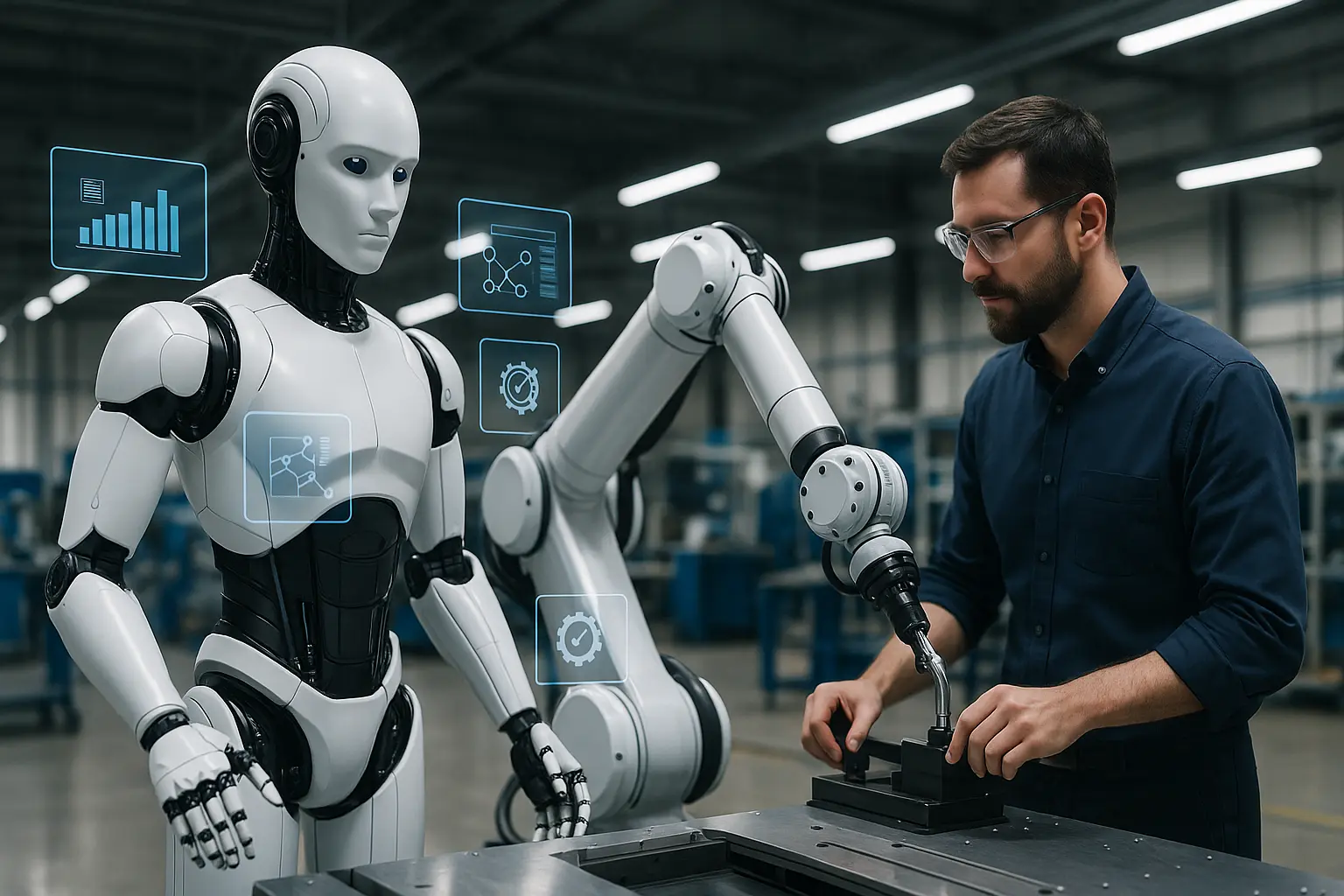
| Manufacturing | Modular robot arms collaborating with human operators | Flexible production, improved safety |
| Warehousing | Autonomous guided vehicles, embodied agents | Real-time routing & optimization |
| Service | Humanoid robots in retail & healthcare | Assistance, logistics, maintenance |
| R&D | Embodied learning inspired by human cognition | Better adaptability and generalization |
Physical AI represents a hybrid future — humans and intelligent machines working together.
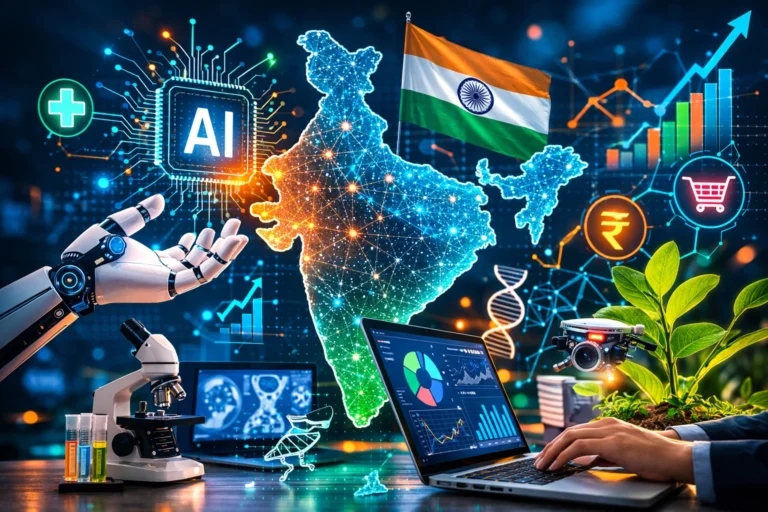
🇮🇳 The India Angle: Opportunity & Advantage
India has a strategic advantage in adopting and scaling Physical AI:
- Make in India & PLI Schemes: Strong foundation for manufacturing and robotics innovation.
- Labor force + AI augmentation: Physical AI can enhance productivity, not replace workers.
- Startup ecosystem: India’s robotics & AI startups can tap into global embodied AI markets.
- Infrastructure modernization: Smart buildings, logistics, and predictive maintenance can create new growth layers.
If India moves quickly on policy, R&D funding, and industry-academia collaboration, it can emerge as a major global player in embodied AI systems.
⚠️ Challenges and Risks
- Data scarcity: Real-world environments are messy — harder to model than digital spaces.
- Safety: Human-robot collaboration requires strict safety standards.
- Regulation: Ethical use, liability, and worker transitions need clear frameworks.
- High costs: Hardware + maintenance investments remain significant.
McKinsey & Company warns that while embodied AI can enhance productivity, full-scale autonomy is still years away.
🕒 What to Watch (2025–2030)
- Rapid scale-up of general-purpose robotic models.
- Expansion of embodied AI in India’s logistics and manufacturing sectors.
- Open-source robotics and simulation platforms.
- Policy evolution around robotics safety, taxation, and ethics.
- M&A activities in robotics and industrial AI.