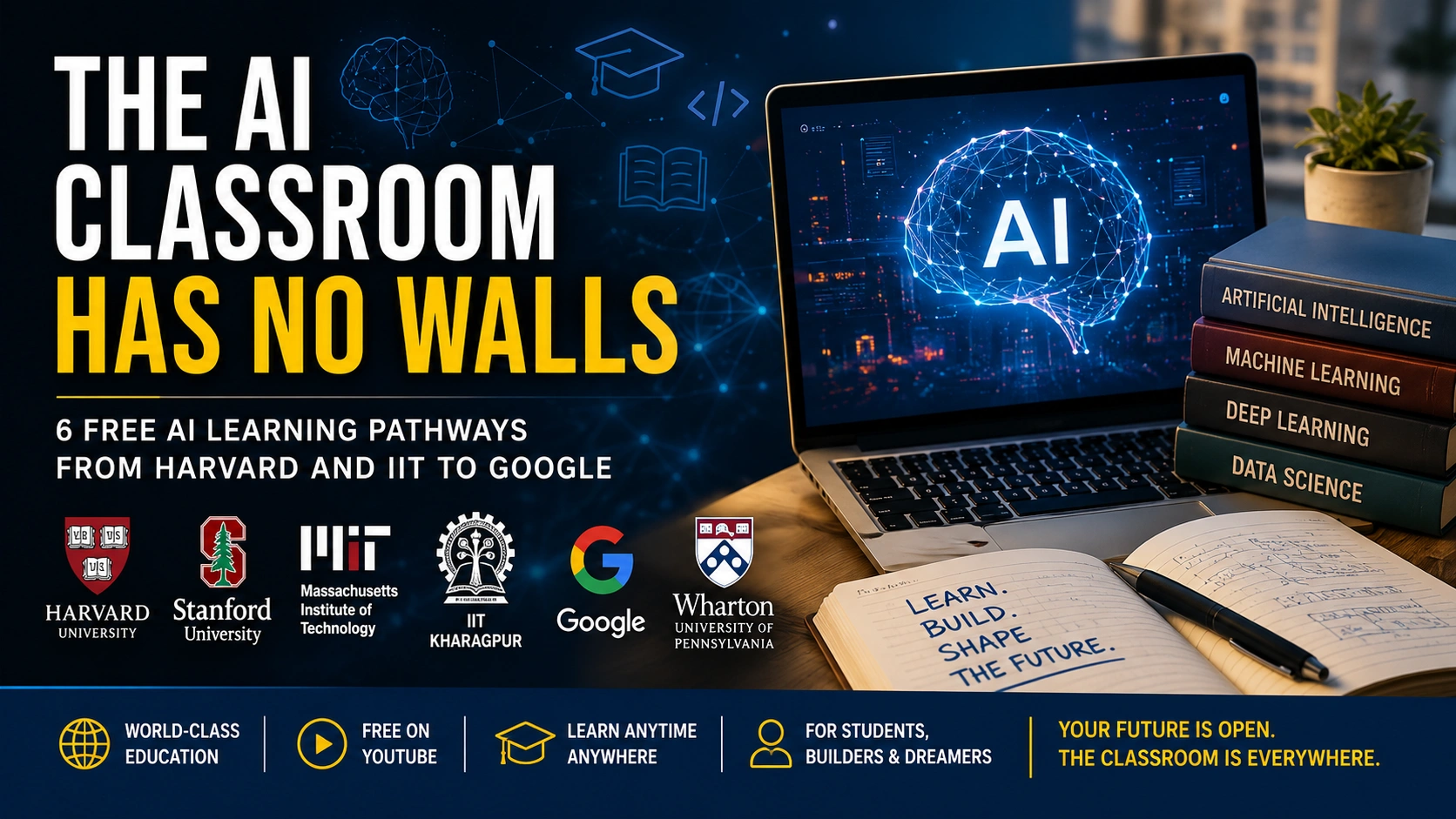
Mid-Week Brief I The Quantiq: The AI Classroom Has No Walls: 6 Free AI Learning Pathways From Harvard and IIT to Google
There was a time when studying Artificial Intelligence at a globally respected institution demanded more than curiosity.
It required admission letters, expensive tuition and often the privilege of living close to the right campus or belonging to the right ecosystem.
For millions of capable learners, those gates remained distant.
But a quiet revolution is underway.
Across the world, universities, research institutions and technology companies are opening their classrooms through YouTube and public learning platforms. Their lectures, technical frameworks and academic discussions are no longer reserved exclusively for enrolled students. Today, they are accessible to a school student in Guwahati, a founder in Bengaluru, a content creator in Shillong or a self-taught learner anywhere carrying curiosity and an internet connection.
This shift deserves greater attention than it receives.
Public conversations around AI often remain trapped inside product launches, flashy demonstrations and endless discussions around prompts and tools. While these conversations have value, they sometimes overlook a deeper truth.
Artificial Intelligence is not merely a collection of apps.
It is a discipline.
And genuine AI literacy begins not when we learn to use a tool, but when we begin to understand how intelligent systems reason, optimise, learn and make decisions.
For a future-ready India — and particularly for emerging regions seeking knowledge-driven transformation — this opening of elite classrooms may prove historic.
This week, The Quantiq moves beyond surface-level tutorials and explores six powerful AI learning pathways now freely accessible online.
Some emerge from Ivy League institutions. Others come from global research powerhouses, Indian academic excellence and industry ecosystems shaping the future of AI.
The common thread is simple.
High-signal learning. Zero tuition barriers.https://thequantiq.com/indias-younger-generation-is-redesigning-the-meaning-of-work-risk-and-ambition/
Harvard University — CS50’s Introduction to Artificial Intelligence with Python
If there is one course that bridges curiosity and technical confidence, it may be Harvard’s celebrated CS50 AI programme.
The CS50 ecosystem has earned global recognition for transforming intimidating computer science concepts into structured and approachable learning journeys. Its Artificial Intelligence course, taught by David Malan and Brian Yu, follows the same philosophy.
The course introduces learners to AI not as science fiction, but as engineering.
Students explore search algorithms, knowledge representation, machine learning, optimisation and natural language processing. Rather than depending entirely on ready-made AI tools, learners gradually build and experiment with intelligent systems themselves.
That distinction matters.
A growing number of AI users can generate outputs but struggle to understand the logic producing those results. Harvard’s approach reverses that dependency. Before learners become consumers of AI products, they are encouraged to understand the architecture underneath.
For aspiring developers, technically curious students and founders seeking structured entry into AI, Harvard’s offering remains one of the strongest gateways available today.
Official Course:
https://pll.harvard.edu/course/cs50s-introduction-artificial-intelligence-python
Lecture Access:
https://www.youtube.com/watch?v=5NgNicANyqM
Stanford University — CS221: Artificial Intelligence Principles and Techniques
If Harvard opens the door, Stanford invites learners deeper into the machinery of intelligent systems.
Stanford’s CS221 carries particular significance because it emerges from an ecosystem that has shaped generations of Silicon Valley innovation and AI research.
Led by Professor Percy Liang, the course explores the intellectual architecture of AI rather than focusing narrowly on temporary trends.
Students encounter machine learning, search and planning, probabilistic reasoning, logic-based systems, Markov Decision Processes and reinforcement learning.
The real strength of CS221 lies in how it trains learners to think.
Modern AI increasingly operates through interconnected systems rather than isolated tools. Recommendation engines, conversational systems and intelligent automation often involve multiple models interacting simultaneously.
Understanding such ecosystems requires more than prompt fluency.
It requires systems thinking.
Stanford’s framework cultivates exactly that mindset.
Official Stanford Playlist:
https://www.youtube.com/playlist?list=PLoROMvodv4rOca_Ovz1DvdtWuz8BfSWL2
MIT — 6.S191 Introduction to Deep Learning
Artificial Intelligence is broad.
Deep learning is where many of today’s breakthroughs are unfolding.
From computer vision and medical diagnostics to language models and image generation, neural architectures increasingly sit at the centre of contemporary AI.
MIT’s 6.S191 programme offers one of the clearest public windows into this frontier.
Directed by Alexander Amini and collaborators, the course explores neural networks, computer vision, sequence modelling and the attention mechanisms powering modern Transformer systems.
Unlike static curricula, MIT frequently refreshes its material to reflect rapid developments.
That makes the lectures unusually relevant.
The course does not promise shortcuts or overnight expertise.
Instead, it provides intellectual tools.
And in the AI era, intellectual tools may ultimately matter more than software subscriptions.
MIT Deep Learning Playlist:
https://www.youtube.com/playlist?list=PLtBw6njQRU-rwp5__7C0oIVt26ZgjG9NI
IIT Kharagpur — Artificial Intelligence Through NPTEL
AI learning is not the monopoly of Western academia.
India has quietly built one of the world’s most meaningful open-learning ecosystems through NPTEL and the IIT network.
Among these offerings, IIT Kharagpur’s Artificial Intelligence course deserves special attention.
Taught by Prof. Sudeshna Sarkar and Prof. Anupam Basu, the course covers intelligent agents, search strategies, reasoning systems, neural networks, learning frameworks and natural language processing.
The academic rigour is serious.
And that is precisely its strength.
At a time when AI conversations increasingly drift toward shortcuts and hacks, IIT Kharagpur reminds learners that durable innovation rests upon conceptual foundations.
For Indian students and self-taught builders, this carries symbolic importance too.
World-class AI education need not always be imported.
It can be taught, built and democratised from within India itself.
NPTEL Course:
https://nptel.ac.in/courses/106105077
YouTube Access:
https://www.youtube.com/watch?v=fV2k2ivttL0
Google — AI Essentials and Generative AI Learning
Universities build foundations.
Industry ecosystems often translate those foundations into practical capability.
This is where Google becomes especially relevant.
Google has significantly expanded its AI learning ecosystem, opening access to beginner and intermediate learning pathways around AI literacy and generative AI.
Its AI Essentials and Generative AI modules focus on practical understanding — responsible AI use, AI-assisted productivity, GenAI concepts and real-world application.
This makes Google particularly useful for professionals, creators and entrepreneurs who may not seek a full academic route but still want meaningful AI literacy.
The learning is accessible.
But it is not superficial.
For many newcomers, Google may provide one of the most approachable entry points into the AI world.
Google AI Essentials:
https://grow.google/ai-essentials/
Google AI Learning Hub:
https://ai.google/learn-ai-skills/
Wharton, University of Pennsylvania — AI, Business and the Future of Work
Artificial Intelligence is not only rewriting software.
It is beginning to reshape workplaces, productivity and the architecture of employment itself.
This is where Wharton becomes especially relevant.
Unlike technically intensive AI courses focused primarily on coding or machine learning, Wharton approaches AI through a wider strategic lens — business transformation, leadership, organisational adaptation and labour-market disruption.
Its public learning ecosystem increasingly explores some of the defining questions of our time.
How will AI reshape jobs?
What becomes of productivity in an automation-driven economy?
How should businesses adopt AI responsibly without widening inequality or social disruption?
These are not abstract debates.
They sit at the centre of boardrooms, startup ecosystems and policy conversations worldwide.
For entrepreneurs, policymakers and students seeking to understand AI beyond code, Wharton offers something distinctive — a bridge between technology and society.
The future will not be shaped only by engineers building AI systems.
It will also be shaped by those learning how to deploy, govern and humanise them.
Wharton AI Channel:
https://www.youtube.com/@WhartonAIAI
Wharton AI Research:
https://ai.wharton.upenn.edu/
Bonus Learning Ecosystems Worth Exploring
IIT Madras / SWAYAM / NPTEL
India’s AI learning landscape extends beyond a single institution. IIT Madras and the broader SWAYAM ecosystem continue expanding access to AI and machine-learning learning pathways for students and professionals.
Columbia Engineering AI Lectures and Playlists
For advanced learners seeking research exposure and graduate-level conversations, Columbia’s engineering ecosystem offers valuable AI lecture series and playlists.
https://www.youtube.com/c/columbiaseas/playlists
The Quantiq Editorial Reflection
The real democratization of Artificial Intelligence does not begin when people receive access to a chatbot.
It begins when they gain access to the blueprint behind the chatbot.
For too long, elite education remained a gated asset. Geography, privilege and income often determined who could participate in advanced technological learning.
That equation is changing.
The existence of these open classrooms should force us to rethink AI literacy itself.
If a student in Northeast India, a young entrepreneur in rural Assam or a self-taught learner anywhere in the world can learn directly from Harvard, Stanford, MIT or IIT classrooms, then the challenge before society is no longer access alone.
It is motivation, awareness and ecosystem support.
A quieter shift is also underway.
For decades, education revolved around marks, grades and certificates. Degrees will continue to matter, but the AI era is nudging society toward something more demonstrable — proof of capability.
Increasingly, recruiters, collaborators and even investors may become less interested in memorised achievement alone and more interested in evidence of experimentation, problem-solving and creation.
The future may not be a contest between credentials and skills.
It may become a partnership between learning and proof.
The question may gradually evolve from “What did you score?” to “What have you built?”
At The Quantiq, we believe AI literacy must become part of public infrastructure — not as a luxury skill for a few, but as a future-readiness movement empowering ordinary citizens to become builders, thinkers and informed participants in the intelligence economy.
The classroom now sits inside a pocket.
The question is whether we choose to enter it.https://thequantiq.com/ai-is-rewriting-the-startup-playbook-and-why-indias-next-wave-of-founders-may-choose-revenue-over-venture-capital/
2 Comments