
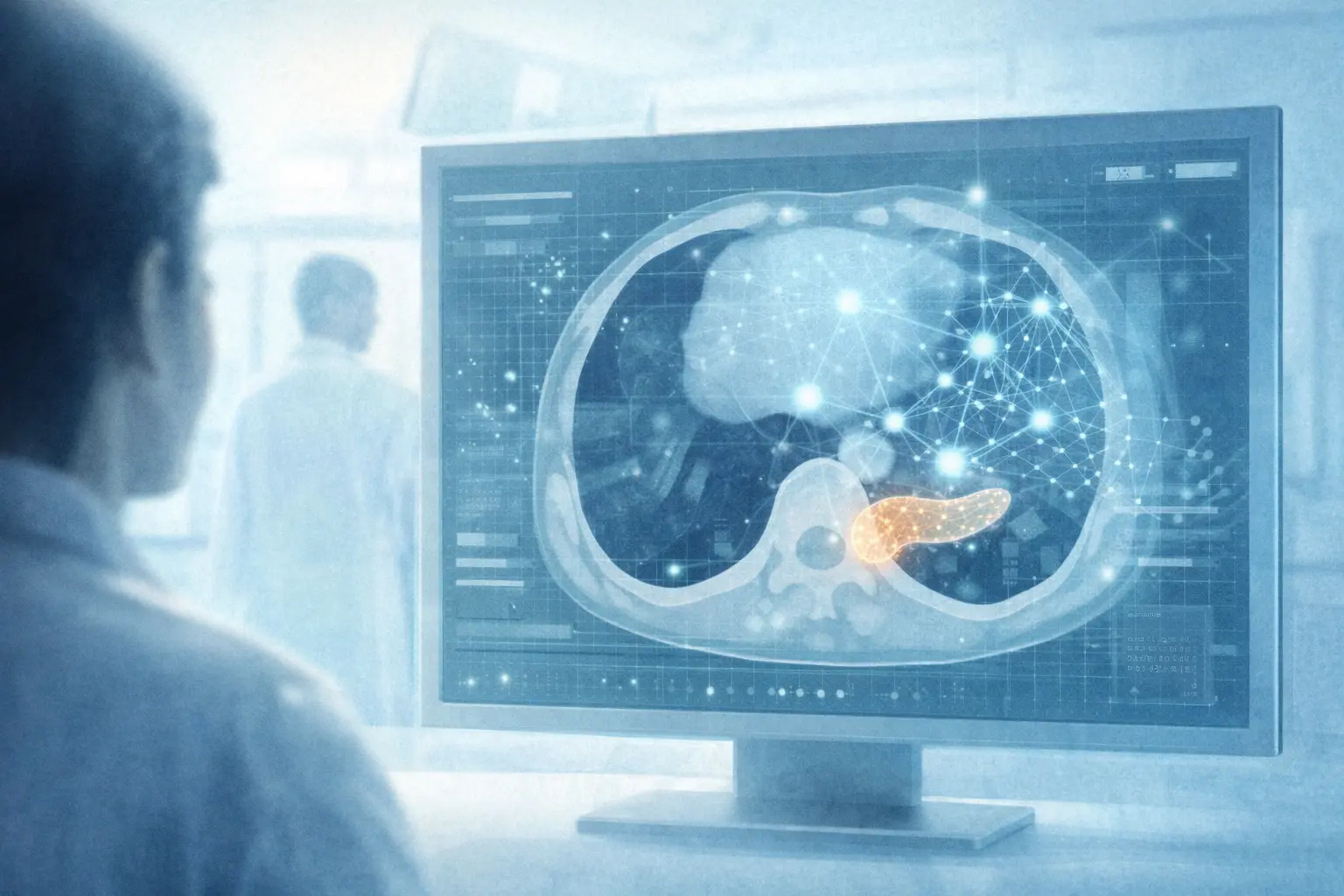
From Silence to Screening: How AI Is Transforming Early Pancreatic Cancer Detection
Pancreatic cancer has long carried one of the darkest reputations in oncology. Often called the “silent killer,” it rarely produces clear symptoms in its early stages, leaving most patients diagnosed only when the disease has already advanced. As a result, global five-year survival rates remain stubbornly low, hovering around 10%.
Now, a breakthrough from China suggests that this grim trajectory may finally be changing — not through a new drug or invasive test, but through artificial intelligence trained to see what human eyes often miss.
The Diagnostic Blind Spot in Routine Scans
In everyday medical practice, millions of people undergo non-contrast CT scans for common complaints such as abdominal pain, kidney stones, or digestive issues. These scans are fast, affordable, and low-radiation — but they are not designed to detect early pancreatic tumors.
Traditionally, oncologists rely on contrast-enhanced CT scans, which require injected dyes and are ordered only when cancer is already suspected. By the time those scans are performed, the opportunity for early surgical intervention is often lost.
This diagnostic gap — where early tumors exist but remain invisible — is where AI is now stepping in.
Meet PANDA: AI Trained to Detect the Invisible
Developed by Alibaba’s DAMO Academy in collaboration with more than ten medical institutions worldwide, PANDA (Pancreatic Cancer Detection with Artificial Intelligence) is a deep-learning model designed specifically to analyze routine, non-contrast CT scans.
Rather than searching for obvious tumors, PANDA learns to detect subtle structural and textural changes in pancreatic tissue — early pathological signals that are extremely difficult for even experienced radiologists to identify consistently.
Clinical Performance That Stands Out
According to peer-reviewed research published in Nature Medicine, PANDA’s performance is not incremental — it is substantial.
In large, multicenter validation studies, the AI system demonstrated:
- 92.9% sensitivity, accurately identifying patients who truly had pancreatic cancer
- 99.9% specificity, meaning an exceptionally low false-positive rate
- A 34.1% improvement in sensitivity compared with average radiologist performance during testing
These results suggest that PANDA is not replacing clinicians — but acting as a powerful second set of eyes, especially in high-volume screening environments.
Real-World Use: From Research to Clinics
Unlike many AI tools that remain confined to labs, PANDA has already crossed into real-world clinical use in China.
The system has been deployed across multiple hospitals, including the People’s Hospital affiliated with Ningbo University, and has analyzed hundreds of thousands of routine CT scans to date.
In one pilot involving approximately 20,000 patients scanned for non-cancer reasons, PANDA flagged 31 early pancreatic lesions that had initially gone unnoticed. For those patients, early detection potentially altered the entire course of treatment — and survival.
How the Technology Works
PANDA’s architecture combines multiple advanced AI techniques:
- Organ localisation – A segmentation model isolates the pancreas from surrounding abdominal structures
- Lesion detection – A convolutional neural network (CNN) scans for microscopic density variations
- Risk classification – A transformer-based model evaluates whether the detected anomaly is malignant, benign, or inflammatory
While transformers are best known from language models, their ability to process complex patterns makes them increasingly valuable in medical imaging.
Regulatory Milestone: FDA Breakthrough Device Status
In April 2025, PANDA received Breakthrough Device designation from the U.S. Food and Drug Administration (FDA) — a significant regulatory signal.
Importantly, this designation does not equal full approval. Instead, it accelerates clinical evaluation and regulatory review for technologies that address serious, unmet medical needs.
For PANDA, the designation underscores growing international confidence in AI-assisted early cancer detection — and opens the door for broader global trials.
The Road Ahead: Toward Preventive AI Medicine
DAMO Academy researchers are now working toward a broader vision: “One Scan, Multiple Checks.” The goal is to expand AI screening capabilities to detect other gastrointestinal cancers — including gastric, esophageal, and liver cancers — from a single routine CT scan.
While these extensions remain in research and pilot stages, they point toward a future where preventive medicine is algorithm-assisted, scalable, and embedded into everyday healthcare workflows.
Why This Matters Beyond China
The implications of PANDA extend far beyond a single country or company.
For health systems globally — especially in populous regions like Asia — AI-enabled early detection could:
- Reduce cancer mortality through earlier intervention
- Lower long-term treatment costs
- Make advanced screening accessible without expensive new infrastructure
As healthcare systems face rising costs and ageing populations, tools like PANDA hint at a future where early diagnosis becomes the default, not the exception.
The Quantiq View
PANDA’s success highlights a quiet but profound shift in medicine: from reactive treatment to predictive intelligence. When AI learns to detect disease before symptoms appear, the definition of healthcare itself begins to change.
As we move deeper into 2026, one thing is becoming clear — in the age of intelligent systems, no tumor should remain invisible.