
North-East on the Cusp: Can Nagaland, Assam and Sikkim Turn Policy Gains into Export Wins?
When NITI Aayog released the fourth edition of its Export Preparedness Index (EPI) 2024, the spotlight fell — once again — on India’s industrial heavyweights. Maharashtra, Tamil Nadu and Gujarat dominated the top rankings.
But buried deeper inside the data tables and state profiles lies a quieter yet more consequential story: India’s North-East is inching closer to export readiness — but only in pockets.
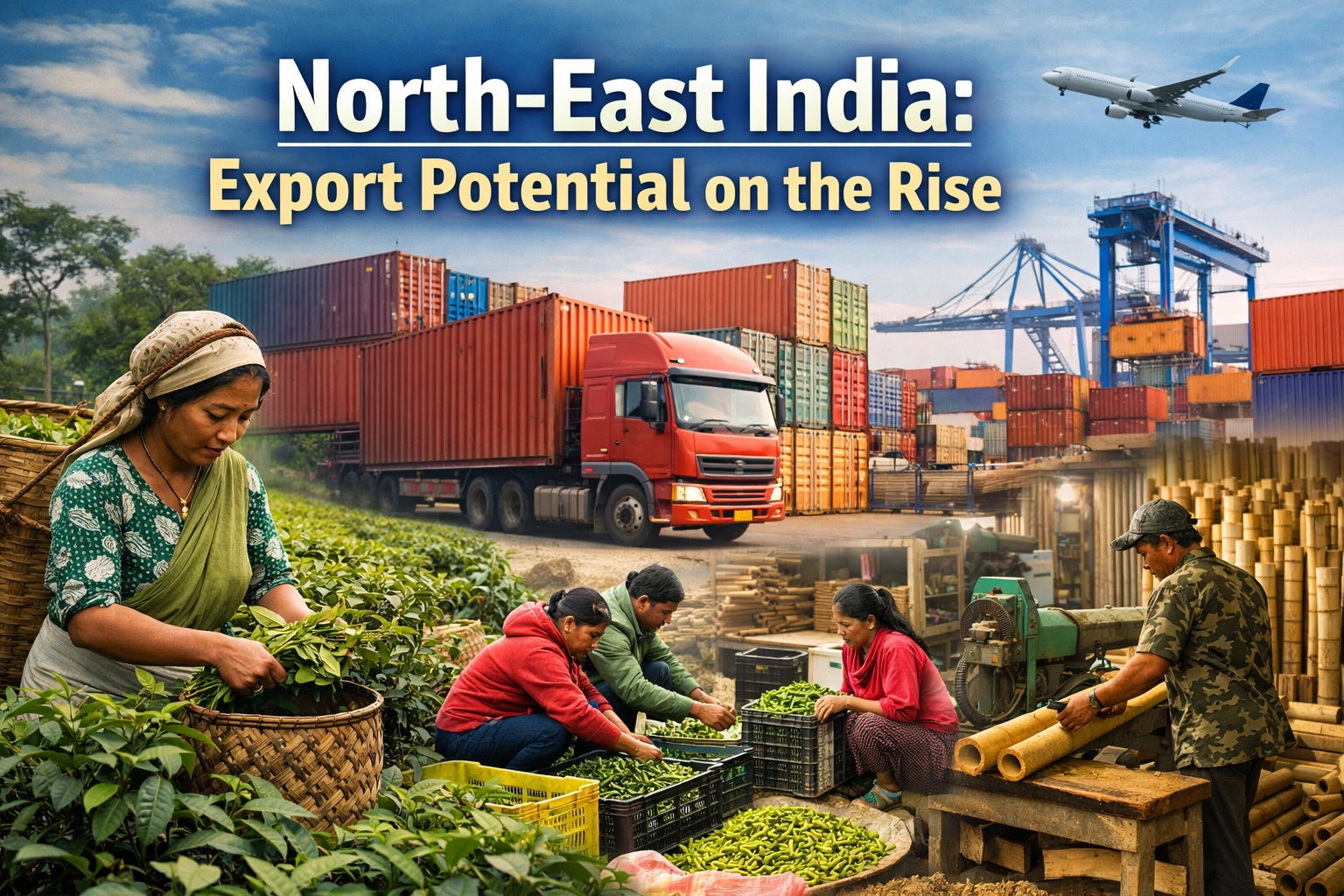
The EPI does not paint the North-East as a laggard region by default. Instead, it reveals a region with distinct exportable advantages — horticulture, bamboo, organic tea and cultural products — constrained not by intent, but by infrastructure, logistics, and scale. In this sense, the North-East represents India’s most underleveraged export frontier.
What the Export Preparedness Index Really Measures
The EPI evaluates states and Union Territories across four pillars:
- Policy Ecosystem – export promotion frameworks and governance
- Business Ecosystem – industrial depth, MSME readiness, innovation
- Export Ecosystem – trade facilitation, logistics, infrastructure
- Export Performance – actual export outcomes and diversification
North-Eastern states are assessed in the “smaller states / hill states” grouping — ensuring comparability while highlighting structural gaps.
North-East at a Glance: What the EPI Signals
The Good News
- Nagaland emerges as one of the stronger performers among North-Eastern and smaller states, signalling that focused policy intervention works.
- Sikkim shows relative strength in policy orientation and organic certification ecosystems.
- Assam retains a global legacy advantage through tea and agri-based exports.
The Hard Truth
- Logistics costs from the North-East remain 20–30% higher than national averages due to distance from ports and fragmented freight movement.
- Cold-chain penetration is insufficient for horticulture exports.
- Export finance penetration among MSMEs and cooperatives is extremely low.
Four Export Sectors Where the North-East Can Win
Horticulture & Processed Foods
The region’s agro-climatic diversity enables production of ginger, turmeric, oranges, pineapples, kiwis and niche spices. Global demand exists — especially in ASEAN and Middle Eastern markets.
Constraint:
Exports fail not at farms, but between harvest and port — due to missing pack-houses, cold storage and quality certification.
Bamboo & Engineered Bamboo Products
The North-East hosts some of India’s richest bamboo reserves. Beyond handicrafts, bamboo now feeds textiles, construction panels, furniture and carbon markets.
Constraint:
Lack of:
- industrial treatment units,
- export-grade drying facilities,
- design-to-market capabilities.
Organic Tea & Niche Plantations
Assam’s global tea brand is undeniable, while Sikkim and parts of Nagaland focus on organic and specialty teas.
Constraint:
Bulk exports dominate. Single-estate branding, traceability and specialty positioning — where margins lie — remain underdeveloped.
Handloom, Handicrafts & Cultural Exports
Global demand for authentic, sustainable, artisan-led products is rising.
Constraint:
Fragmented artisans, inconsistent quality, and poor digital export readiness.
Why Exports Stall: The Three Structural Bottlenecks
Connectivity & Logistics
Most exporters must route goods through Kolkata or distant ports. Lack of multimodal hubs and container aggregation inflates costs and delays shipments.
Cold Chain & Processing
Without integrated pack-houses, even premium horticulture loses export viability within days.
Export Finance & Compliance
Small exporters struggle with:
- export documentation,
- certification costs,
- access to working capital.
Case Snapshots from the EPI
Nagaland
Ranked among the better performers in the North-East category — showing that small states can compete with the right policy mix.
Assam
Strong business ecosystem due to tea and agri base, but weaker export infrastructure scores limit value realization.
Sikkim
High policy intent and organic credentials; constrained by geography and limited export scale.
The Quantiq View
The Export Preparedness Index 2024 makes one thing clear:
The North-East does not need more intent — it needs execution.
With focused logistics investment, cluster-based value addition and exporter-friendly finance, the region can deliver not just export numbers, but inclusive rural growth and sustainable trade leadership.




One Comment