
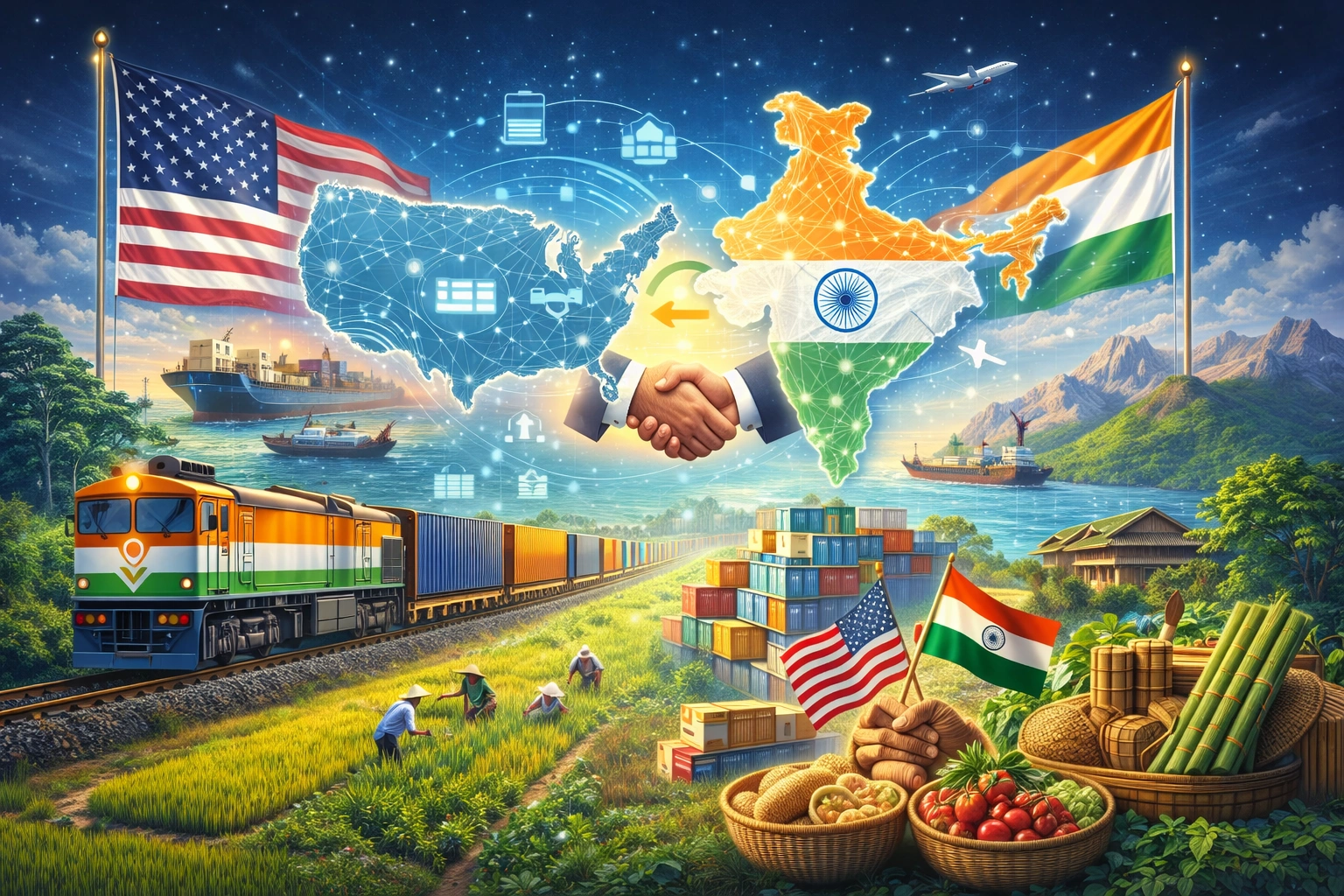
The US–India Trade Moment: Opportunity Knocks, But Will India — and the North East — Answer?
Why the next trade deal could reshape India’s global positioning, and what the North East must do before it’s too late.
A quiet but consequential churn is underway in global trade diplomacy. As the United States looks to de-risk its supply chains and India seeks deeper access to advanced markets, a renewed US–India trade understanding appears not just likely, but strategically inevitable. This is not about a single free trade agreement or a headline-grabbing announcement. It is about alignment — economic, technological and geopolitical.
For India, this moment carries both promise and peril. For the North East, it is either a historic opening or another missed bus.
Why the US Suddenly Needs India More Than Ever
The global trade order is fragmenting. The US is no longer chasing low-cost efficiency alone; it is prioritising resilience, trust and strategic alignment. China’s centrality to global manufacturing is being reassessed. Europe is inward-looking. Southeast Asia is saturated.
India, with its scale, democracy, and expanding digital and manufacturing base, fits the American requirement of a long-term partner — not a tactical substitute.
The conversations currently underway go far beyond tariffs. They include:
- Supply-chain diversification in electronics, pharmaceuticals and critical minerals
- Technology transfer and co-development in semiconductors, defence and clean energy
- Market access for agricultural products, medical devices and services
- Data governance, digital trade and IP protection
This is trade policy as strategic architecture, not transactional bargaining.
India’s Real Challenge: Execution, Not Intent
India’s intent is clear. Its execution record is mixed.
Past trade negotiations — whether with the EU, RCEP, or the UK — reveal a recurring problem: India enters talks with macro ambition but struggles with micro readiness. Domestic industry protection, regulatory unpredictability and logistics inefficiencies weaken negotiating credibility.
A US–India trade framework will reward countries that can deliver at speed, not just promise scale.
This is where internal India matters — and where the North East becomes strategically relevant.
Why the North East Suddenly Matters in Global Trade
For decades, India’s North East was treated as a security problem or a subsidy region. In a changing global trade map, it is something else entirely: India’s eastern gateway.
Geographically, the North East sits closer to Southeast Asia than to Delhi. Strategically, it lies at the intersection of India’s Act East policy and America’s Indo-Pacific vision. Economically, it offers under-utilised assets that align perfectly with emerging US trade priorities.
Where the Opportunities Lie
- Agro-processing and Organic Value Chains
The US market is aggressively shifting toward traceable, organic and ethically sourced food products. The North East already produces tea, spices, bamboo, medicinal plants, fruits and niche agri-commodities that fit this demand — but exports raw, not refined value. - Bamboo, Green Materials and Climate Trade
As the US tightens sustainability norms, bamboo-based products, carbon-linked agroforestry and green construction materials from the North East can become globally relevant — if scale, certification and branding are fixed. - Healthcare, Wellness and Natural Products
From herbal formulations to wellness tourism and medical textiles, the region has latent strengths aligned with American consumer trends. - Strategic Logistics and Trans-Asian Trade
With improved connectivity to Bangladesh, Myanmar and Southeast Asia, the North East can evolve from a landlocked region to a land-linked trade corridor.
The Brutal Truth: Opportunity Will Not Wait
Here is the uncomfortable reality: trade deals do not create capabilities; they reward prepared regions.
If the US–India trade framework is finalised in the coming months, American buyers will look for Indian partners who can meet compliance, consistency and scale immediately. They will not wait for state governments to draft vision documents or for entrepreneurs to “explore possibilities.”
Without urgent action, the benefits will once again concentrate in western and southern India.
Immediate Tasks Before Us — Especially for the North East
If the North East wants a seat at this trade table, three things must happen fast:
1. Build Export-Ready Clusters, Not Isolated Units
Single factories or farms will not attract US buyers. Clusters with shared certification, logistics, cold storage, and quality control will.
2. Align With US Compliance Standards Now
Food safety, sustainability audits, digital traceability and ESG reporting are not future concerns — they are entry tickets.
3. Create a Trade Narrative That Travels
The US market buys stories as much as products. The North East lacks a cohesive export narrative — one that connects sustainability, community livelihoods and strategic geography.
A Window That Will Not Stay Open
The US–India trade moment is not a ceremonial handshake. It is a test of India’s readiness to operate as a serious global economic partner.
For the North East, this is a once-in-a-generation chance to rewrite its economic destiny — from periphery to pivot.
But trade rewards speed, clarity and execution. Not sentiment.
If we wait for perfect policies or ideal conditions, the deal will be signed, supply chains will be locked, and the opportunity will pass — quietly, efficiently, and permanently.
History will not ask whether the North East had potential.
It will ask whether it was ready.https://thequantiq.com/the-india-eu-trade-deal-and-north-east-india-strategic-asset-or-strategic-blind-spot/



One Comment