The Death of the “Prime Time” Slot: India’s AdEx Enters the Algorithmic Era
India’s advertising industry has crossed a decisive inflection point. The numbers are still growing, but the power structure behind those numbers has fundamentally changed. What once revolved around a handful of prime-time television slots is now dictated by algorithms, data, and intent-driven media.
As India’s total Advertising Expenditure (AdEx) heads toward the ₹1.3 lakh crore mark, the headline figure masks a far more consequential shift: digital media is no longer a growth engine—it is the centre of gravity.
A Market That’s Growing, but Reordering Itself
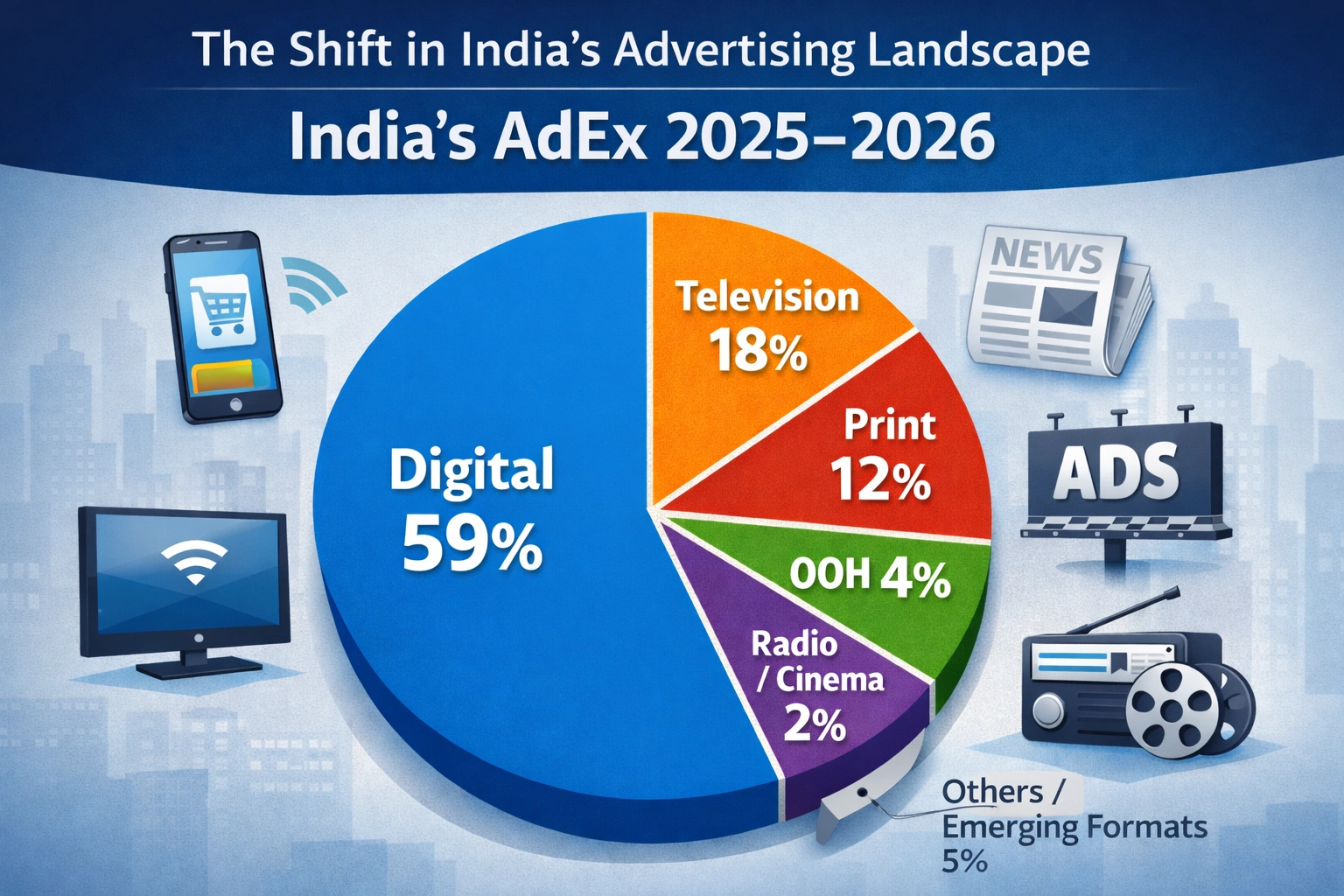
India’s advertising market continues to expand at a healthy pace, supported by consumption growth, platform proliferation, and deeper digital penetration. Industry estimates show that by the end of 2025, digital advertising had overtaken all traditional media combined, accounting for nearly 59% of total AdEx. Projections for 2026 indicate that this share will rise further, pushing digital toward an irreversible dominance.
But this is not merely a case of “digital versus traditional.” What is unfolding is a structural reallocation of advertising power, not a cyclical budget swing.
India’s Advertising Expenditure by Media (2025–2026 Share)
- Digital: 59%
- Television: 18%
- Print: 12%
- Out-of-Home (OOH): 4%
- Radio & Cinema: 2%
- Others / Emerging Formats: 5%
Percentages rounded; classifications aligned with Dentsu India media framework.
Together, these figures mark the end of television’s historical role as the unquestioned anchor of Indian media plans.
Digital Isn’t Winning on Reach—It’s Winning on Intent
Digital’s rise is often attributed to reach and cost efficiency. That explanation is incomplete.
The real driver is intent proximity. Digital platforms allow brands to influence consumers not just when they are watching or reading—but when they are searching, scrolling, comparing, and buying.
Within digital, two segments are reshaping how budgets are allocated:
Retail Media: Advertising at the Moment of Purchase
Retail media—ads placed within e-commerce and quick-commerce ecosystems—has emerged as one of the fastest-growing formats in India. By 2026, retail media is expected to command a significant share of digital budgets as brands move money from top-funnel awareness to transaction-adjacent visibility.
In practical terms, this means advertising dollars are migrating from storytelling to sell-through. If a brand is invisible at the digital shelf, it is increasingly invisible to the consumer.
Connected TV (CTV): The New Premium Screen
While linear television advertising is under pressure, Connected TV (CTV) is growing at a double-digit pace. Advertisers are no longer buying “channels”; they are buying households, enabled by programmatic targeting and audience data.
CTV combines the emotional impact of the large screen with digital precision, making it the preferred destination for premium video budgets. This shift is quietly dismantling the legacy concept of “prime time.”
Traditional Media: Still Relevant, but No Longer Central
Despite frequent obituaries, traditional media has not disappeared—but its role has changed.
- Television continues to deliver scale, particularly for large FMCG and political campaigns, but its share of total AdEx is structurally declining.
- Print remains resilient in India due to its strong regional and vernacular base. Government advertising and Tier-2/Tier-3 retail expansion continue to support print, even as English-language publications face pressure.
- Out-of-Home (OOH) has stabilised, with Digital OOH providing incremental growth in urban centres.
- Radio and Cinema remain niche, contributing marginally to overall spend.
The defining trend is not collapse, but loss of centrality
The Rise of “Others”: Signals of Fragmentation
A notable feature of India’s current media mix is the emergence of a 5% “Others / Emerging Formats” category. In line with the Dentsu India CMO Report’s classification framework, this bucket includes:
- Experiential and event-based marketing
- Brand activations
- Influencer-led and creator-driven campaigns
- Sponsorships and native integrations
- Hybrid and unclassified media formats
The existence of this category is itself instructive. It reflects a market fragmenting faster than reporting frameworks can neatly categorise—a hallmark of mature advertising ecosystems.
From Mass Reach to Attentive Reach
For decades, advertising success in India was defined by mass reach—how many eyeballs could be captured at a specific time. That metric is now obsolete.
The new currency is attentive reach:
- Who is watching?
- In what context?
- With what intent?
- And how close are they to action?
Social media and online video—together accounting for a substantial portion of digital spend—are driving this shift through creator-led commerce, short-form immersion, and algorithmic distribution.
In this environment, advertising is no longer episodic. It is continuous, adaptive, and always on.
Methodology & Classification Note
Media mix classifications in this analysis are aligned with industry reporting conventions used in the Dentsu India CMO Report. Digital includes search, social, online video, display, and programmatic formats. Television refers to linear broadcast advertising. Print includes national and regional newspapers. OOH includes static and digital formats. Radio and Cinema are grouped together. “Others / Emerging Formats” includes experiential marketing, influencer-led campaigns, sponsorships, brand activations, and unclassified hybrid media. Percentages are rounded.
The Quantiq Outlook
y 2027, digital is projected to command nearly 70% of every rupee spent on advertising in India. The era of the 30-second prime-time TV spot is giving way to an economy of algorithms, data, and measurable outcomes.
Prime time didn’t disappear overnight.
It was slowly outperformed—by relevance, precision, and intent.
And in India’s advertising future, attention doesn’t wait for a time slot anymore.https://thequantiq.com/sunday-brief-5-game-changing-ai-tools/