
India’s Banks Face Their First AI Shock — And This Time, It’s Not About Efficiency
On a quiet April morning, a subtle but powerful shift entered India’s financial conversation. The Finance Minister spoke of an “AI-born challenge.” Almost immediately, banks were urged to work together.
That choice of words matters.
For years, artificial intelligence has been seen as a tool for efficiency. It promised faster loans, smarter fraud detection, and smoother customer experiences. Banks competed to adopt it. Fintechs pushed it further. Regulators watched with cautious optimism.
Now, the narrative is changing.
The question is no longer how AI can help banks grow. Instead, it is about how AI might disrupt the system itself.
This is not just another phase of innovation. It is the beginning of a structural shift.
What is the “AI-born challenge” in Indian banking?
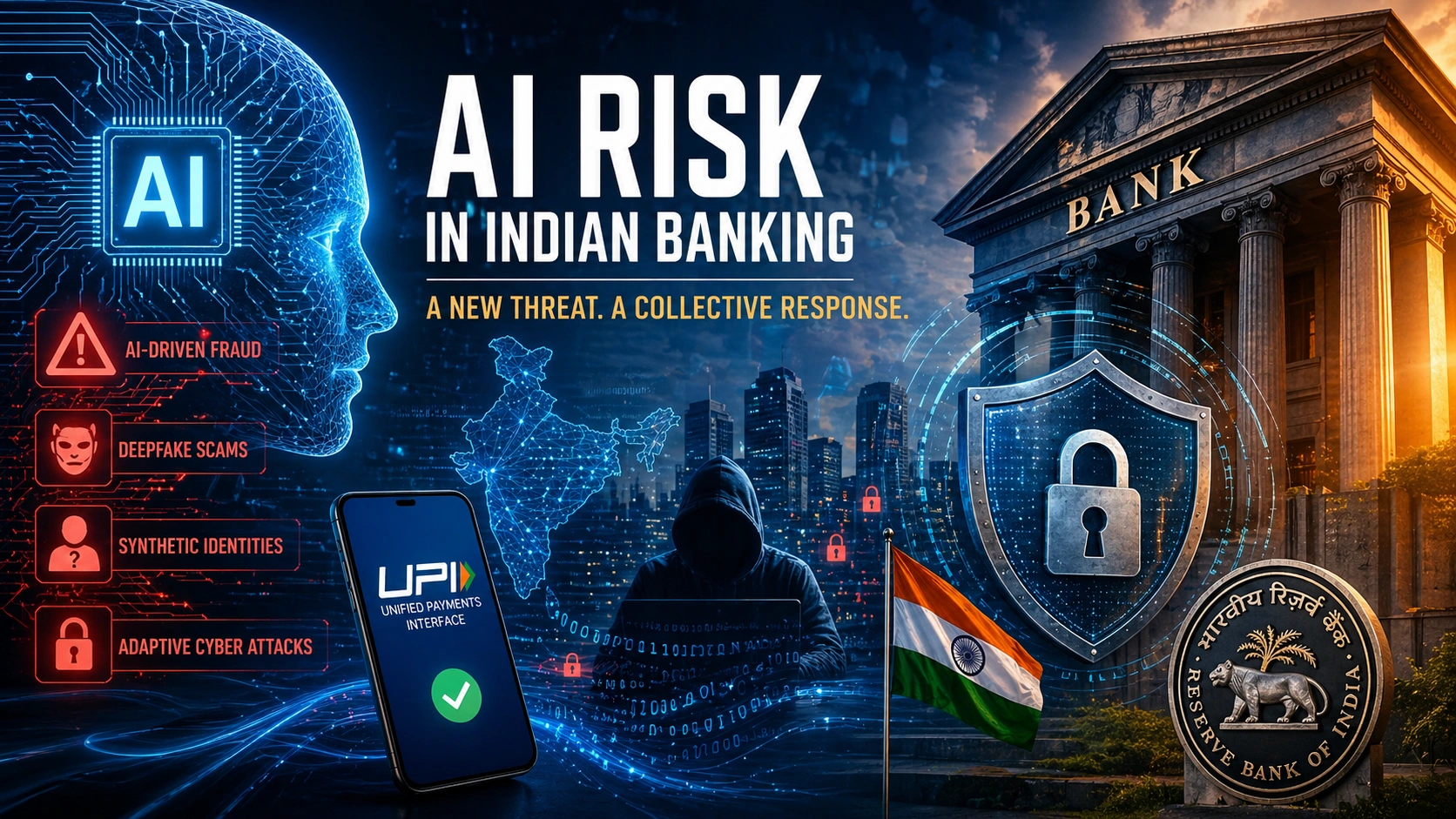
The “AI-born challenge” refers to emerging risks posed by artificial intelligence in the banking sector, including AI-driven fraud, deepfake attacks, synthetic identities, and adaptive cyber threats that can bypass traditional security systems.
When the tool becomes the threat
Every transformative technology eventually reaches a turning point. At first, it creates advantage. Later, it introduces risk.
AI is now crossing that line in finance.
The concern is not only about powerful models. It is about access. For the first time, individuals and small groups can use capabilities that were once limited to large institutions. They can operate at scale, move quickly, and often remain undetected.
As a result, new forms of risk are emerging.
Fraud is becoming more sophisticated. Synthetic identities can now be created with alarming accuracy. Voice cloning can mimic real customers. Cyberattacks are no longer static; they learn and adapt in real time.
Because of this, traditional safeguards are starting to weaken. Rule-based systems struggle to keep up. Even older AI models are proving insufficient.
In short, the threat is no longer predictable. It is generative.
India’s paradox: strength at scale, risk at scale
India’s financial system stands as a global benchmark. The rise of UPI, the integration of Aadhaar, and the growth of digital infrastructure have transformed access and efficiency.
Transactions that once took days now happen in seconds. Millions have entered the formal financial system.
However, scale brings complexity.
A system that handles billions of transactions must remain stable at all times. At the same time, its openness increases exposure. Interconnected systems create more entry points for risk.
When AI-driven threats enter such an ecosystem, the consequences can spread quickly.
A single coordinated attack may not remain isolated. It can move across institutions and affect user trust. In finance, perception matters as much as reality. Even a temporary loss of confidence can trigger wider effects.
This is why the call for banks to work together is so significant.
From competition to coordination
Indian banking has always been competitive. Public sector banks, private players, and fintech firms have all built their own strengths. Collaboration has usually been limited.
Now, that is beginning to change.
When risks become systemic, competition alone is not enough. No single institution can fully defend against AI-driven threats that operate across networks.
Therefore, coordination becomes necessary.
We may be seeing the early stages of a shared security approach. This could include common threat intelligence, coordinated responses, and stronger regulatory alignment.
If this trend continues, it could reshape the sector. Resilience may become just as important as growth.
The global undercurrent
India is not facing this challenge alone.
Across the world, financial systems are beginning to reassess AI risks. In the United States and Europe, regulators are studying issues such as model risk, algorithmic bias, and AI-driven manipulation.
At the same time, large AI companies are gaining influence. Their technologies cut across industries, including finance. This creates new dependencies that fall outside traditional regulatory structures.
As a result, financial stability is becoming linked to broader technological ecosystems.
India must respond within this global context. It needs to protect its systems while adapting to rapidly evolving external forces.
The opportunity beneath the anxiety
While the risks are real, they also open new doors.
As threats grow, so does the need for solutions. Demand for advanced cybersecurity, AI auditing, and real-time risk intelligence is likely to rise sharply.
Financial institutions will need systems that can anticipate threats, not just react to them.
This creates space for innovation.
India’s strong base in technology and AI talent offers an advantage. Startups can build solutions designed for large-scale, high-speed financial environments.
There is also a strategic angle. As countries begin to view AI as critical infrastructure, domestic capabilities will become more important.
In this sense, the challenge is also an opportunity. It is a chance to lead.
A moment of inflection
Some turning points arrive quietly. They do not create immediate disruption. Instead, they signal deeper change.
This is one such moment.
The first phase of AI in banking focused on adoption. The next phase required adaptation. Now, a new phase is emerging—one defined by resilience.
How India responds will shape its financial future.
For now, one thing is clear. When banks begin to close ranks, it is rarely without reason.
The rules are changing.
And this time, the challenger is not another institution.
It is the technology itself.https://thequantiq.com/india-growth-moderation-rbi-west-asia-impact/
Frequently Aasked Questions:
1. Why are Indian banks concerned about AI risks?
Indian banks are concerned because AI enables advanced fraud techniques, automated cyberattacks, and identity manipulation at scale, making traditional security systems less effective.
2. What role is RBI playing in AI-related banking risks?
The Reserve Bank of India is actively engaging with banks to assess risks, strengthen cybersecurity frameworks, and encourage coordinated responses to AI-driven threats.
3. How can AI impact India’s digital payment ecosystem?
AI can exploit vulnerabilities in high-volume systems like UPI through automated fraud and coordinated attacks, potentially affecting trust and financial stability.
4. Is AI more of an opportunity or a risk for banks?
AI is both—while it enhances efficiency and customer experience, it also introduces new systemic risks that require advanced safeguards and regulatory oversight.




One Comment