India’s Growth Story Hits a Subtle Speed Breaker—RBI Signals Early Shift
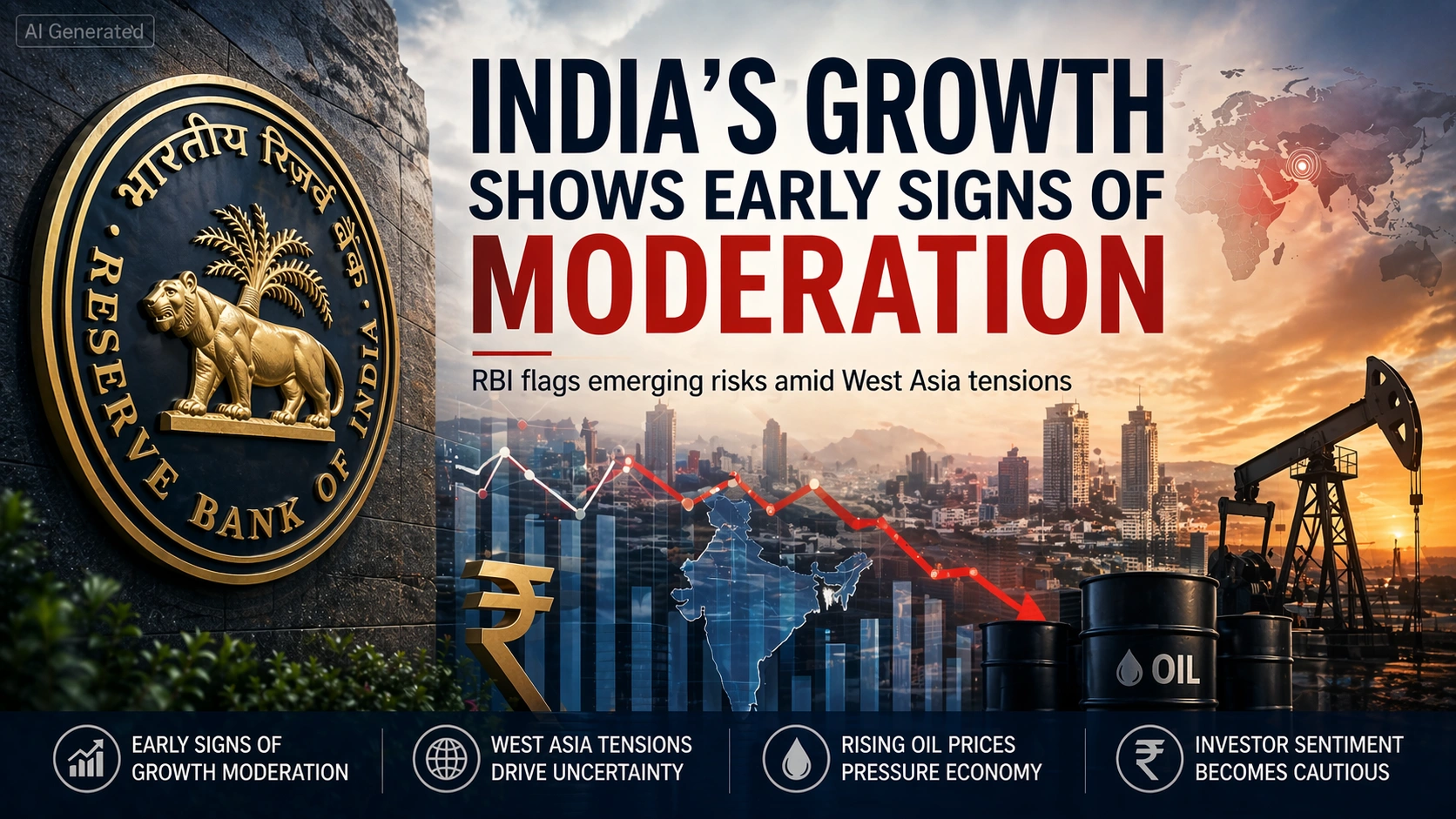
India’s growth story, for all its resilience over the past few years, is beginning to show the first faint signs of strain. Not a slowdown that alarms—yet—but a moderation that deserves attention. The latest monthly bulletin from the Reserve Bank of India (RBI) reads less like a warning siren and more like a subtle shift in tone: the economy is still expanding, but the pace may be losing a bit of its earlier sharpness.
A Global Shock Meets Domestic Momentum
At the heart of this emerging moderation lies a familiar external trigger—the evolving geopolitical tensions in West Asia. Historically, India has been particularly sensitive to disruptions in this region, given its heavy dependence on crude oil imports. Any sustained spike in oil prices feeds directly into inflation, widens the current account deficit, and subtly tightens the financial conditions that businesses operate in.
The RBI bulletin does not suggest an imminent downturn. In fact, it explicitly acknowledges that growth remains “broadly positive.” But beneath that reassurance lies a more nuanced observation: certain high-frequency indicators—often the earliest signals of economic direction—are beginning to show reduced momentum.
This is how slowdowns begin, not with dramatic collapses, but with a gradual easing of intensity.
Reading the Signals: What’s Slowing?
The early signs are scattered rather than systemic. Consumption patterns in select sectors appear less buoyant than before. Export momentum faces uncertainty due to global headwinds. Investment pipelines, while still active, are navigating a more cautious financing environment.
Yet, this is not 2020, nor even 2019. India’s macroeconomic fundamentals remain relatively strong—public capex continues, digital infrastructure is expanding, and formalisation of the economy is deepening.
The story, therefore, is not of reversal—but recalibration.
Markets Tell a Parallel Story
Interestingly, while macro indicators hint at moderation, financial markets are narrating a more layered story.
Banks and financial institutions, often the first to reflect shifts in economic sentiment, have reported results that underscore both resilience and emerging caution. Union Bank of India, for instance, has shown stable performance, suggesting that credit demand has not yet weakened significantly. However, the composition of that demand—and the risk appetite behind it—may be evolving.
Similarly, asset management companies like Aditya Birla Sun Life AMC are offering a window into investor psychology. Flows into mutual funds, especially equity-oriented schemes, remain active—but with increasing selectivity. Investors are no longer chasing broad market rallies indiscriminately; they are becoming more discerning, favouring sectors and themes that promise stability in an uncertain global environment.
This shift matters. Markets often adjust before the real economy does.
The Oil Factor: India’s Silent Vulnerability
No discussion of India’s growth trajectory is complete without acknowledging its energy dependence. West Asia tensions are not just geopolitical events; for India, they translate into tangible economic variables—fuel prices, logistics costs, inflation expectations, and ultimately, consumer sentiment.
A sustained rise in crude prices could force policymakers into difficult trade-offs. The RBI may need to remain cautious on interest rates longer than anticipated, even if growth softens. Fiscal pressures could also mount if fuel subsidies or tax adjustments are used to cushion consumers.
In this sense, the current moderation is as much imported as it is domestic.
Why This Isn’t a Crisis—Yet
It would be a mistake to interpret these signals as the beginning of a downturn. India’s economy today is structurally different from its past iterations. Corporate balance sheets are healthier, banks are better capitalised, and digital ecosystems are unlocking new efficiencies across sectors.
Moreover, government-led capital expenditure continues to act as a counter-cyclical buffer. Infrastructure projects, manufacturing incentives, and supply-chain diversification efforts are still driving medium-term growth.
What we are witnessing is not a collapse in demand, but a tempering of momentum.
The Real Question: Temporary Pause or Trend Shift?
The coming quarters will be critical in determining whether this moderation is transient or structural.
If geopolitical tensions ease and commodity prices stabilise, India could quickly regain its earlier growth tempo. On the other hand, if global uncertainties persist—whether from conflicts, financial tightening, or slowing major economies—the current moderation could deepen into a more sustained phase of slower growth.
For policymakers, the challenge will be to balance inflation control with growth support. For businesses, it will be about navigating uncertainty without losing long-term vision. And for investors, the game is already changing—from aggressive risk-taking to calibrated optimism.
The Quantiq Take
India’s economic narrative is evolving from one of post-pandemic rebound to one of strategic endurance. The easy gains have largely been made; what lies ahead will demand sharper policy calibration, smarter capital allocation, and a deeper understanding of global interlinkages.
The RBI’s bulletin doesn’t signal trouble—it signals transition.
And in transitions lie both risk and opportunity.https://thequantiq.com/indias-food-export-story-is-changing-and-northeast-india-may-be-its-biggest-winner/




One Comment