
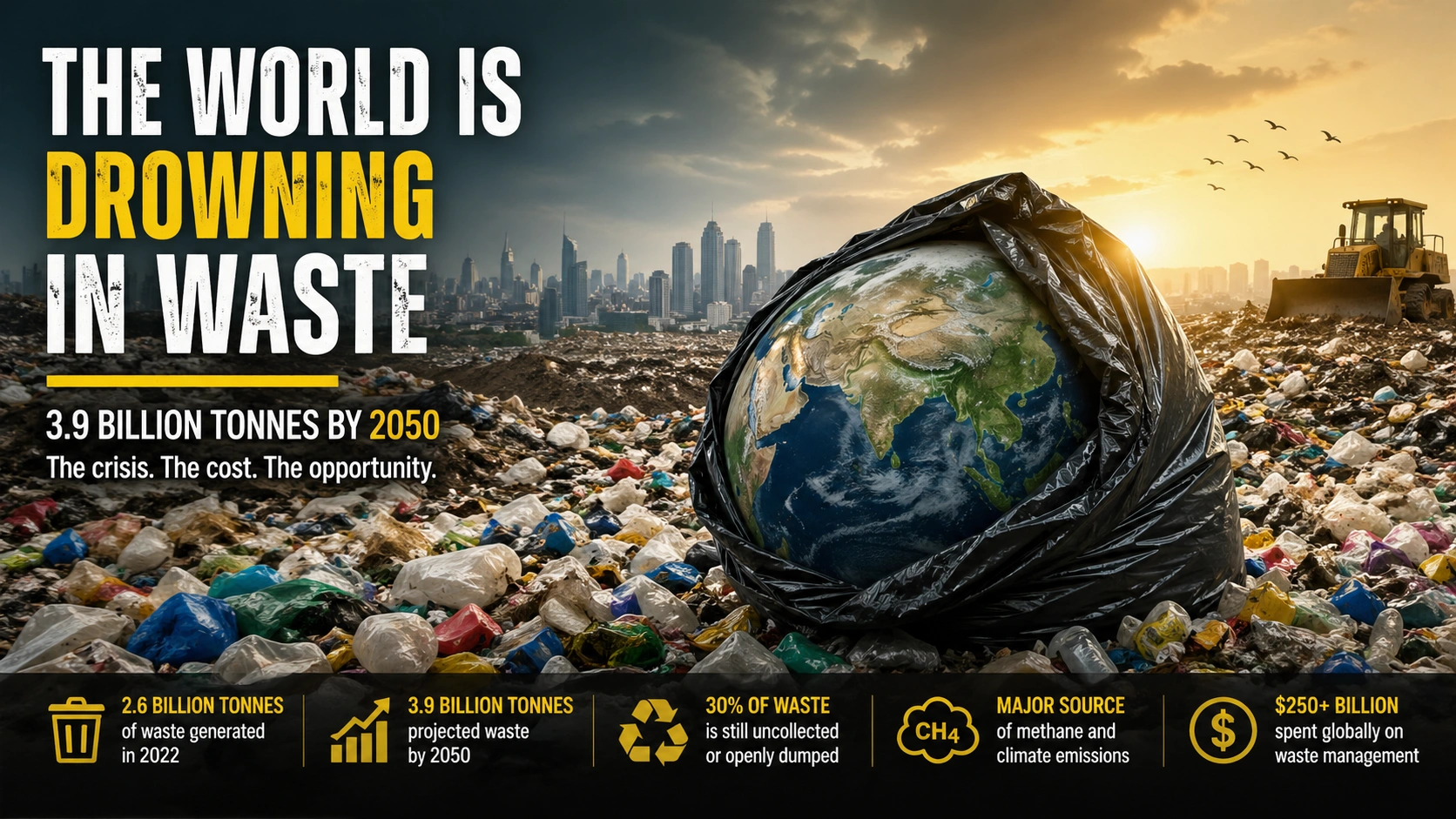
The World is Drowning in Waste: 3.9 Billion Tonnes by 2050
A Crisis We Chose Not to See
There are crises we notice immediately. And then there are those that build quietly around us. Waste belongs to the second kind. It sits at the edges of daily life—inside bins, along streets, beneath landfills—rarely demanding attention until it becomes overwhelming.
In 2022, the world generated about 2.6 billion tonnes of waste. That figure should have triggered urgency. It didn’t. Perhaps because numbers at this scale feel distant. Yet the trajectory is unmistakable. By 2050, global waste is projected to reach 3.9 billion tonnes. These estimates, drawn from the World Bank’s latest What a Waste 3.0 report, underline the scale of a crisis that has quietly accelerated over the past decade.
This is not just growth. It is accumulation without a plan.
The Illusion of “Away”
We believe waste disappears once it leaves our homes. It does not. There is no “away.” Waste simply moves—from households to streets, from streets to dumps, and from dumps to rivers and oceans.
What cannot be carried away settles into landfills. There, it decomposes, releasing methane into the atmosphere. Or it is burned in the open, filling the air with toxic smoke. The system is not designed to eliminate waste. It is designed to relocate it.
That illusion is beginning to break. The World Bank report points out that unmanaged waste continues to leak into ecosystems, turning a local issue into a global environmental threat.
A World Divided by Garbage
Waste tells a story of inequality.
High-income countries generate more waste, but they manage to collect and process most of it. Low-income countries generate less, yet struggle to collect even a fraction. The result is stark. Nearly 30 percent of global waste is either uncollected or openly dumped, according to the World Bank’s global dataset.
This is not just poor waste management. It is a structural imbalance. The ability to handle waste depends on infrastructure, governance, and economic strength. Where systems are weak, waste becomes visible. Where systems are strong, it is simply hidden.
Cities Under Strain
The crisis is unfolding fastest in cities.
Urban populations are rising. Consumption is increasing. Packaging waste is expanding at an unprecedented pace. Yet waste management systems are struggling to keep up.
Municipal budgets are stretched. Infrastructure is outdated. Planning is often reactive. The result is visible in everyday urban life—overflowing dumps, clogged drains, and polluted surroundings.
Waste is no longer a background issue. It is becoming a defining feature of how cities function, a trend also highlighted in the World Bank’s assessment of urban waste systems across 200+ countries.
The Climate Link We Ignore
Waste is not just a sanitation issue. It is a climate issue.
Organic waste releases methane, a greenhouse gas far more potent than carbon dioxide. Open burning releases black carbon, worsening both air quality and global warming. Despite this, waste remains underrepresented in climate discussions.
This gap in attention comes at a cost. The environmental impact of unmanaged waste continues to grow, quietly but steadily. The World Bank estimates that emissions from waste are already a significant contributor to global greenhouse gases.
The Economics of What We Throw Away
The financial dimension of the crisis is equally significant.
Managing global waste already costs over $250 billion annually, and the figure is rising. This estimate, again drawn from the World Bank’s analysis, reflects only the direct costs of managing waste—not the broader economic losses from inefficiency.
At the same time, valuable materials are lost every day—plastics, metals, organic matter—discarded instead of reused.
Waste is not just a by-product. It is misplaced value.
What we fail to recover becomes an economic loss. What we fail to manage becomes a fiscal burden.
Crisis, or Opportunity?
It is easy to focus only on the problem. But waste also presents a turning point.
With the right systems, waste can become a resource. It can be recycled, converted into energy, or reintegrated into production cycles. It can create jobs and open new industries. The World Bank report itself frames waste management not just as a cost, but as an opportunity for economic growth and employment.
The same system that is failing today holds the potential to drive future economic growth.
The difference lies in how we choose to respond.
The Road to 2050
The direction is already clear. Waste volumes will rise. Pressure on cities will increase. Costs will escalate.
The real question is not whether waste will grow. It will.
The question is whether systems will evolve fast enough to manage it.
Because by 2050, the issue will no longer be how much waste we produce. It will be whether we built the capacity to handle it.
And that decision is being made now.https://thequantiq.com/the-2-kg-race-can-india-become-the-global-green-hydrogen-price-maker/

One Comment