
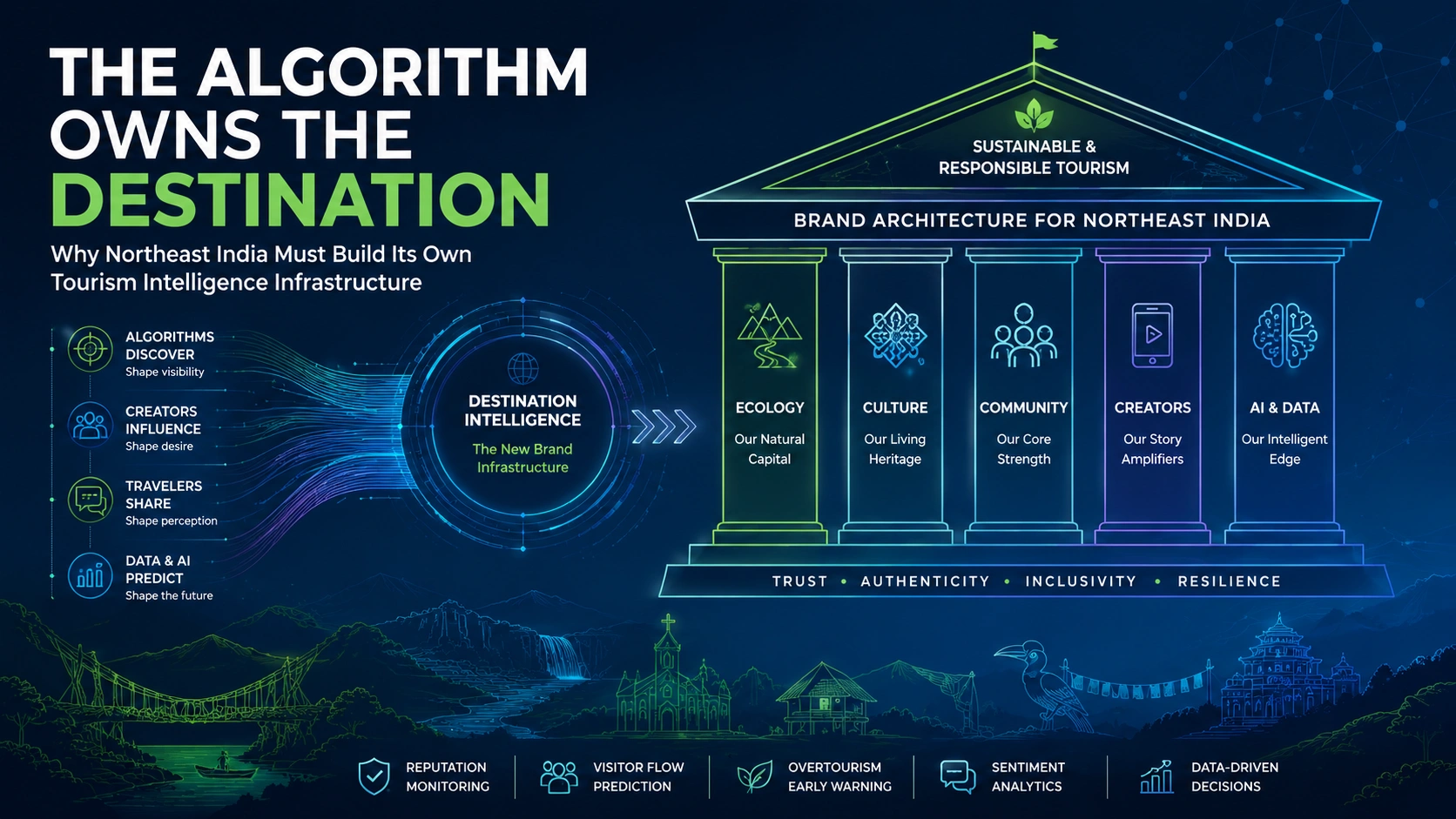
The Algorithm Owns the Destination: Why Northeast India Must Build Its Own Tourism Intelligence Infrastructure Before Global Platforms Define Its Identity
Nobody planned this transformation.
No tourism department approved the campaign. No advertising agency designed the strategy. No celebrity signed an endorsement deal. No government office allocated a marketing budget.
Yet something extraordinary happened.
A young traveler from Bengaluru visited the crystal-clear waters of the Umngot River in Meghalaya. He took out his smartphone and recorded a simple thirty-second video. The footage showed a wooden boat appearing to float magically over transparent water. He added trending music and uploaded the reel to Instagram.
The results were immediate.
Within days, millions watched the video.
Within weeks, travel searches for Dawki increased sharply across India.
Within months, the destination began receiving far more visitors than its fragile ecosystem could comfortably handle. Some disappointed tourists soon started calling the place overcrowded and overrated.
In a remarkably short period, Northeast India’s tourism brand had been rewritten.
No institution controlled this process.
No government designed this outcome.
This single episode reveals something far bigger than the success of one viral travel reel.
It shows that destination branding itself has changed permanently.
For decades, tourism marketing depended on carefully designed advertising campaigns. Today, that old system is rapidly losing relevance.
Algorithms now shape discovery.
Smartphones influence perception.
Creators determine visibility.
Ordinary travelers publish experiences in real time, often reaching audiences larger than official tourism campaigns.
For a region as asset-rich as Northeast India, this transformation creates both extraordinary opportunity and serious risk.
The uncomfortable truth is becoming impossible to ignore.
One of India’s most valuable tourism brands may now be Northeast India itself.
Yet nobody is actively managing it.
The Collapse of the Old Tourism Branding Model
For decades, destination marketing followed a predictable formula.
Governments identified their strongest tourism assets. Advertising agencies designed campaigns. Celebrities were hired as ambassadors. Television, newspapers, billboards, and travel magazines pushed a carefully curated narrative.
The audience consumed passively.
The destination controlled the story.
India offers famous examples.
Gujarat Tourism built enormous recall through its “Khushboo Gujarat Ki” campaign fronted by Amitabh Bachchan.
Kerala Tourism built the globally recognized “God’s Own Country” identity through decades of consistent storytelling.
The system worked because attention itself was scarce.
Today, attention is infinite.
And nobody controls it.
Social media has not merely improved tourism marketing.
It has structurally bypassed it.
Northeast India Never Had a Legacy Brand Infrastructure
Unlike mature tourism markets such as Kerala, Goa or Rajasthan, Northeast India never developed a sustained and region-wide destination branding architecture that achieved national recall over decades.
There were important exceptions.
Assam notably experimented with large-scale destination marketing through the “Awesome Assam” campaign, appointing Priyanka Chopra as brand ambassador in a globally promoted effort to reposition the state within India’s tourism map.
The campaign was ambitious and represented one of the Northeast’s strongest attempts at celebrity-led destination branding.
But unlike Kerala’s multi-decade institutional consistency or Gujarat’s deeply sustained national tourism identity, these efforts remained fragmented and state-specific rather than evolving into a coherent, long-term regional tourism architecture for Northeast India as a whole.
As a result, when the smartphone and social media era arrived, much of Northeast India entered the age of digital discovery without a mature legacy brand foundation.
The old system did not collapse here.
In many parts of the region, it never fully matured in the first place.
User Generated Content Has Become Tourism Infrastructure
The biggest misunderstanding policymakers make is believing user-generated content is simply a new form of advertising.
It is not.
User-generated content has become infrastructure.
Research from Nielsen and CrowdRiff consistently shows that over 90 percent of consumers now trust peer-generated content more than traditional advertising.
When travelers decide where to go, they no longer begin with official tourism websites.
They begin with:
Instagram reels.
YouTube travel vlogs.
Google reviews.
TripAdvisor comments.
Travel communities.
The destination is no longer defined by what governments say.
It is defined by what visitors experience and publish.
In effect, every tourist now functions as an unpaid publisher.
Meghalaya’s Success Story Also Reveals a Dangerous Pattern
Meghalaya welcomed over 1.6 million tourists in 2024.
Much of this growth came not through institutional campaigns but through social media visibility.
Dawki became a national sensation because its extraordinary visual beauty translated perfectly onto smartphone screens.
But the same success revealed a dangerous truth.
The first wave of viral videos showed empty waters, pristine scenery and magical floating boats.
The second wave of visitors encountered overcrowding, commercialization and expectation mismatch.
Soon, disappointed travelers began posting negative reviews.
The same user-generated content ecosystem that built the brand started damaging it.
No tourism department could control that reversal.
Because in the smartphone era, reputation compounds in real time.
The Creator Economy Has Become Tourism Infrastructure
Something revolutionary is quietly happening.
Tourism infrastructure no longer means airports, roads and hotels alone.
The creator economy itself has become infrastructure.
A Khasi college student documenting hidden waterfalls.
A young Assamese drone filmmaker showcasing river islands.
A Mizo travel creator introducing village experiences.
A Naga food blogger recording indigenous culinary traditions.
A Monpa storyteller documenting Himalayan monasteries.
Together, these individuals collectively influence tourism flows more effectively than many government campaigns.
This changes everything.
The region’s most powerful tourism marketers are no longer institutions.
They are ordinary local creators.
And most of them are unpaid.
The AI Layer Nobody Is Discussing
This is where the next battle will be fought.
Tourism is rapidly becoming an intelligence-driven industry.
The destinations that win globally in the next decade will not necessarily be the most beautiful destinations.
They will be destinations capable of using artificial intelligence to manage attention itself.
Imagine Northeast India deploying:
AI-powered sentiment monitoring that detects negative reviews early.
Predictive crowd management systems that anticipate overtourism.
Machine learning systems identifying emerging travel trends before destinations go viral.
Multilingual AI travel assistants helping foreign visitors navigate remote regions.
AI reputation engines continuously monitoring how destinations are discussed globally.
Digital twins allowing visitors to preview destinations virtually before arrival.
The future of tourism will not be managed by brochures.
It will be managed by intelligent systems.
And Northeast India has barely begun preparing.
The Digital Colonialism Nobody Is Talking About
This may be the most uncomfortable question of all.
Every viral reel recorded in Northeast India creates economic value.
But who captures that value?
When someone films indigenous festivals in Nagaland, sacred monasteries in Arunachal, tribal traditions in Mizoram or Bihu celebrations in Assam, that content generates advertising revenue.
But the economic benefit rarely flows back to local communities.
Instead, the value is captured by global platforms like:
This creates a new form of digital extraction.
The region’s ecological beauty and cultural heritage generate enormous digital economic value.
Yet communities that preserve those assets often receive very little.
This is not merely a tourism question.
It is a question of economic sovereignty.
Dzükou Valley Offers a Warning for the Entire Region
The wildfire incident in Dzükou Valley in late 2025 was not simply an environmental accident.
It was a warning.
Social media visibility accelerated tourist footfall.
Tourists unfamiliar with ecological sensitivities created unintended damage.
The local community organization managing the valley was forced to intervene through stricter visitor regulations.
The lesson is profound.
Virality without governance creates fragility.
When destination management fails, negative user-generated content spreads faster than positive content.
And fragile ecosystems pay the price.
Learning From Bhutan, New Zealand and Japan
The world already offers important lessons.
Bhutan deliberately adopted high-value low-volume tourism.
It protects cultural integrity over visitor numbers.
New Zealand built community-driven tourism models where indigenous Māori identity remains central to destination branding.
Japan perfected hyper-local tourism storytelling, allowing small communities to become globally recognized micro-destinations.
Northeast India must study these examples carefully.
Because mass tourism alone cannot become the strategy.
The region’s greatest strength is authenticity.
And authenticity is fragile.https://www.mfa.gov.bt/tourism/
Northeast India Needs Destination Intelligence Infrastructure
This is the missing infrastructure nobody is building.
The real challenge is no longer promotion.
It is intelligence.
The region urgently needs:
Continuous real-time destination sentiment monitoring.
AI systems tracking how destinations are discussed globally.
Creator databases mapping influential local storytellers.
Community-led tourism governance models.
Early warning systems for overtourism risk.
Cultural protection frameworks preventing exploitation.
Local content creator development programs.
AI-powered tourism intelligence dashboards for every Northeast state.
The future belongs not to destinations attracting the highest footfall.
The future belongs to destinations managing reputation intelligently.https://thequantiq.com/the-72-hour-rule-northeast-india-tourism/
Tourism Is No Longer Hospitality. It Is a Digital Asset Economy.
This is the biggest mental shift policymakers must understand.
Tourism is no longer simply hotels, guides and transportation.
In the digital era, tourism is an asset economy built around four monetizable strategic assets:
Ecology.
Culture.
Authenticity.
Attention.
And the winner will be the destination capable of governing attention itself.
The Historic Choice Before Northeast India
Northeast India possesses one of the richest collections of tourism assets anywhere in Asia.
Ancient cultures.
Untouched biodiversity.
Living indigenous traditions.
Spectacular landscapes.
Authentic communities.
But beauty alone is no longer enough.
The destinations that win in the algorithm era will not necessarily be the most beautiful places.
They will be places that build intelligent systems capable of managing visibility, reputation and digital value creation.
Northeast India now faces a historic choice.
Remain a passive subject of algorithm-driven discovery.
Or build its own sovereign destination intelligence architecture before global platforms permanently define its identity.
The region does not need a Bollywood ambassador.
It needs intelligence infrastructure.
The algorithm already owns the destination.
The question is whether Northeast India will learn to own the intelligence behind it.https://thequantiq.com/northeast-india-single-tourism-destination/
The Quantiq Assessment
Northeast India’s tourism brand may be the most valuable unmanaged digital asset in Indian tourism.
Social media did not create this brand.
It merely revealed it.
The future of tourism in Northeast India will not be determined by advertising budgets.
It will be determined by how intelligently the region learns to govern attention itself.
The age of destination marketing is ending.
The age of destination intelligence has begun.
And Northeast India cannot afford to arrive late.
This is no longer a tourism conversation.
It is a civilizational conversation.https://thequantiq.com/inlamobi-blue-valley-cluster-northeast-entrepreneurs/

One Comment