
The GCC Wave Has Reached Tier-2 India. Why Is the Northeast Still Waiting?
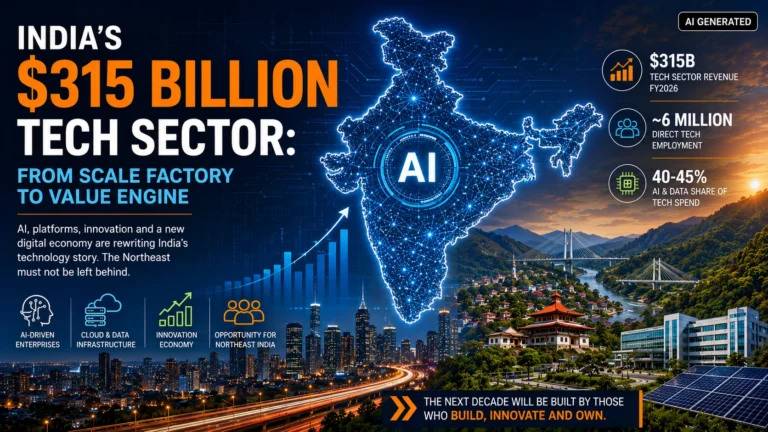
India’s Global Capability Centre economy is approaching $100 billion. As the next wave moves beyond the metros, the Northeast has many of the ingredients needed to participate. What it lacks is a policy and talent strategy built for the GCC economy of 2026.
There was a time when a Global Capability Centre, or GCC, was little more than a sophisticated name for a back office.
That era is over.
India now has 2,117 GCCs operating across 3,728 units, employing about 2.36 million professionals and generating $98.4 billion in revenue, according to the 2026 Nasscom-Zinnov GCC Landscape report. The number of GCCs has grown by 32% since FY21.
More importantly, the nature of these centres has changed.https://zinnov.com/centers-of-excellence/zinnov-nasscom-india-gcc-landscape-2026-report/
Today’s GCC is increasingly involved in artificial intelligence, product engineering, cybersecurity, analytics, research and development, digital transformation and global business operations. Nearly half of the GCCs established since FY2021 were reportedly launched with AI as a core focus, while 96% of those established after FY2021 began with product or portfolio mandates rather than waiting years to move up the value chain.
India’s GCC story is therefore no longer simply about cost.
It is about capability, talent and ownership.
And that brings us to a question that deserves much more attention in the Northeast.
If India’s GCC economy is now moving beyond the traditional metros, why is the Northeast still waiting at the gate?
The GCC centre is moving
For years, Bengaluru, Hyderabad, Pune, Chennai, Mumbai and Delhi NCR dominated India’s GCC landscape. The reasons were obvious. These cities offered deep talent pools, established technology ecosystems, international connectivity and mature commercial infrastructure.
But the economics are changing.
JLL estimates that India’s GCC market could grow to around $105 billion and more than 2,500 centres by 2030. Its latest analysis also points to Tier-II cities offering significant cost advantages, with savings of 25% to 50% possible across real estate, talent and operating costs compared with Tier-I locations.
This is not just a future projection.
JLL’s 2026 India GCC Guide notes that Tier-II cities are already emerging as attractive alternatives to the established hubs. Ahmedabad, Kolkata, Jaipur, Coimbatore, Mysuru and Kochi are increasingly benefiting from lower costs, improving infrastructure, state incentives and access to new talent pools.https://www.jll.com/en-in/insights/beyond-metros-the-tier-two-emergence
The shift is significant because companies are discovering something that should matter enormously to the Northeast.
A new GCC location does not need to become another Bengaluru.
It needs to become good enough at something that matters.
That is how the next generation of Indian GCC clusters will emerge.
The Northeast has the ingredients
The Northeast is not starting from zero.
Guwahati already has an emerging technology ecosystem. Assam has IIT Guwahati, NIT Silchar and a sizeable network of engineering and educational institutions. The region has a young population, English-language capability and operating costs that can be attractive compared with India’s major technology centres.
Guwahati also offers something that many Tier-II cities cannot easily replicate: it is the natural business gateway to the Northeast and has growing connectivity with the rest of India and neighbouring markets.
Yet these ingredients have not translated into a meaningful GCC cluster.
The problem is often described as a lack of scale.
That explanation is too convenient.
Coimbatore, Jaipur and other emerging locations did not first acquire the scale of Bengaluru and then attract GCCs. Their ecosystems developed around specific strengths, talent pipelines, infrastructure and increasingly supportive state policies.
The Northeast has many ingredients.
What it has not yet developed is a clear GCC proposition.
And that is where the policy problem becomes difficult to ignore.
Assam is still using a 2017 IT framework
The Assam government’s current IT policy portal continues to reference the Information Technology & Electronics Policy of Assam 2017 for IT incentives. At the same time, the state’s broader policy landscape has moved forward, with newer frameworks covering start-ups, electronics and semiconductors, aerospace and defence manufacturing, MRO, logistics and warehousing, among others.
That contrast is revealing.
The technology industry has moved from conventional IT services towards AI, cloud platforms, cybersecurity, global product development, advanced analytics and specialised business functions.
The GCC model has moved even faster.
Yet Assam’s dedicated IT incentive framework still reflects an earlier technology economy.
This is not an argument that Assam has no investment policy.
It does.
It is an argument that the state does not yet appear to have a GCC-specific policy instrument designed for the competitive environment that exists in 2026.
That distinction matters.
States such as Uttar Pradesh, Andhra Pradesh and Haryana are building dedicated GCC frameworks and competing directly for global mandates. Across India, policy is becoming part of the location strategy itself.
A company choosing between two cities is no longer looking only at salary levels and office rent.
It is also looking at incentives, infrastructure, approvals, talent availability, connectivity and the ease of doing business.
The competition has changed.
The Northeast should not try to build another Bengaluru
This may be the most important strategic lesson.
The Northeast should not try to compete with Bengaluru, Hyderabad or Pune for every kind of GCC mandate.
That would be expensive and unrealistic.
Instead, the region should identify areas where it can build a specialised advantage.
One opportunity lies in Global Business Services.
Finance and accounting, procurement, human resources, compliance and other shared-service functions can provide an entry point for first-time GCC locations. These functions need reliable talent, process discipline and cost competitiveness. They do not always require the enormous engineering ecosystem found in Bengaluru.
A second opportunity lies in sustainability and ESG intelligence.
Global companies are facing growing demands for climate reporting, supply-chain transparency, environmental data and sustainability disclosures. The Northeast already sits within one of India’s most ecologically significant regions, with strong connections to forests, biodiversity, agriculture, tea, bamboo and natural-resource-based economies.
That creates an unusual possibility.
Instead of simply selling the Northeast as a low-cost destination, Assam could position parts of the region as a specialised sustainability intelligence hub.
But there is an even more interesting opportunity.
It comes from artificial intelligence.
The AI opportunity hiding in the Northeast
The GCC industry itself is becoming AI-native.
Recent industry analysis describes the emergence of AI-native GCCs that bring together AI engineers, data scientists, cybersecurity specialists and product teams. The emphasis is shifting from executing predefined tasks to building technology, owning products and solving global business problems.
This transformation creates an opportunity that did not exist when Assam’s IT policy was written.
India’s linguistic diversity is becoming increasingly important to AI.
Large language models need training data, evaluation datasets, speech samples, localisation and human feedback across languages and cultural contexts. Low-resource Indian languages remain particularly challenging for AI systems because the available datasets and specialised expertise are much smaller than those available for English and a handful of major Indian languages.
This is where the Northeast has an underappreciated asset.https://thequantiq.com/ai-moving-beyond-model-five-ai-trends-india/
Assamese, Bodo, Mising, Karbi, Dimasa and other regional languages should not be viewed only as cultural resources.
They can become part of an emerging AI language infrastructure economy.
Data annotation, speech datasets, localisation, model evaluation, red-teaming, translation and culturally sensitive AI testing could become specialised service areas for global technology companies.
The opportunity is not to build another generic BPO.
It is to build capabilities that the next generation of AI companies will actually need.
Talent must come before the GCC
There is, however, a catch.
A policy alone will not create a GCC ecosystem.
Talent is becoming one of the most important differentiators in India’s GCC competition. Recent industry analysis shows that GCC leaders are increasingly focused on specialised skills, adaptability, leadership pipelines and the ability to work effectively in an AI-led environment.
That changes the traditional skilling conversation.
Assam does not need another generic programme promising to make young people “IT ready”.
It needs to make them GCC ready.
IIT Guwahati, NIT Silchar and the state’s engineering colleges could work with industry to build specialised programmes in cloud operations, cybersecurity, AI evaluation, data governance, ESG reporting, financial operations and multilingual AI.
The sequence matters.
The Northeast should build the talent pool before the GCC arrives.
The objective should be simple: create a workforce that makes a global company think seriously about Guwahati before it has ever opened an office there.
One anchor can change the equation
Emerging GCC locations rarely become clusters overnight.
They need a first credible success story.
For Assam, that could mean pursuing one major global company or Indian multinational with a carefully designed, outcome-linked incentive package.
The objective should not be to offer subsidies indefinitely.
It should be to reduce the risk of being the first mover.
Once a credible global company demonstrates that Guwahati can support a specialised GCC, other companies have something far more valuable than a government brochure.
They have evidence.
That is how a cluster begins.
Connectivity is part of the GCC proposition
There is another issue that deserves greater attention: connectivity.
For a conventional IT operation, physical distance may matter less than it once did. For a global capability centre, however, senior executives, global teams and specialised talent still need to move frequently.
A GCC location must therefore be easy to reach.
Air connectivity should be treated as part of Assam’s GCC strategy rather than as a separate infrastructure discussion.
The pitch to a global executive should not end with, “Guwahati is cheaper.”
It should begin with, “Guwahati can give you a capability that you will struggle to build elsewhere.”
A modest target could be enough
The Northeast does not need hundreds of GCCs to prove that the model works.
A target of 15 to 25 specialised GCC or GCC-linked units by 2030 would be modest against India’s overall GCC ecosystem. Yet even that number could create several thousand direct jobs and stimulate demand for professional services, commercial real estate, skilling, housing, transport and entrepreneurship.
More importantly, it could create the beginnings of a cluster.
That is the real prize.
The first GCC creates jobs.
The second creates confidence.
The fifth begins to create an ecosystem.
The fifteenth creates a destination.https://thequantiq.com/northeast-india-global-capability-centres-gcc-opportunity/
The Quantiq Assessment
Has the Northeast missed the GCC bus?
Not yet.
India’s GCC economy is still expanding, and the movement beyond the traditional metropolitan centres is only beginning. JLL’s latest assessment confirms that Tier-II cities are becoming an increasingly important part of India’s multi-hub GCC model.
But the window will not remain open forever.
The states that build policy, infrastructure and talent ecosystems today will have an advantage over those that begin after the next wave has already been allocated.
For Assam, the challenge is therefore much bigger than attracting a few technology companies.
It is about recognising that the global services economy has changed.
The old BPO model rewarded scale and lower labour costs.
The new GCC model rewards specialised talent, intellectual ownership, artificial intelligence, data, governance and ecosystem depth.
The Northeast possesses several of those ingredients.
What it lacks is a mechanism for bringing them together.
The region is not absent from India’s GCC opportunity because it has no potential.
It is absent because it has not yet turned that potential into a proposition.
The GCC wave has reached Tier-II India.
The Northeast now has a choice.
It can build its own station.
Or it can watch the next wave pass as well.