
When One Incident Can Damage the Brand of an Entire Region
The Shillong violence is a reminder that Northeast India cannot build a common tourism brand without protecting the trust and confidence of the people who travel through it.
On 3 August 2026, The Quantiq published an article titled “Brand Northeast”, inspired by the vision articulated by Union Minister Jyotiraditya Scindia about giving Northeast India a stronger and more unified identity in the eyes of the world.
The idea was not to make eight states look alike. It was almost the opposite.
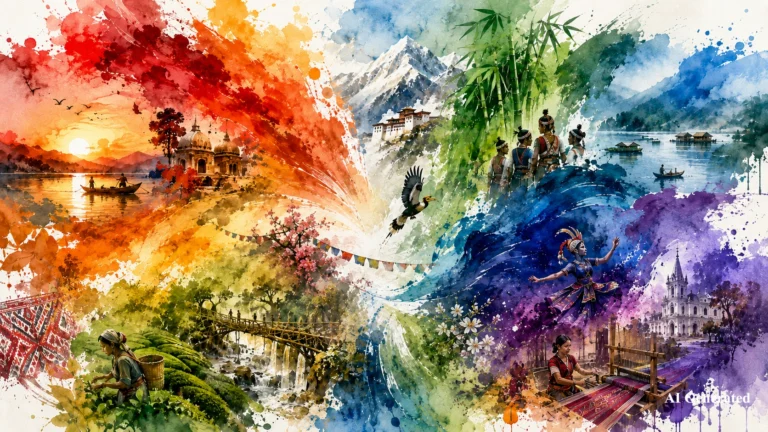
Assam should remain Assam. Meghalaya should remain Meghalaya. Nagaland should remain Nagaland. Arunachal Pradesh, Manipur, Mizoram, Tripura and Sikkim should each retain their distinctive cultures, landscapes and identities.
But these eight identities can still become part of one larger economic story.
That story could be called Northeast India.https://thequantiq.com/brand-north-east-doner-value-chain-strategy/
The events in Shillong this week, however, have shown just how fragile that story can be.
A brand is built slowly and damaged quickly
The recent disturbances in Shillong following a Khasi Students’ Union rally have resulted in violence, damage to vehicles, disruption of movement and growing concern among visitors. Assam-registered vehicles were among those targeted, and subsequent developments affected movement between Assam and Meghalaya. Reports have also emerged of tourists being stranded and travel services being disrupted.
The immediate priority is, of course, restoring peace and ensuring the safety of residents and visitors.
But there is another consequence that deserves much greater attention.
What does an incident like this do to the image of Meghalaya, and ultimately to the image of Northeast India?
That question matters because tourism is not built only with roads, airports, hotels and promotional campaigns.
Tourism is built on something much more fragile.
Trust.
A traveller wants to believe that a destination is safe. A family wants to believe that it will be welcomed.
A tourist wants to know that a journey across a state boundary will not suddenly become a source of anxiety.
Once that confidence begins to disappear, the economic consequences can travel far beyond the original incident.https://necouncil.gov.in/
A tourist has something local businesses do not have
There is a fundamental difference between a tourist and a tourism-dependent business.
A tourist can change the destination. A hotel cannot. A taxi driver cannot. A homestay owner cannot. A restaurant cannot.
A young person who has invested savings into a tourism business cannot simply move the business to another state because the destination has suddenly acquired a negative perception.
A family planning a holiday to Meghalaya can choose Assam instead.
It can choose Arunachal Pradesh. It can choose Sikkim. It can choose another part of India.
Or it can simply postpone the trip. For the traveller, changing the itinerary may be a minor inconvenience.
For a local tourism entrepreneur, it could mean a cancelled booking, an empty room, a lost taxi journey, a restaurant table that remains vacant or a guide who loses a day’s income.
And when hundreds or thousands of travellers make similar decisions, the impact becomes much larger.
That is the vulnerability of tourism.
Meghalaya does not need to be perfect. It needs to remain trusted.
This argument should not be misunderstood as an attack on Meghalaya.
Quite the contrary.
Meghalaya has one of the strongest tourism propositions in Northeast India. Its dramatic landscapes, waterfalls, caves, living-root bridges, music, food, indigenous culture and relatively distinctive visitor experience give it enormous potential.https://www.meghalayatourism.in/
That is precisely why its reputation matters.
A destination can spend years building an image of hospitality and discovery. A handful of disturbing images can challenge that image within hours.
The problem is amplified by social media.
A traveller today does not rely only on a tourism department website or a glossy travel brochure. Before booking, people search YouTube, Instagram, Google, travel forums and news websites. They look at what other travellers are saying.
A video showing violence can reach millions of people who know nothing about the circumstances behind it.
The viewer may not ask who was responsible.
The viewer may simply ask:
“Do I really want to take my family there?”
That is the question the tourism industry cannot afford to ignore.
The tourist from Assam is not Assam’s tourist
There is another mindset that the Northeast needs to rethink.
Why should an Assamese tourist visiting Meghalaya be seen primarily as an Assamese visitor?
Why not simply see that person as a customer of the Northeast?
Imagine a family arriving in Guwahati, travelling to Shillong, spending several days in Meghalaya, hiring local taxis, staying in a homestay, eating at local restaurants and purchasing local products.
The money spent in Meghalaya does not reduce Assam’s economic opportunity.
It creates a larger regional tourism ecosystem. The same family may return another year to visit Kaziranga.
Another family may travel to Arunachal Pradesh.
Another may discover Nagaland.
Another may visit Mizoram or Tripura.
This is how tourism can work across the Northeast.
The region should not be fighting over the same tourist. It should be working together to attract more tourists.
That is the economic logic behind a Common Brand Northeast.
The Northeast has an extraordinary tourism story waiting to be told
Few parts of India can offer such diversity within one broad geographical region.
Assam has Kaziranga, the Brahmaputra, tea and a rich cultural heritage.
Meghalaya has its mountains, caves, waterfalls, living-root bridges and distinctive indigenous traditions.
Arunachal Pradesh offers Himalayan landscapes and extraordinary cultural diversity.
Nagaland has a strong festival and indigenous cultural proposition.
Mizoram, Manipur and Tripura each possess their own distinctive landscapes, traditions and experiences.
Sikkim brings a Himalayan tourism proposition with a global appeal.
These are not competing stories.
They can become chapters of one larger story.
A visitor who comes to Northeast India does not have to choose one state forever.
The region can encourage visitors to return repeatedly, each time discovering another part of it.
That creates a much larger tourism economy.
It also creates opportunities for airlines, hotels, transport operators, restaurants, guides, artisans, digital creators, adventure companies, local food businesses and thousands of young entrepreneurs.
The biggest opportunity may belong to the young
This is where the conversation needs to move beyond tourism statistics.
The young people of Shillong and Guwahati may live on different sides of a state boundary, speak different languages and belong to different communities.
But their aspirations are remarkably similar.
They want meaningful employment.
They want better incomes.
They want to build businesses.
They want access to technology.
They want to remain connected to the world.
And many of them would prefer to build their future in the Northeast rather than leave it permanently in search of opportunities elsewhere.
That is the common ground that deserves far more attention.
An Assamese taxi driver and a Meghalaya hotel employee may have different identities, but they are part of the same tourism economy.
A Guwahati travel company and a Shillong adventure operator can be competitors, but they can also become partners.
A craftsperson in one state can sell to tourists who arrived through another.
A young entrepreneur in one state can build a digital platform that serves customers across all eight.
The future does not have to be a competition between eight small economies.
It can be the creation of one interconnected regional economy.
A common brand begins with common confidence
This is why the idea of Brand Northeast is much bigger than marketing.
A logo cannot create a common brand.
A government advertisement cannot create a common brand.
A tourism campaign cannot create a common brand if the visitor’s actual experience contradicts the promise.
A common brand requires confidence.
The visitor needs confidence that the region is welcoming.
The business needs confidence that people and goods can move freely.
The investor needs confidence that the region can work as an integrated market.
And the young entrepreneur needs confidence that building a business in Northeast India is a worthwhile proposition.
This is particularly important because an outsider may not always distinguish between the eight states as carefully as people within the region do.
For many people elsewhere in India, and for international visitors, the first mental association is simply:
Northeast India.
That creates an enormous opportunity.
But it also creates a shared responsibility.
When one destination suffers a major reputational setback, the perception of the wider region can also be affected.
We should not confuse identity with isolation
There is nothing wrong with protecting identity.
In fact, identity is one of the Northeast’s greatest assets.
The region’s languages, food, music, textiles, traditions, landscapes and indigenous cultures are precisely what make it different from other parts of India.
The answer is not to dilute that diversity.
The answer is to monetise diversity intelligently and responsibly.
A visitor should be able to experience Meghalaya without feeling that Assam is an unwanted presence.
An entrepreneur from Assam should be able to collaborate on business in Meghalaya without being viewed through the lens of a larger political narrative.
And a visitor from outside the region should be able to move across the Northeast without feeling that state boundaries represent social barriers.
That is what an economically integrated Northeast should look like.https://thequantiq.com/tourism-ecosystem-destination-management-northeast-india/
Confidence is infrastructure too
We usually talk about tourism infrastructure in terms of airports, highways, hotels, internet connectivity and public transport.
All of those are important.
But there is another form of infrastructure that is rarely measured.
Confidence.
If a traveller does not feel confident about visiting a destination, a new highway will not solve the problem.
If a business fears disruption to movement, a new airport alone will not remove that concern.
If an investor believes that regional tensions can suddenly affect commerce, infrastructure investment may not produce the expected economic multiplier.
Confidence is therefore an invisible form of infrastructure.
And like physical infrastructure, it takes years to build.
Unlike physical infrastructure, it can be damaged almost instantly.
The Northeast has a choice
The Shillong incident will eventually pass.
Normal traffic will return. Hotels will reopen. Tourists will come back. Businesses will recover.
But the region should use this moment to ask a larger question.
What kind of Northeast does the next generation want to inherit?
One where every state protects its identity by looking suspiciously at the next state?
Or one where eight distinctive identities become the foundation of one powerful economic proposition?
The choice does not require anyone to forget history, abandon identity or ignore legitimate concerns.
It requires only a change in perspective.
A tourist visiting Meghalaya is not a loss for Assam.
An investor choosing Assam is not a loss for Meghalaya.
A traveller discovering Nagaland does not reduce Arunachal Pradesh’s opportunity.
The economic pie does not have to remain fixed.
The Northeast can make the pie much bigger.
From eight identities to one economic opportunity
The idea of a Common Brand Northeast was never about making eight states look like one.
It was about making eight states matter more together.
That means creating tourism circuits rather than isolated destinations.
It means building regional supply chains rather than fragmented markets.
It means encouraging entrepreneurs to think beyond state borders.
It means turning cultural diversity into economic value.
And above all, it means protecting the confidence of the people who come to experience the region.
The world has thousands of destinations competing for the same tourist.
The tourist has choices.
The investor has choices.
The entrepreneur has choices.
The Northeast therefore cannot afford to become its own biggest obstacle.
The region has something extraordinarily valuable: eight states with eight distinctive identities and an almost limitless variety of stories to tell.
The challenge is to ensure that those stories are connected by a larger narrative of hospitality, safety, opportunity and shared prosperity.
Because a brand is not what we tell the world we are.
A brand is what people experience when they meet us.
And if Northeast India truly wants the world to discover it as one of India’s most exciting economic and tourism destinations, that experience must begin at home.https://thequantiq.com/northeast-india-single-tourism-destination/
Eight states can remain eight identities. But they can still become one economic opportunity.