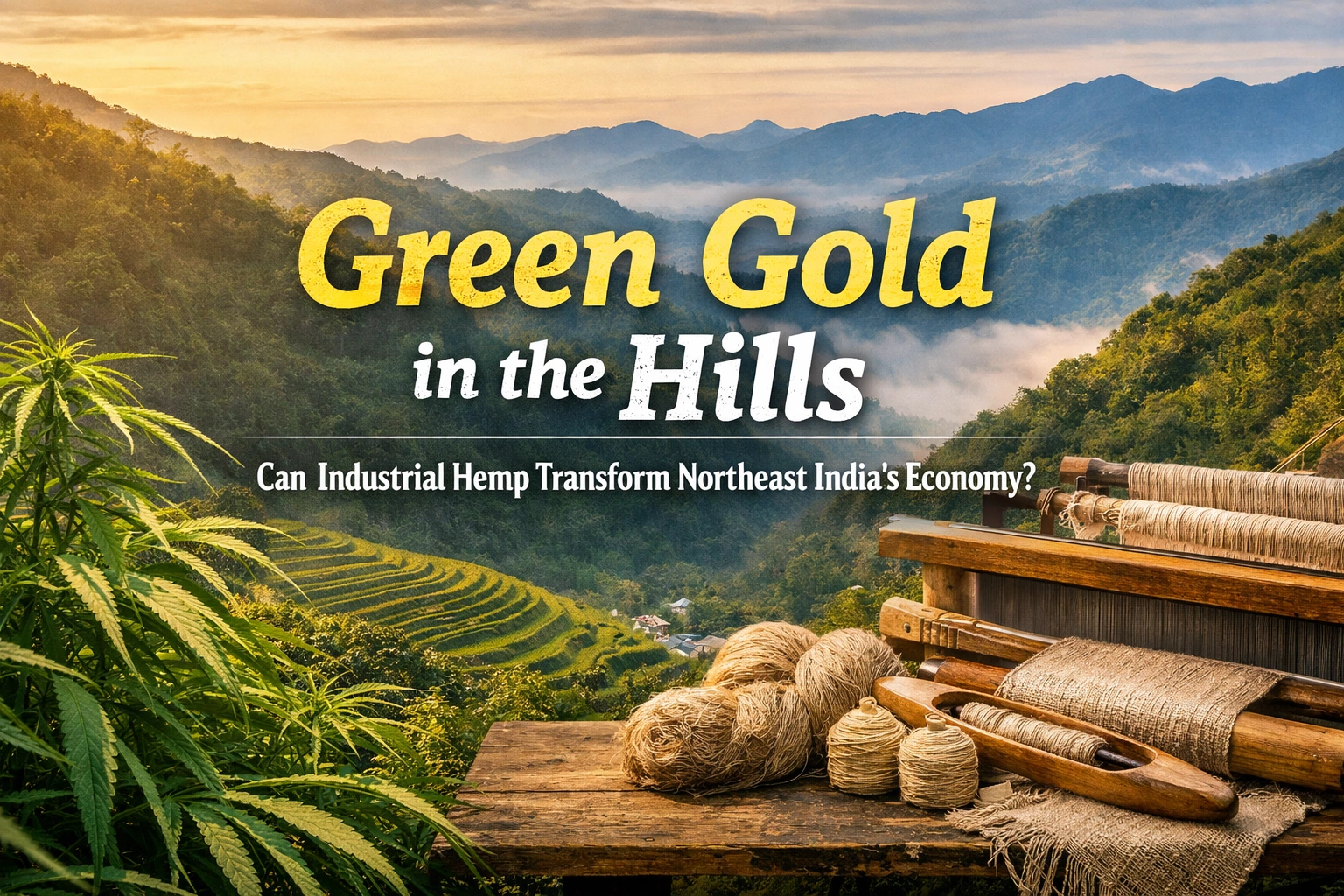
Green Gold in the Hills
Why Legalising Industrial Hemp Could Trigger Northeast India’s Most Consequential Economic Shift
— and how the region can emerge as a global slow fashion procurement hub
There is a plant growing quietly across the hills of Nagaland, Manipur, Mizoram, and Arunachal Pradesh.
It asks for almost nothing.
No irrigation. No pesticides. No fertilisers.
Yet it offers everything.
Its fibre is stronger than cotton. Its seeds are rich in protein. Its oil is nutritionally dense. It can be used to build materials, produce textiles, develop bioplastics, and even restore degraded soil.
Global industries have already taken note. Automotive manufacturers such as BMW and Mercedes-Benz use hemp-based composites in vehicle interiors. European textile brands pay a premium for hemp fibre.
In India, licensed farmers in Uttarakhand have reported earnings approaching ₹1 lakh per acre under controlled cultivation.
The plant is industrial hemp—Cannabis sativa with very low THC content.
And it may be the most underutilised economic lever in Northeast India.
A Global Market Expanding at Unusual Speed
The opportunity becomes clearer when placed in a global context.
The industrial hemp market, estimated at over $11 billion in 2025, is projected to grow rapidly over the next decade. Forecasts suggest it could cross $70 billion by the early 2030s, driven by demand in textiles, composites, food, and sustainable materials.
At the same time, the global shift toward sustainable fashion is accelerating. Consumers are changing. Regulations are tightening. Brands are under pressure to prove environmental responsibility.
This is not a niche trend. It is a structural transition.
Yet there is a problem.
Supply is not keeping up with demand.
A significant proportion of slow fashion brands still struggle to source reliable, traceable, eco-certified fabric at scale.
This gap is where Northeast India enters the conversation.
What Industrial Hemp Is — And What It Is Not
The biggest barrier to hemp adoption in India is not technical. It is psychological.
The word “cannabis” still carries stigma.
Industrial hemp, however, is not marijuana.
It contains less than 0.3% THC. That is far below psychoactive levels. It cannot be used as a recreational drug.
Globally, this distinction is well established. The United States, the European Union, and several other economies regulate hemp separately from narcotic cannabis.
India has already taken initial steps. Hemp seed products are recognised under food regulations.
The confusion that remains is historical, not scientific.
A Natural Advantage Already Exists
Unlike many industries that require new infrastructure from scratch, hemp already grows across the Northeast.
Wild cannabis plants are common across hill regions. They grow without intervention. They adapt to altitude and climate conditions that challenge other crops.
This creates a rare advantage.
The region does not need to introduce a new crop.
It needs to formalise and scale what already exists.
Hemp also aligns with the region’s agricultural realities.
It requires far less water than cotton. It grows without heavy chemical input. It improves soil health over time. In areas affected by shifting cultivation, this matters.
For small farmers, input cost determines viability. Hemp changes that equation.
The Economic Shift at the Farm Level
What makes hemp unusual is not just its yield. It is its structure.
A single crop can generate multiple revenue streams.
Fibre can be used in textiles and construction.
Seeds can be processed into food and oil.
Biomass can be used in wellness and industrial applications.
Few crops offer this level of diversification.
In regions where annual farm incomes remain low, even modest improvements matter. A crop that can potentially double income without increasing input cost is not incremental. It is transformative.
Agriculture continues to support a large share of the workforce across the Northeast. Any meaningful shift in farm economics has ripple effects across the entire regional economy.
The Textile Opportunity That Changes Everything
The most immediate opportunity lies not in exports of raw hemp, but in textiles.
Pure hemp fibre is strong but coarse. This once limited its use in fine fabrics.
That limitation no longer holds.
Blended yarns—especially hemp mixed with cotton—have changed the equation. These blends retain strength while improving softness and usability.
More importantly, they reduce water usage and improve durability.
For Northeast India, this intersects with an existing strength.
The region already has one of the richest handloom traditions in the world.
Weaving clusters exist. Skills exist. Cultural value exists.
What is missing is a cost-efficient, sustainable raw material.
Locally processed hemp, blended with cotton, can fill that gap.
It reduces dependence on imported yarn.
It lowers input costs.
It improves product positioning in global markets.
For a weaver, that means higher margins.
For a region, that means competitive advantage.
The Slow Fashion Moment
Global fashion is under pressure to change.
Consumers are demanding transparency. Regulators are demanding accountability. Brands are searching for suppliers who can provide traceable, ethical, and sustainable materials.
This is where most supply chains fail.
Authenticity cannot be manufactured at scale. Traceability is difficult. Sustainability is expensive.
Northeast India, with the right framework, can solve all three.
It offers living textile traditions.
It offers community-based production.
It offers the ability to build traceable supply chains from farm to fabric.
When combined with hemp, this becomes even stronger.
The region can produce textiles that are not only sustainable, but verifiably so.
That is exactly what the global slow fashion market is looking for.
What Needs to Be Built
The transformation does not require massive industrial infrastructure.
It requires coordinated, small-scale systems.
Localised processing units can separate fibre from stalk.
Cluster-level operations can blend yarn.
Existing handloom networks can handle weaving.
The model is distributed, not centralised.
Examples already exist in parts of India, particularly in Uttarakhand, where pilot ecosystems have linked farmers to global markets.
The Northeast has one clear advantage over such models.
It already has a dense handloom base.
That removes one of the biggest barriers to scaling.
The Policy Reality
The legal pathway is not unclear.
Under the NDPS Act, state governments already have the authority to license hemp cultivation for industrial purposes.
Some states have acted. Others are exploring.
The Northeast does not need a new law.
It needs to use an existing one.
A clear licensing framework, basic compliance mechanisms, and support for processing clusters would be enough to begin.
This is not a long-horizon reform.
It is an actionable policy decision.
The Strategic Question
When all elements are placed together, the picture becomes difficult to ignore.
A rapidly growing global market.
A supply gap that remains unresolved.
A region with natural, cultural, and structural advantages.
A crop that already grows in abundance.
The question is no longer whether the opportunity exists.
The question is whether it will be recognised in time.
The Bottom Line
Northeast India is not being asked to build something entirely new.
It is being asked to organise what already exists.
To formalise cultivation.
To enable processing.
To connect production to global demand.
The pieces are already in place.
What is missing is alignment.
If that alignment happens, industrial hemp could do more than improve agriculture.
It could redefine the economic identity of the region.
A Final Thought
For years, development conversations around the Northeast have focused on infrastructure, connectivity, and policy gaps.
Those matter.
But sometimes, transformation begins elsewhere.
Sometimes, it begins with recognising the value of something already growing quietly in the background.
Industrial hemp is not the entire answer.
But it may be the beginning of one.https://thequantiq.com/northeast-india-infrastructure-spending-outcome-gap/