

₹6.11 Lakh Crore Spent: Is Northeast India’s Infrastructure Decade a Success?
On April 1, 2026, India’s Ministry of Development of North Eastern Region (MDoNER) tabled a comprehensive self-assessment in the Lok Sabha. Presented by Minister of State Sukanta Majumdar, the data reveals a consequential shift. Northeast India has completed a decade of intense infrastructure building. However, it has yet to translate this massive investment into a measurable economic transformation.
The Scale of Federal Investment in Northeast India
At the center of this story is a defining number: ₹6.11 lakh crore. Between FY2014–15 and FY2024–25, the Union government deployed these funds under the 10% Gross Budgetary Support mechanism. Notably, actual expenditure marginally exceeded allocations. This signals a rare phase of fiscal absorption for a region once known for underutilization.
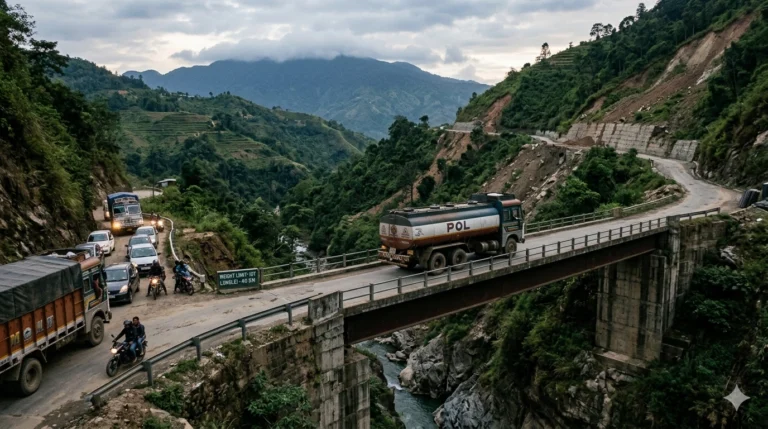
The physical outcomes of this Northeast India infrastructure development are undeniable:
- Highways: Expanded from 10,905 km to 16,207 km (a 49% increase).
- Railways: Annual allocations surged nearly fivefold.
- Aviation: Ninety operational routes now function under the UDAN scheme.
- Digital: High-speed connectivity now reaches over 6,300 gram panchayats.
Why Physical Connectivity Hasn’t Triggered Private Investment
These developments mark the completion of the Northeast’s “Infrastructure Decade.” The region is no longer geographically isolated. Within India’s Act East Policy, this transformation positions the Northeast as a strategic gateway to Southeast Asia.
And yet, the most important insight from the Lok Sabha data is what has not followed. The government admits that these investments are merely “creating the necessary conditions for economic gains to materialize.” The gains themselves remain largely invisible.
The gap is most evident in fund utilization. In FY2023–24, actual expenditure stood at only ₹1,944 crore against a revised estimate of ₹5,849 crore. This utilization rate of roughly one-third stems from land acquisition hurdles and administrative constraints.
The Startup Imbalance: Public vs. Private Capital
The distinction between building infrastructure and generating output becomes sharper when looking at private capital. The North East Venture Fund has supported only 21 startups with a deployment of ₹16.76 crore over three years. Compared to ₹6.11 lakh crore in public spending, this signals a deep structural imbalance.
While these startups have generated roughly 10,000 jobs, the gains are uneven. Assam dominates the ecosystem, accounting for nearly 75% of registered ventures. Most other states remain off the entrepreneurial map.
Moving from Infrastructure to Economic Outcomes
The economic paradox deepens with growth data. Many states in the region show double-digit GSDP expansion. However, the Northeast’s contribution to national GDP remains stuck at approximately 3.01%. This is “catch-up growth”—high percentages from a very low base that do not yet carry substantial economic weight.
Infrastructure alone does not move goods. Trade requires systems:
- Logistics hubs and industrial clusters.
- Policy clarity for cross-border facilitation.
- Measurable export flows to validate the strategic narrative.
Currently, official reports stop short of publishing concrete export figures. For a region positioned as India’s gateway to ASEAN, this absence of trade data is a defining gap.
The Start of the Outcome Decade
Northeast India has finished the first phase of its journey. It has built the “hardware” of connectivity in challenging terrain. But hardware is not an economy.
An economy is defined by the movement of goods, capital, and ideas. The question is no longer whether the money was spent, but whether the infrastructure can be activated. For policymakers and entrepreneurs, the challenge is now clear: convert connectivity into commerce. The Northeast has entered its Outcome Decade, and it is time to build the roadmap.https://thequantiq.com/viksit-bharat-net-zero-22-trillion-india/




One Comment