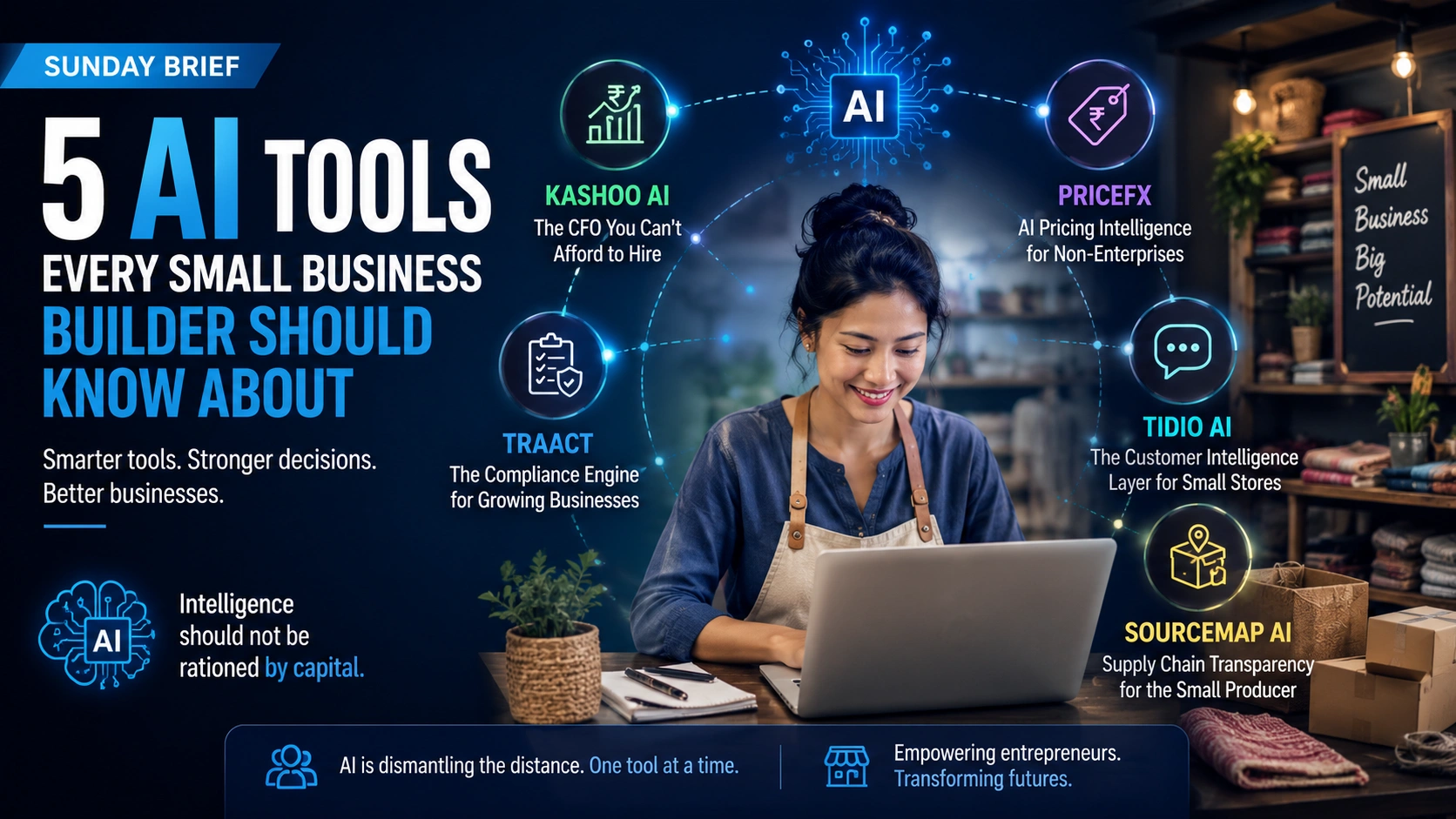
Sunday Brief: 5 AI Tools Every Small Business Builder Should Know About
Every week, the AI headlines go to the giants — OpenAI, Google, Microsoft. But quietly, in the margins of that noise, a different kind of intelligence is being built. Not for Fortune 500 boardrooms.
For the founder managing three suppliers and a spreadsheet. For the first-generation entrepreneur running a SHG. For the small trader trying to understand why her costs keep rising while her margins keep shrinking.
This week, we look at five AI tools that are quietly redefining what it means to run a small business in 2026.
Kashoo AI — The CFO You Can’t Afford to Hire
What it does: Kashoo’s AI layer transforms basic bookkeeping into real-time financial intelligence — automatically categorising transactions, flagging anomalies, and generating plain-language cash flow summaries without requiring any accounting knowledge.
Why it matters: Most small businesses fail not from lack of effort, but from lack of financial visibility. Kashoo closes that gap without the cost of a finance team.
Best for: First-generation entrepreneurs, micro-enterprises, SHG-led businesses, and anyone running a business on instinct rather than numbers.
Quiet advantage: It doesn’t just track money — it explains money. In language that doesn’t require a CA to decode.
Traact — The Compliance Engine for Growing Businesses
What it does: An AI-powered legal and compliance management tool that tracks regulatory deadlines, flags compliance gaps, and auto-generates required documentation across jurisdictions — from GST filings to labour law obligations.
Why it matters: Compliance failures kill more small businesses than competition does. Traact replaces the anxiety of “did I miss something?” with a quiet, persistent intelligence that watches for you.
Best for: Small businesses scaling across states, exporters navigating multi-country compliance, and MSMEs entering government procurement channels.
Quiet advantage: It converts the most feared part of running a business — the paperwork layer — into a manageable, automated background process.
Pricefx — AI Pricing Intelligence for Non-Enterprises
What it does: Originally built for enterprises, Pricefx now offers AI-driven dynamic pricing tools accessible to mid-market and growth-stage businesses — analysing competitor pricing, demand signals, and margin thresholds to recommend optimal price points in real time.
Why it matters: Pricing is the single highest-leverage decision in any business. Most small businesses price on gut. Pricefx replaces gut with data.
Best for: D2C brands, e-commerce sellers, textile and handicraft exporters, and product-led businesses navigating seasonal demand volatility.
Quiet advantage: Moves pricing from a fixed decision made quarterly to a living, responsive strategy — the way large retailers have always operated, now available to everyone.
Tidio AI — The Customer Intelligence Layer for Small Stores
What it does: An AI-powered customer engagement platform that combines live chat, automated support, and deep behavioural analytics — understanding not just what customers ask, but why they leave, what they hesitate over, and what triggers a purchase.
Why it matters: Customer acquisition is expensive. Customer understanding is priceless. Tidio gives small businesses the kind of behavioural intelligence that was once only available to large e-commerce platforms.
Best for: D2C brands, handloom and handicraft sellers, tourism operators, and any small business with an online presence trying to improve conversion.
Quiet advantage: Turns every customer interaction into a data point — building institutional knowledge about buyers that most small businesses never accumulate.https://thequantiq.com/future-of-work-india-wef-skills-crisis-ai/
Sourcemap AI — Supply Chain Transparency for the Small Producer
What it does: An AI-enhanced supply chain mapping tool that traces raw materials from source to shelf — identifying risks, bottlenecks, and sustainability gaps across complex, multi-tier supply chains.
Why it matters: Global buyers increasingly demand supply chain traceability. For Northeast India’s producers of silk, agarwood, bamboo, and organic food — this is not a future requirement. It is already a present barrier to premium market access.
Best for: Exporters, GI-tagged product producers, artisan cooperatives, and any business selling into international or institutional markets.
Quiet advantage: Converts supply chain transparency — once a luxury of large brands — into an accessible tool for small producers seeking global credibility.
The Deeper Shift
What connects these five tools is not a shared category.
It is a shared belief: that intelligence should not be rationed by capital.
For decades, the tools that gave large businesses their edge — financial forecasting, compliance management, pricing intelligence, customer analytics, supply chain visibility — were simply unavailable to small operators. Too expensive. Too complex. Too distant.
AI is dismantling that distance. One tool at a time.
The Quantiq Take
The most consequential AI transformation of this decade will not happen in Silicon Valley.
It will happen in the lakhs of small businesses across this country that suddenly have access to intelligence they were never supposed to have.
Northeast India’s entrepreneurs are not late to this revolution.
They are exactly on time.https://thequantiq.com/the-rise-of-agentic-ai-and-indias-it-crossroads/





One Comment