India’s White Revolution 2.0
How Digital Ecosystems Are Transforming the World’s Largest Dairy Sector
India today is the world’s largest producer of milk, contributing nearly 25% of global output. But the next phase of growth—often described as White Revolution 2.0—is no longer driven by volume alone. It is being powered by digital public infrastructure, focused on traceability, transparency, efficiency, and farmer-centric value creation.
At the heart of this transformation is a coordinated digital push led by the National Dairy Development Board (NDDB), which is knitting together farmers, cattle, cooperatives, logistics, and markets into a single, data-driven ecosystem—often described as a “cow-to-consumer” digital thread.
The Foundation: “Pashu Aadhaar” and the National Digital Livestock Mission
The cornerstone of this transformation is the National Digital Livestock Mission (NDLM), under which a unified platform—Bharat Pashudhan—has been created to digitally identify and manage India’s vast livestock population.
What is Pashu Aadhaar?
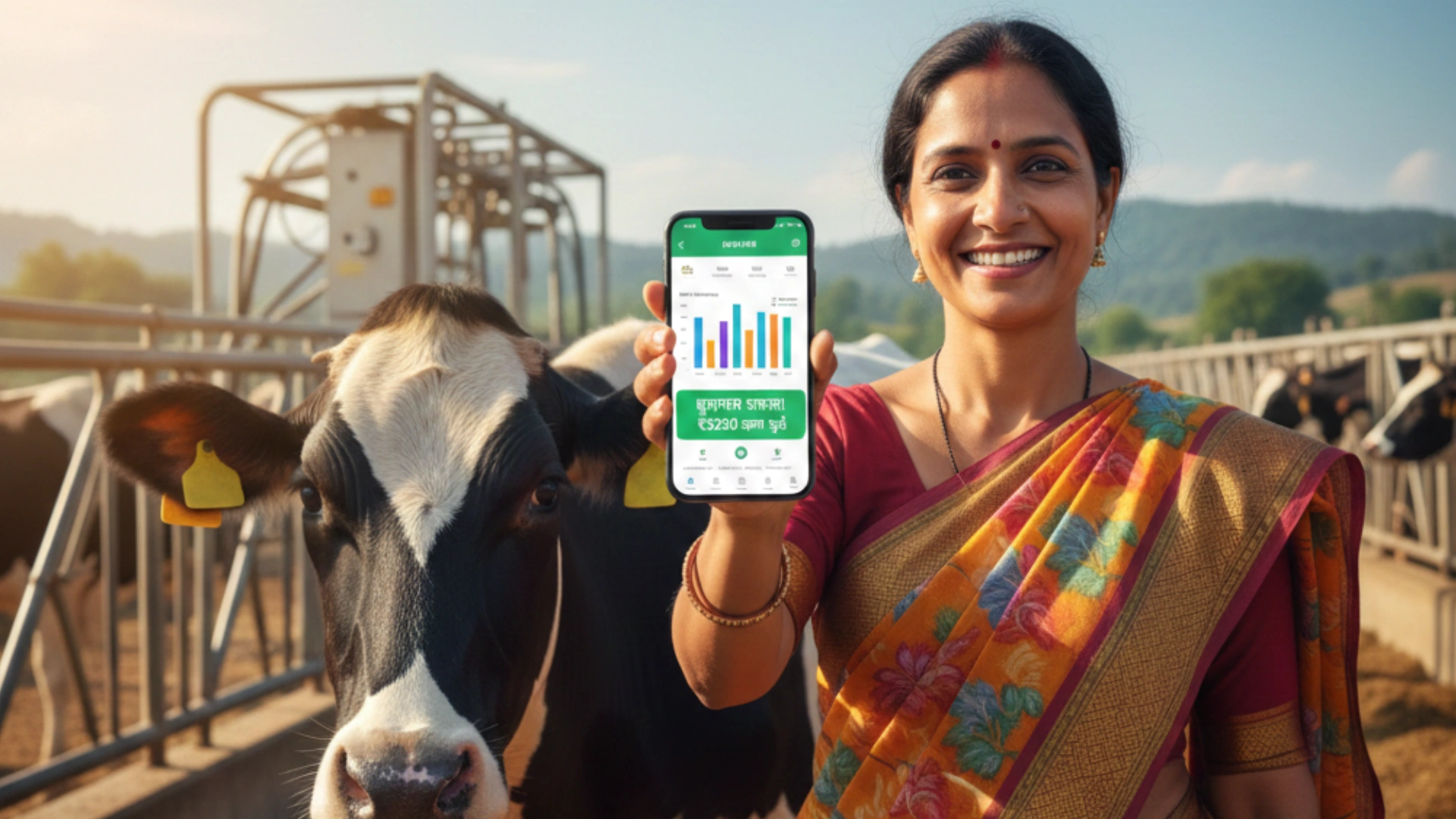
- Unique Digital Identity: Each animal is issued a 12-digit barcoded ear tag, popularly known as Pashu Aadhaar.
- Complete Traceability: The ID functions as a primary key, recording vaccinations, breeding history, disease incidents, and medical treatments.
- Unprecedented Scale:
- 35.68 crore Pashu Aadhaar tags generated
- 84+ crore transactions recorded (as of November 2025)
Direct Farmer Support
Farmers can access doorstep veterinary services through the 1962 toll-free helpline and companion mobile applications—reducing response times, improving animal health outcomes, and cutting informal costs.
Automating the Milk Collection Point: Fairness Through Technology
For millions of small dairy farmers, the Dairy Cooperative Society (DCS) is the most critical interface with the formal economy. The Automatic Milk Collection System (AMCS) has fundamentally transformed this daily transaction.
Why AMCS Matters
- Instant Transparency: Milk quantity, fat content, and quality are digitally measured and recorded. Farmers receive real-time SMS confirmations.
- Financial Inclusion: Payments are transferred directly to bank accounts, eliminating delays, disputes, and manual manipulation.
- Large-Scale Adoption:
- 17.3 lakh+ milk producers
- 54 milk unions already onboarded
This automation has quietly strengthened trust between farmers and cooperatives—one of the most critical yet intangible assets of India’s dairy economy.
NDERP: The Open-Source Digital Backbone of Dairy Operations
Modern dairy operations demand enterprise-grade systems tailored to sector-specific realities. Enter NDDB Dairy ERP (NDERP)—a purpose-built, open-source ERP solution for dairy and edible oil cooperatives.
Key Advantages
- Cost-Effective by Design: Built on the Frappe ERPNext framework, NDERP eliminates high proprietary licensing costs.
- End-to-End Integration: Modules span procurement, milk billing, production, HR, payroll, inventory, and finance.
- Mass-Balancing Intelligence: Specialized production modules use mass-balance techniques to minimize processing losses and improve yield efficiency.
For cooperatives operating on thin margins, this digital backbone is proving to be a strategic equalizer.
GIS-Powered Milk Route Optimisation: Cutting Costs, Not Corners
Transportation is among the highest cost components in the dairy value chain. To address this, NDDB has deployed Milk Route Optimisation using GIS (Geographical Information Systems).
How GIS is Changing Dairy Logistics
- Data-Driven Routing: Manual planning gives way to digitized maps that identify the most efficient procurement and distribution routes.
- Proven Impact: In initiatives such as the Vidarbha–Marathwada Dairy Development Project, redesigned routes delivered measurable savings in fuel consumption, time, and vehicle wear.
- Free for Cooperatives: The GIS-based route planning software is provided free of cost, accelerating nationwide adoption.
The result is a leaner, greener, and more resilient dairy supply chain.
Benchmarking, Genetics, and Quality Control at Scale
Digitalization is also reshaping the future of India’s dairy herd—not just current operations.
Key Platforms
- Semen Station Management System (SSMS):
- Used by 38 graded semen stations
- Tracks the full bull lifecycle
- Ensures frozen semen doses meet national quality standards
- i-DIS (Internet-based Dairy Information System):
- Adopted by 198 milk unions
- Enables data sharing, performance benchmarking, and peer comparison
- Encourages healthy competition and operational excellence
Together, these systems strengthen genetics, productivity, and quality assurance across the sector.
A Farmer-First Digital Revolution
India’s White Revolution 2.0 is not merely a story of technology adoption—it is a story of institutional innovation with the small and marginal farmer at its center. By digitally linking every animal, every transaction, and every liter of milk into a transparent and traceable ecosystem, India is quietly setting a global benchmark for technology-driven, inclusive agriculture.
As climate pressures rise and global food systems search for resilient models, India’s digitally empowered dairy sector may well become one of the most studied—and replicated—success stories of the decade.