
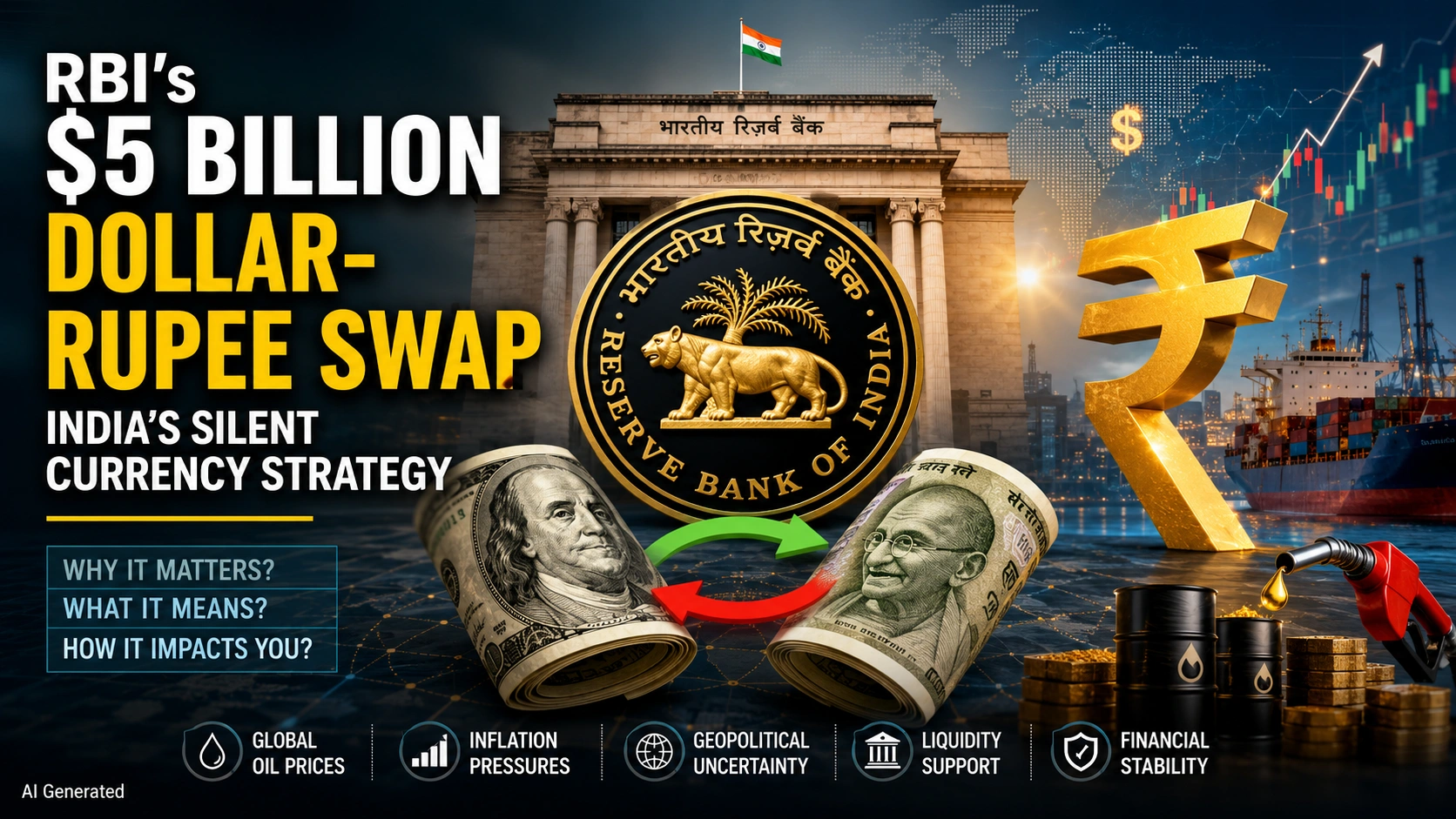
Why RBI’s $5 Billion Dollar-Rupee Swap Is About More Than Just the Rupee
The Reserve Bank of India’s decision to conduct a US$5 billion dollar-rupee swap auction is not merely a technical liquidity exercise. It reflects a deeper global economic reality in which central banks are increasingly managing currency pressures, capital flows, inflation risks, and geopolitical uncertainty through sophisticated financial tools. As the Indian rupee faces sustained pressure amid global demand for the US dollar, the RBI’s move signals both caution and strategic confidence. The development also highlights India’s long-term ambition to strengthen financial resilience, stabilise liquidity, and gradually reduce excessive dependence on the dollar-dominated global system.
The Quiet Currency Battle Most Indians Never Notice
Far away from television debates and election rallies, another battle is unfolding silently every day — inside currency markets, banking corridors and central bank war rooms.
No missiles are fired. No borders are crossed. Yet trillions of dollars move across the world in search of safety, stability and confidence.
And in that invisible global contest, the US dollar still remains the undisputed emperor.
That is precisely why the Reserve Bank of India’s latest announcement of a US$5 billion dollar-rupee swap auction deserves far more attention than it is receiving.
At first glance, the development appears technical, almost boring. To the average citizen, phrases like “USD/INR Buy/Sell Swap Auction” sound like financial jargon designed for economists and bankers. But beneath that dry terminology lies a much larger story about the pressures facing emerging economies, the psychology of modern financial systems, and India’s ongoing attempt to navigate an increasingly unstable global order.
The RBI is not merely injecting liquidity.
It is buying time, managing confidence, and preparing the Indian financial system for rougher global waters ahead.
What Exactly Is a Dollar-Rupee Swap?
In simple terms, a dollar-rupee swap allows banks to temporarily exchange US dollars with the RBI in return for Indian rupees, with an agreement to reverse the transaction later.
Under the latest arrangement, banks will pledge dollars to the RBI now and reclaim them after the tenure ends.
This helps in multiple ways.
First, injects rupee liquidity on a temporary, collateralised basis — without permanently expanding the money supply. Second, it helps banks manage funding stress during periods of tightening liquidity. Third, it indirectly supports stability in currency markets by ensuring that the financial system does not panic amid global uncertainty.
But central banking in the 21st century is no longer just about money supply.
It is increasingly about perception.
Confidence itself has become a monetary tool.
When the RBI steps in with a large swap operation, it sends a signal to markets that India’s central bank is alert, prepared and willing to act before stress escalates into instability.
That signalling effect matters enormously.
Why Is the Rupee Under Pressure?
To understand the significance of this move, one must first understand the global obsession with the US dollar.
Whenever uncertainty rises anywhere in the world — whether due to wars, oil shocks, inflation fears or geopolitical tensions — global investors rush towards the dollar. It is still considered the safest financial shelter on the planet.
That global demand naturally strengthens the dollar against most currencies, including the rupee.
India, despite being one of the world’s fastest-growing major economies, remains heavily dependent on imports in several strategic sectors. Crude oil alone creates massive dollar demand because India buys a substantial portion of its energy from international markets using the American currency.
When oil prices rise or global tensions intensify, demand for dollars increases further.
At the same time, foreign institutional investors often pull money out of emerging markets during uncertain periods and shift capital towards safer Western assets. This creates additional pressure on currencies like the rupee.
The result is a familiar cycle:
the dollar strengthens, imports become costlier, inflation risks rise, and central banks are forced to intervene carefully.
This is not unique to India.
Almost every major emerging economy is facing versions of the same problem.
The World Is Entering a New Era of Economic Uncertainty
The timing of RBI’s move is particularly significant.
The global economy is currently navigating multiple overlapping uncertainties.
Wars and geopolitical tensions continue to disrupt trade routes and energy markets. Central banks across advanced economies remain cautious about inflation. Interest rates in the United States continue to influence global capital flows. Supply chains remain vulnerable. Commodity prices fluctuate unpredictably.
In such an environment, emerging economies cannot afford complacency.
Even relatively healthy economies can face sudden currency pressure if global sentiment turns negative.
This is why modern central banks increasingly act preemptively rather than reactively.
The RBI’s swap auction appears to be part of precisely such a strategy.
Rather than waiting for severe stress to emerge, the central bank is attempting to maintain sufficient liquidity and confidence in advance.
That approach reflects institutional maturity.
This Is Not Just About Mumbai or Dalal Street
The effects of currency pressure do not remain confined to financial markets.
Eventually, they reach ordinary households.
A weaker rupee can make imported products more expensive. Fuel prices can rise. Aviation costs may increase. Electronics, industrial machinery, medicines and fertilizers become costlier. Businesses dependent on imported raw materials face higher expenses, which are often passed on to consumers.
Even students planning to study abroad indirectly feel the impact when the rupee weakens sharply against the dollar.
In a region like Northeast India, where logistics costs are already high and aviation connectivity plays a critical economic role, global currency fluctuations can quietly intensify existing vulnerabilities.
Most people may never track dollar index charts or RBI circulars.
Yet the consequences of these macroeconomic movements slowly shape everyday economic realities.
This is why understanding monetary policy is no longer an elite exercise reserved for economists.
It has become part of public life.
The Dollar Still Rules the World — But Cracks Are Emerging
For decades, the global financial system has revolved around the dominance of the US dollar.
International trade, energy markets, reserves, debt systems and global finance have all been deeply tied to it.
But the world is also slowly changing.
Countries across Asia, Africa and Latin America are increasingly exploring alternatives to reduce excessive dependence on the dollar. Bilateral trade settlements in local currencies are rising. Discussions around BRICS currency mechanisms have gained visibility. Digital payment ecosystems are expanding rapidly.
India itself has shown growing interest in promoting international trade settlement in rupees.
However, replacing dollar dominance is neither simple nor immediate.
Trust in global finance is built over decades, sometimes centuries.
For now, the dollar remains central to the global system.
And that means countries like India must continue developing sophisticated mechanisms to manage exposure and volatility.
The RBI’s latest swap operation reflects precisely that balancing act — navigating the present reality while preparing for a more multipolar financial future.
The Real Story Is About Strategic Stability
One of the biggest misconceptions about central banking is that action only happens during crises.
In reality, the most effective interventions are often those designed to prevent panic before it begins.
That is what makes this swap operation strategically important.
The RBI is not signalling weakness.
It is signalling preparedness.
There is a major difference between the two.
India today possesses far stronger foreign exchange reserves, financial institutions and macroeconomic resilience compared to many previous decades. But global volatility has also become more complex and interconnected.
In this environment, stability itself becomes a strategic asset.
And maintaining that stability requires constant calibration.
The modern central bank is no longer merely printing currency or controlling interest rates. It is simultaneously managing liquidity, expectations, investor psychology, market sentiment and geopolitical risk.
The RBI’s dollar swap is therefore not just a financial transaction.
It is part of a larger defensive architecture protecting economic confidence.
India’s Economic Rise Will Depend on Financial Resilience
India’s ambitions are enormous.
The country aims to become a manufacturing powerhouse, a digital economy leader, a major geopolitical player and eventually one of the world’s largest economies.
But sustained economic rise requires more than GDP growth headlines.
It requires financial resilience.
Currency stability, liquidity management, institutional credibility and strategic monetary policy will increasingly define which economies can withstand future global shocks.
That is why developments like the RBI’s dollar-rupee swap matter far beyond the banking sector.
They offer a glimpse into how modern economies quietly defend themselves in an age where finance, geopolitics and national strategy are becoming inseparable.
The next great global battles may not always begin with armies or tariffs.
Some may begin quietly in currency markets, swap windows and central bank corridors.
And India, fully aware of that reality, appears determined not to be caught unprepared.https://thequantiq.com/indian-rupee-depreciation-ai-economy/