
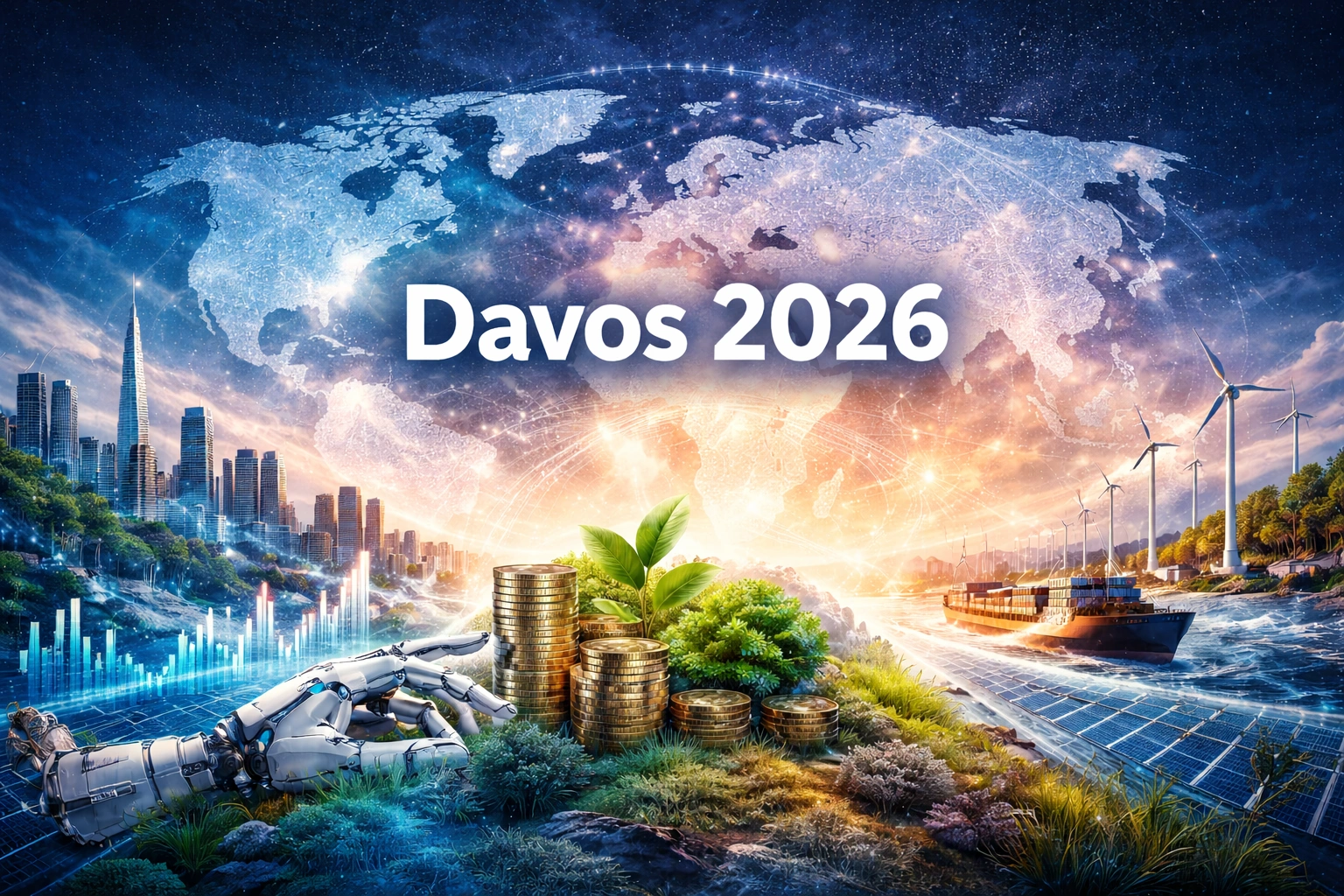
WEF Davos 2026: The Signals Shaping the Global Economy — and India’s Make-or-Break Choices
Once caricatured as elite networking or grandstanding diplomacy, the annual meeting of the World Economic Forum now serves a different function. It is no longer where deals are struck in public view; it is where global alignment is tested. Capital, governments, and technology leaders use Davos to reveal priorities, anxieties, and limits—often through repetition rather than proclamation.
Read this way, Davos 2026, held under the theme “A Spirit of Dialogue,” delivered not drama but clarity. The signals were measured, conditional, and deeply relevant for economies like India’s that sit at the intersection of growth ambition and execution pressure.
Capital’s Tough Love: Stability Over Speed
One of the clearest messages at Davos 2026 was the renewed emphasis on capital discipline. Across conversations on infrastructure, technology, climate, and emerging markets, investors consistently stressed selectivity over scale and patience over speed.
This was not a narrative of capital withdrawal. Rather, it reflected a shift in expectations. Long-term investors signalled preference for jurisdictions that demonstrate policy stability, execution capacity, and regulatory predictability. Risk discussions moved beyond traditional geopolitical flashpoints to focus on economic fragmentation, trade friction, and financial volatility.
For India, the implication is significant. While global interest in India’s growth story remains strong, Davos conversations underscored a clear subtext: narratives attract attention, but governance retains capital. The era when momentum alone could compensate for institutional inconsistency is drawing to a close.
AI’s Power Shift: Infrastructure, Not Hype
Artificial intelligence discussions at Davos 2026 reflected a marked tonal shift. Gone was the fascination with consumer-facing novelty. In its place was a sober focus on AI as economic infrastructure—comparable to broadband or electricity in earlier phases of development.
AI was framed around productivity, system optimisation, and large-scale deployment across manufacturing, energy, logistics, and public services. The emphasis was not on experimentation but on integration. As several global technology leaders noted, the real bottlenecks are no longer algorithms but physical infrastructure—power, grids, data capacity, and skills.
For India, this presents a dual reality. India is widely recognised for its AI talent base and digital adoption. However, Davos discussions repeatedly highlighted a gap between capability and diffusion. The next phase of advantage will depend not on pilots or proofs of concept, but on institutional adoption—across MSMEs, utilities, and state systems.
AI, in short, has become a state capacity challenge, not merely a startup opportunity.
Climate Finance After Davos: Adaptation Meets Reality
Climate conversations at Davos 2026 were notably pragmatic. While the urgency of climate action remains undisputed, the dominant question shifted decisively toward financing structures: who pays, how risks are shared, and what returns are viable.
Discussions prioritised adaptation over mitigation rhetoric, with water systems, food security, nature finance, and resilience emerging as central themes. This is where initiatives such as UpLink’s Water Resilience Challenge gained prominence—not as symbolic showcases, but as examples of deployable solutions aligned with blended finance and procurement pathways.
For the Global South, this shift is critical. Adaptation is capital-intensive and immediate. Davos made clear that grants alone will not suffice; concessional finance, patient capital, and institutional demand will determine scale. Climate action has entered its political economy phase, where realism increasingly shapes outcomes.
India’s positioning reflects this maturity. Its climate commitments—alongside long-term Net Zero goals—are being paired with an emphasis on renewables, conservation, and climate-resilient infrastructure as competitive advantages rather than constraints.
Supply Chains: Rebalancing Without Romance
Despite frequent references to “China+1” strategies, Davos 2026 produced few dramatic supply-chain announcements. Instead, executives spoke candidly about incremental rebalancing driven by logistics reliability, energy security, workforce readiness, and regulatory coherence.
The message was unambiguous: incentives alone are insufficient. What matters is the ability to deliver consistently and at scale. Execution risk emerged as a dominant concern, outweighing cost arbitrage or headline policy announcements.
India’s manufacturing ambitions were widely acknowledged, particularly in light of ongoing production-linked incentive programmes and sector-specific initiatives. However, Davos conversations framed these as necessary but not sufficient. The real test lies in infrastructure delivery, inter-state coordination, and skills alignment.
The question has shifted from “Why India?” to “Can India deliver—on time and repeatedly?”
India at Davos: Optimism, Now Conditional
India’s presence at Davos 2026 was unmistakable. The country featured prominently in discussions on growth, technology, and geopolitical balance. Yet the tone has evolved. Optimism remains strong, but it is increasingly conditional.
Global stakeholders spoke less about potential and more about outcomes—regulatory predictability, institutional capacity, and measurable delivery. One notable development was the rise of state-level economic diplomacy, with Indian states pitching directly to investors and partners. This subnational turn reflects both confidence and recognition that execution ultimately happens locally.
India is no longer being discovered. It is being evaluated.
What Davos 2026 Really Signals
Taken together, Davos 2026 revealed four enduring signals:
- Capital rewards stability more than speed
- AI is now infrastructure, not experimentation
- Climate action depends on financing realism
- India’s opportunity is real—but conditional on execution
The next phase of global growth will favour institutional capacity over ambition.
India’s Real Davos Test
Davos 2026 did not deliver dramatic announcements. Instead, it offered clarity.
The defining question for India is no longer whether the world believes in its potential. That debate is settled. The question now is whether India can institutionalise delivery at the scale global capital and technology now expect—across infrastructure, AI deployment, climate resilience, and manufacturing.
This is a shift from vision to governance, from summits to systems, from aspiration to repeatable performance.
Davos, in that sense, delivered both endorsement and warning. The window of opportunity is open—but not indefinitely. Capital is patient, not sentimental. Technology is powerful, but unforgiving. Climate finance is available, but conditional.
The countries that succeed in the coming decade will not be those that speak most confidently on global stages, but those that quietly build the institutional muscle to turn alignment into outcomes.That is the most important signal Davos sent this year.https://thequantiq.com/ai-at-davos-2026-from-innovation-narrative-to-geopolitical-weapon/





One Comment