
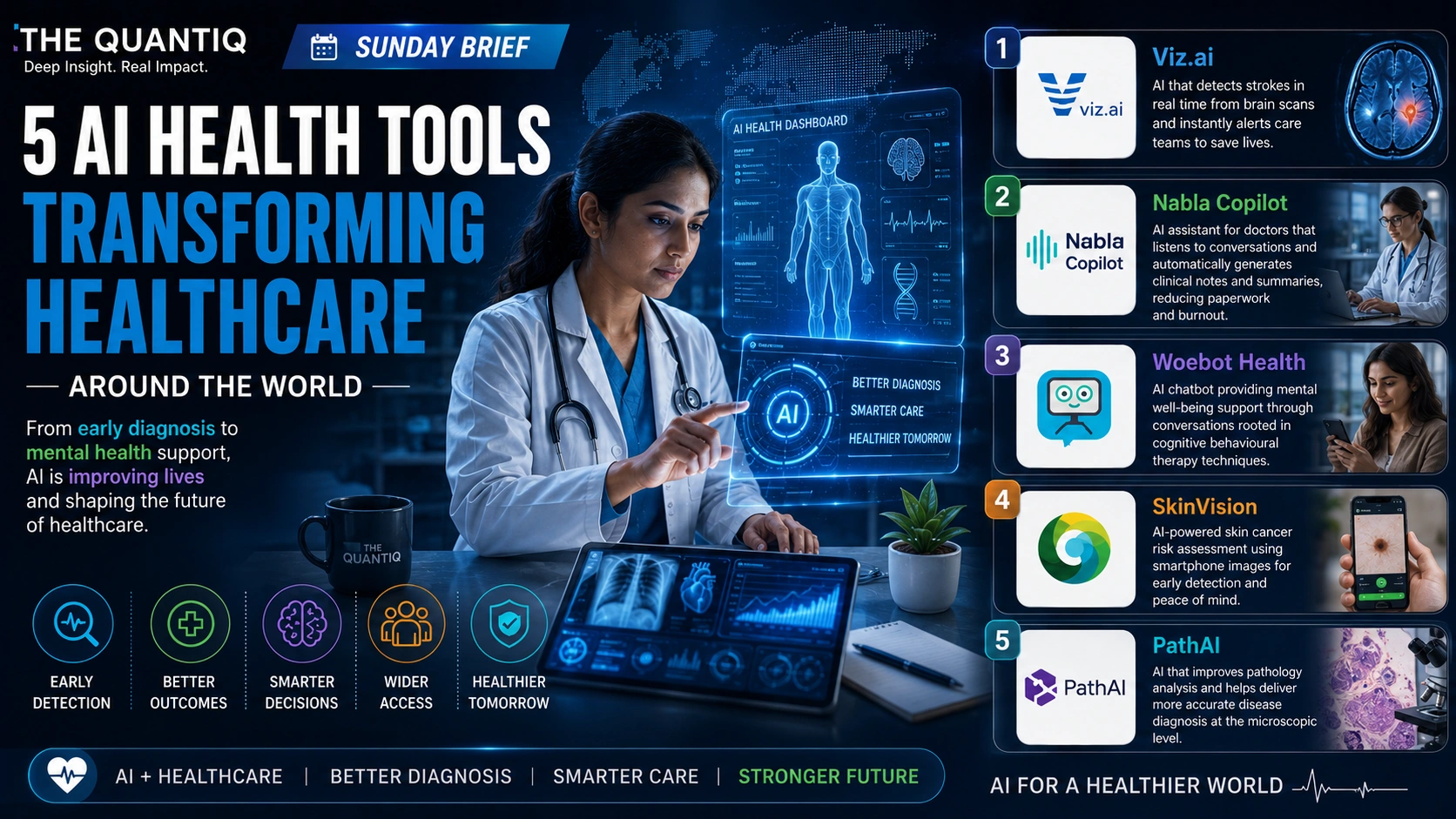
Sunday Brief: 5 AI Health Tools Quietly Transforming Healthcare Around the World
For millions of people across the world, the future of healthcare may increasingly involve AI systems capable of detecting diseases earlier, assisting doctors, improving mental health support and making medical services more accessible.
Yet unlike flashy consumer AI tools that dominate headlines, many healthcare-focused AI platforms are evolving quietly behind the scenes — often with life-changing implications.
In this Sunday Brief, The Quantiq explores five AI-powered health tools and platforms from around the world that are helping reshape the future of healthcare.https://thequantiq.com/indias-private-hospital-boom-who-is-really-profiting-from-the-healthcare-gold-rush/
Nabla Copilot
AI That Helps Doctors Reduce Burnout
Nabla develops an AI assistant designed for doctors and clinicians. The system listens to doctor-patient conversations and automatically generates medical notes and summaries.
This is important because one of the biggest hidden crises in healthcare today is physician burnout caused by documentation overload and administrative work.
Instead of replacing doctors, Nabla aims to reduce repetitive paperwork so healthcare professionals can spend more time focusing on patients.
AI may not only transform diagnosis. It may also help restore the human side of healthcare.
Viz.ai
AI That Helps Detect Stroke Faster
Viz.ai uses artificial intelligence to analyse brain scans and rapidly alert medical teams when signs of stroke are detected.
In stroke treatment, time is critical. Faster detection can dramatically improve survival and recovery outcomes.
Viz.ai represents a growing category of healthcare AI focused on:
- real-time decision support,
- emergency care,
- and hospital coordination.
In the future, AI could become the invisible emergency assistant working behind hospital systems.
Woebot Health
The AI Chatbot Focused on Mental Health Support
Mental health challenges are rising globally, yet access to therapists and psychological support remains deeply unequal.
Woebot Health is attempting to address part of that gap through an AI-powered conversational mental health assistant.
The platform uses conversational AI techniques inspired by cognitive behavioural therapy principles to help users track emotions, manage stress and build healthier mental habits.
Importantly, tools like Woebot are not replacements for professional mental healthcare. But they may provide early-stage support, emotional check-ins and accessibility for individuals who might otherwise receive no support at all.
The rise of AI mental health tools also reflects a broader shift in healthcare:
the growing recognition that emotional wellbeing is becoming as important as physical health in modern societies.
As loneliness, anxiety and burnout increase globally, AI-driven mental wellness ecosystems may become an important component of future healthcare infrastructure.
SkinVision
AI-Powered Early Detection for Skin Cancer
Early detection often determines survival in many diseases.
SkinVision uses AI-powered image analysis to help users assess potential skin cancer risks through smartphone photography.
Users can photograph skin spots or moles, after which the system evaluates whether medical consultation may be advisable.
The significance of such tools lies not merely in convenience, but in accessibility. In many regions, dermatologists remain limited or expensive, causing delays in diagnosis.
AI-assisted screening tools may eventually help bridge that gap by encouraging earlier intervention.
As smartphone penetration expands globally, healthcare may increasingly move toward portable, AI-assisted diagnostics accessible directly from personal devices.
The smartphone itself may gradually evolve into a frontline health monitoring platform.
PathAI
AI Helping Improve Disease Diagnosis at the Microscopic Level
While some AI health tools interact directly with patients, others operate behind the scenes inside laboratories and diagnostic systems.
PathAI focuses on using artificial intelligence to improve pathology analysis — the microscopic examination of tissues used in diagnosing diseases such as cancer.
Pathology remains one of the most critical components of modern medicine, yet diagnostic variability and workload pressures continue to challenge healthcare systems globally.
AI-assisted pathology platforms can help improve consistency, reduce diagnostic errors and accelerate research processes.
This may become especially important in the era of precision medicine, where treatment decisions increasingly depend on highly detailed diagnostic insights.
The future of healthcare may not simply involve smarter hospitals. It may involve smarter diagnostics at every level.
The Bigger Picture: AI Is Quietly Reshaping Healthcare
The most interesting aspect of the AI healthcare revolution is that much of it is happening quietly.
Unlike social media AI trends that generate instant viral attention, healthcare transformation tends to evolve more gradually, carefully and under intense regulatory scrutiny.
But the long-term implications may be enormous.
Artificial intelligence could help:
- improve early disease detection,
- expand access to healthcare,
- reduce diagnostic delays,
- personalise treatment,
- strengthen mental health support,
- and ease pressure on overstretched medical systems.
At the same time, serious questions remain around:
- privacy,
- ethics,
- data security,
- algorithmic bias,
- and overdependence on automated systems.
Healthcare may therefore become one of the most sensitive and important testing grounds for responsible AI development.
What This Could Mean for India and North East India
For India, AI-powered healthcare could become transformational.
Large populations, uneven healthcare access and shortages of medical specialists continue to create enormous pressure on the healthcare system. AI-assisted diagnostics, telemedicine and multilingual health tools could eventually help bridge some of those gaps.
For North East India in particular, AI-enabled healthcare may hold significant long-term potential.
Remote geographies, difficult terrain and uneven specialist availability have historically affected healthcare access across many parts of the region. AI-powered telemedicine, mobile diagnostics and digital health systems could gradually improve accessibility for rural and underserved communities.
If implemented responsibly, AI may eventually help reduce the healthcare distance between metropolitan centres and remote regions.
And that may become one of the most meaningful applications of artificial intelligence in the years ahead.https://thequantiq.com/sunday-brief-6/


One Comment