India Enters JLR’s Global Manufacturing Core: Why Tata’s Tamil Nadu Bet Matters
When Tata Motors inaugurated its new passenger vehicle manufacturing facility in Ranipet, Tamil Nadu, the headlines largely focused on the investment size—nearly US$1 billion—and the ceremonial presence of political and corporate leadership. But beneath the surface, something far more consequential unfolded.
India has officially entered Jaguar Land Rover’s (JLR) global manufacturing map.
That single development marks a quiet but decisive shift in India’s role in the global automotive economy—from a high-growth consumption market to a trusted manufacturing nerve centre for premium global brands.
This is not just a factory. It is a signal.
A Milestone That Goes Beyond Infrastructure
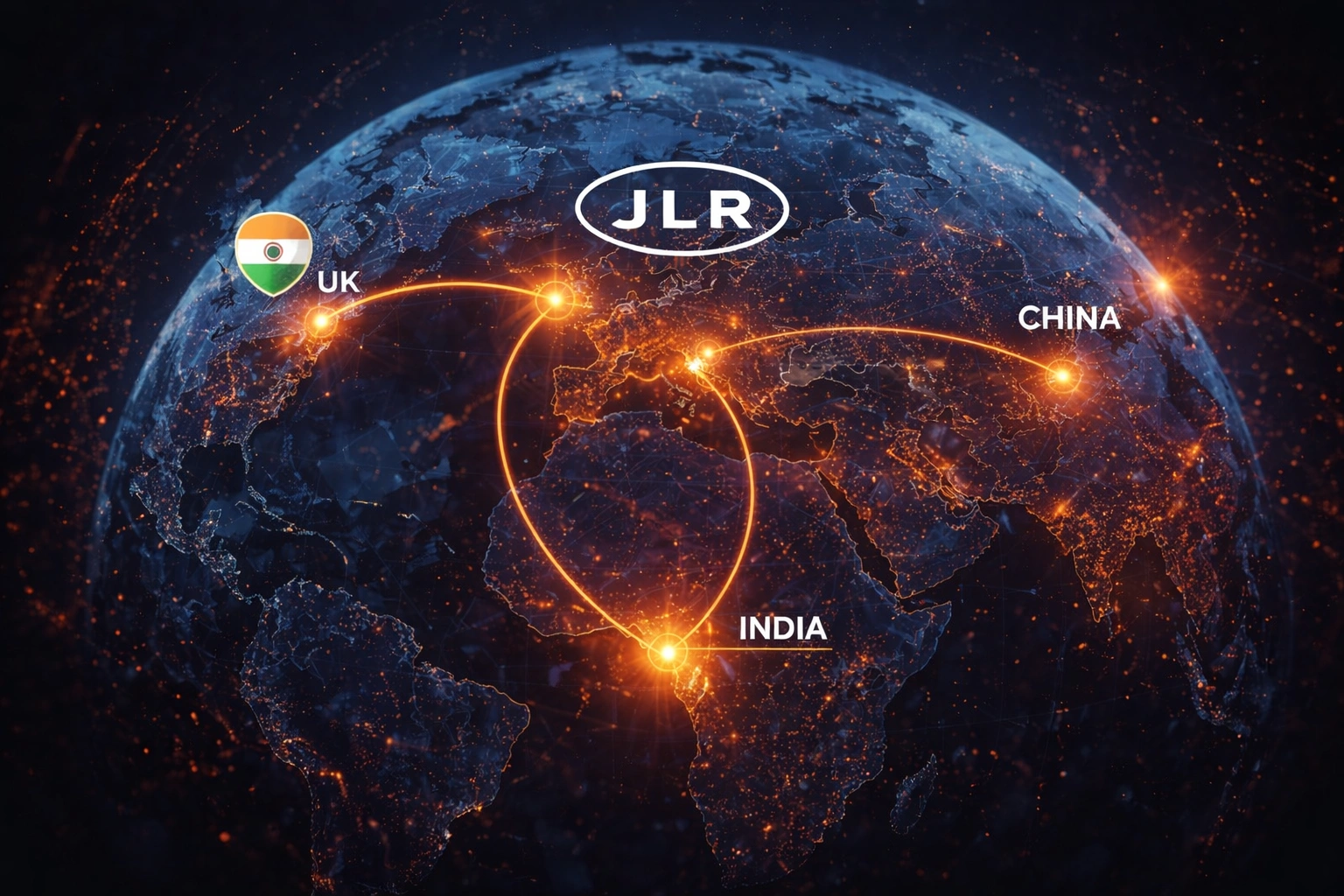
The Ranipet facility is part of Tata Motors’ expanding manufacturing footprint and represents India’s formal inclusion in JLR’s global production ecosystem, which already spans the UK, Austria, China, and Brazil. For a brand positioned firmly in the premium and luxury automotive segment, manufacturing geography is not chosen lightly.
According to N. Chandrasekaran, the facility is expected to produce between 250,000 and 300,000 vehicles annually at full capacity. More importantly, it underscores Tata Group’s long-term strategic intent: anchoring advanced automotive manufacturing in India—not as a peripheral base, but as a core node.
In an industry increasingly defined by geopolitical risk, supply chain fragility, and technological disruption, manufacturing location has become a strategic decision rather than a cost calculation.
Why JLR’s Manufacturing Entry into India Matters
For decades, India’s participation in the global automotive value chain has been skewed towards small cars, components, and cost-efficient engineering services. While these capabilities are substantial, premium vehicle manufacturing remained largely offshore.
That barrier has now been breached.
By bringing India into JLR’s global manufacturing base, Tata Motors is signaling global confidence in Indian capabilities across:
- Precision manufacturing
- Quality assurance at luxury benchmarks
- Skilled automotive talent
- Supplier ecosystem maturity
This transition elevates India from being “competitive” to being trusted—a crucial distinction in high-end manufacturing.
The Strategic Timing Is No Coincidence
This move must be viewed against the backdrop of a rapidly rebalancing global auto industry.
Over the last five years, automakers have been forced to rethink deeply entrenched assumptions:
- Europe faces energy cost volatility and regulatory pressures
- China is witnessing rising geopolitical and trade friction
- Global supply chains are being redesigned for resilience, not just efficiency
India, meanwhile, offers a rare convergence of advantages:
- Political and macroeconomic stability
- Competitive manufacturing costs
- A deep engineering talent pool
- Expanding domestic demand aligned with global standards
For Tata Motors, integrating India into JLR’s manufacturing geography is also a strategic hedge—diversifying production risk while retaining control within the Tata ecosystem.
Tamil Nadu’s Emergence as India’s Premium Auto Corridor
The choice of Tamil Nadu is equally strategic.
Already home to major automotive and EV investments, the state has quietly positioned itself as India’s most advanced auto manufacturing cluster. With robust infrastructure, port connectivity, policy continuity, and a skilled workforce, Tamil Nadu increasingly resembles the kind of industrial ecosystem seen in Germany or South Korea.
The inauguration by M. K. Stalin reinforces the state’s intent to attract high-value, technology-driven manufacturing rather than volume-led, low-margin production.
For India’s federal manufacturing ambitions, this creates a powerful template: state-level execution aligned with national industrial strategy.
What This Means for India’s Automotive Value Chain
The long-term implications of this development extend well beyond Tata Motors or JLR.
Supplier Ecosystem Upgrade
Premium vehicle manufacturing demands higher standards across components, materials, and processes. Indian suppliers aligned with this facility will be forced—by design—to move up the value chain.
Skill and Capability Spillovers
Advanced manufacturing brings with it new competencies in robotics, automation, precision engineering, and quality systems. These skills diffuse across industries over time.
Export-Led Manufacturing Potential
With India now part of JLR’s global manufacturing map, the possibility of export-oriented production becomes tangible, reinforcing India’s ambition to be a net exporter of high-value manufactured goods.
EV and Future Mobility Readiness
As JLR accelerates its electrification roadmap globally, India’s manufacturing integration today creates pathways for EV and next-generation vehicle production tomorrow.
Tata Group’s Long Game Comes into Focus
For the Tata Group, this move aligns seamlessly with its broader strategy.
Across sectors—from steel and semiconductors to electronics and aerospace—the group has consistently focused on embedding India deeper into global value chains rather than chasing short-term gains.
Tata Motors’ integration with JLR has often been cited as one of India’s most successful outbound acquisitions. The Ranipet facility now completes the loop: global capability flowing back into domestic manufacturing.
This is not just about scale. It is about sovereignty in manufacturing capability.
A Quiet Shift in India’s Global Perception
Perhaps the most important outcome of this development is intangible.
When global automakers evaluate future manufacturing locations, precedent matters. India’s inclusion in JLR’s core manufacturing geography sends a powerful signal to boardrooms worldwide: India is no longer just a market to sell into—it is a place to build from.
That perception shift cannot be bought through incentives alone. It must be earned through execution.
The Quantiq Take
The Ranipet facility should not be read as a regional industrial event or a routine investment announcement. It represents a deeper reconfiguration of India’s role in the global automotive economy.
India’s journey from back office to factory floor has been long. The move from factory floor to global manufacturing core is far more significant—and far more difficult.
With this step, Tata Motors and JLR have demonstrated that India is ready.
Not as an alternative.
Not as a backup.
But as a strategic pillar.
And that may well be the most important signal to emerge from this quiet but consequential milestone.https://thequantiq.com/auto-mobility-india-mobility-future-beyond-evs/