The Security–Development Imbalance: Reading Manipur’s 2026 Budget as a Political Document
When a Budget Stops Being Just Numbers
Budgets are often presented as technical documents—columns of expenditure, lines of allocation, a ritual of governance.
But sometimes, a budget reads like something else entirely.
A signal. A response. A diagnosis.
The 2026–27 budget of Manipur is one such document.
Because when more than half of a major expenditure block is allocated to policing, the question is no longer about fiscal priorities. It is about the condition of the state itself.
The Number That Defines the Budget
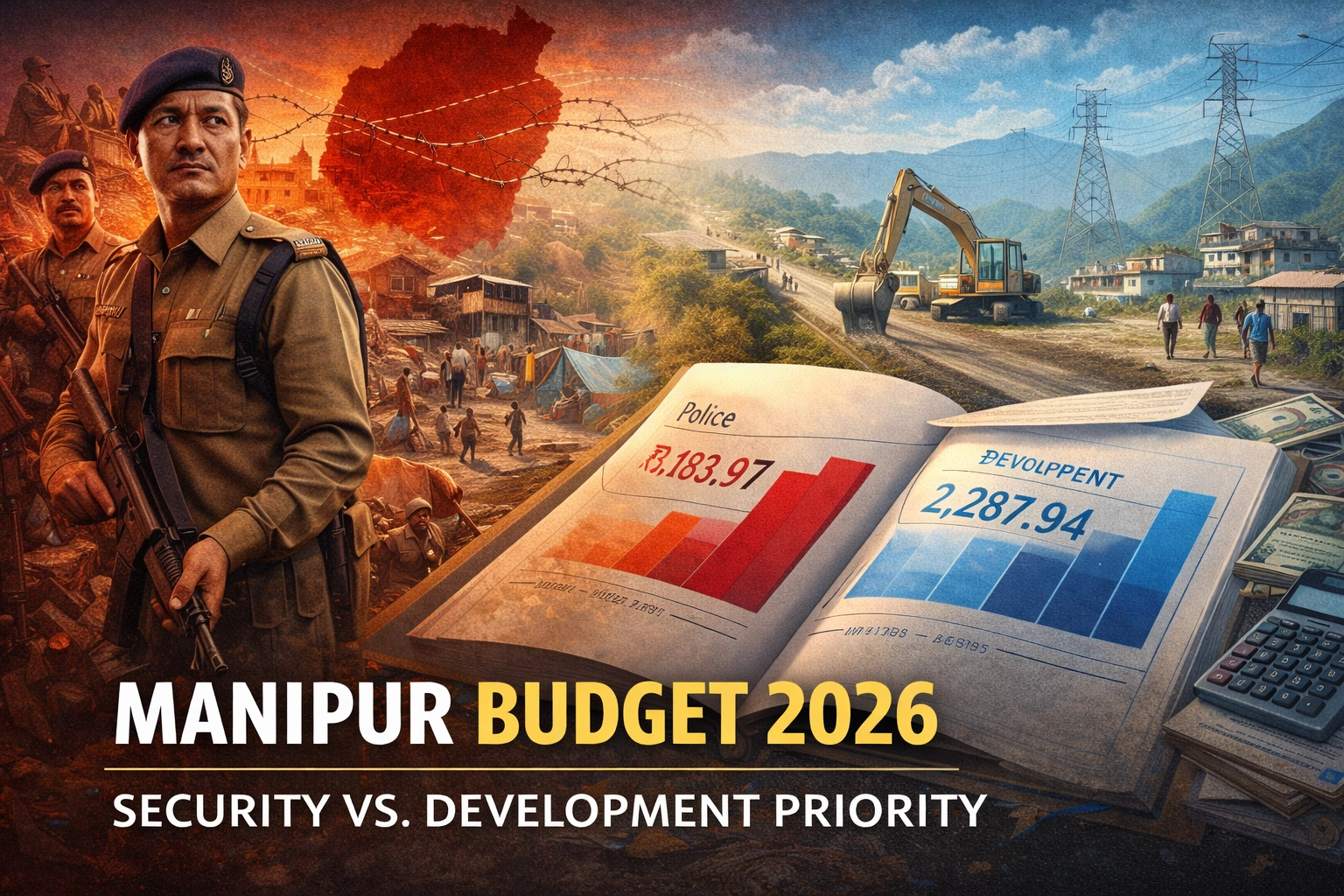
On 11 March 2026, the Manipur Legislative Assembly passed a set of 14 Demands for Grants amounting to ₹5,471.91 crore. Within this, one allocation stands out with stark clarity:
₹3,183.97 crore for the Police department.
That is 58.2 percent of the total in this batch.
It is not a statistical anomaly. It is the arithmetic of a state still navigating the aftershocks of the ethnic violence that erupted in 2023—an event that displaced tens of thousands and redrew both the social and economic landscape of Manipur.
Reading Beyond the First Layer
A deeper reading of the budget reveals that this ₹5,471.91 crore is only part of the story. A second batch of demands, passed days later, adds another ₹8,208.80 crore, including significant allocations for education and finance.
Taken together, the full budget for 2026–27 is estimated at over ₹35,000 crore.
And yet, the first batch—where policing dominates—offers a more immediate insight.
It reflects urgency. It reflects pressure. It reflects a government prioritising control before reconstruction.
A State Built Around Security
Manipur already has one of the highest police-to-population ratios in India—second only to Nagaland among Northeast states.
This is not new. It is the outcome of decades of insurgency management layered over more recent ethnic tensions.
What is new, however, is the scale of fiscal commitment toward maintaining order.
Alongside policing, the government has allocated substantial funds for the rehabilitation of internally displaced persons—an acknowledgment that the crisis is not just about law and order, but about lives interrupted and livelihoods lost.
The Quiet Story of What Gets Less
Budgets are as much about what they underfund as what they prioritise.
In comparison to policing, sectors like land resources, industry, and agriculture receive a fraction of the allocation. Public Works and power retain visibility, but they do not define the narrative.
This creates an imbalance—not necessarily unjustified, but deeply consequential.
Because while security can stabilise a situation, it does not by itself create opportunity.
Roads as a Counterweight
There is, however, an attempt to maintain momentum on infrastructure.
Allocations toward road connectivity—supported by central schemes and ministries—suggest that the state is trying to prevent a complete slowdown in development activity. Roads, in this context, are more than infrastructure. They are signals of continuity, an assertion that governance has not retreated.
But whether this is enough to offset the overwhelming tilt toward security spending remains an open question.
The Core Dilemma
Manipur’s budget presents a dilemma that extends beyond the state.
How long can a government prioritise stability over growth before the absence of development becomes a new source of instability?
It is a question without easy answers.
In the short term, the allocation toward policing may be unavoidable. A state emerging from conflict cannot afford fragility. But in the long term, a prolonged imbalance risks deepening the very conditions that led to unrest.
The Quantiq View
This is not a budget of ambition. It is a budget of necessity.
It reflects a government attempting to hold the line—to restore order, to manage displacement, to maintain basic governance in a fragile environment. But budgets also shape futures.
If the balance does not gradually shift toward livelihoods, infrastructure, and economic opportunity, the recovery risks remaining incomplete. Because stability, in the end, is not sustained by force alone. It is sustained by the presence of opportunity.https://thequantiq.com/industrial-hemp-northeast-india-slow-fashion/