
The Next Billion-Dollar Startups May Not Use AI at All
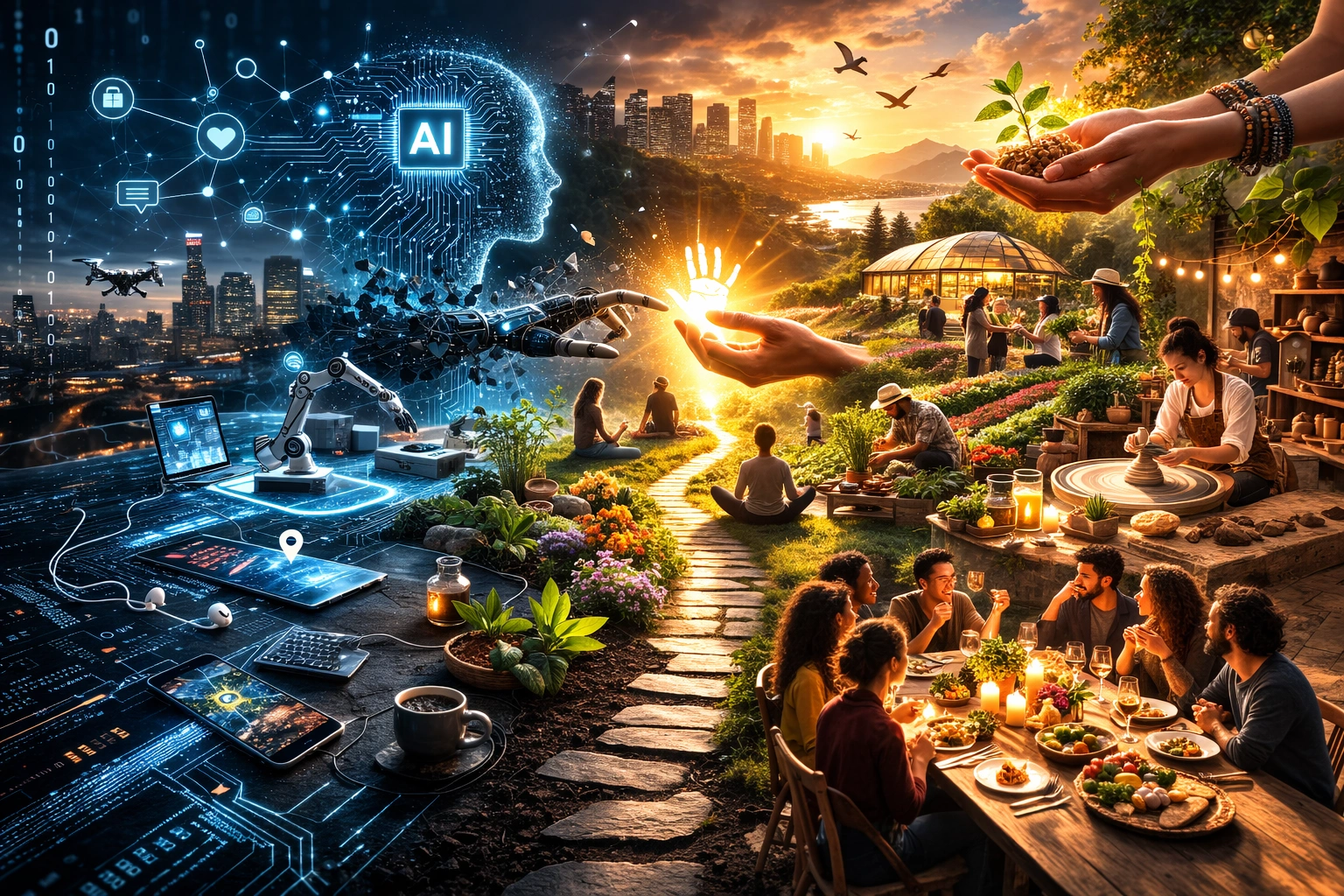
The global conversation around artificial intelligence has, for understandable reasons, revolved around disruption. Every week brings a new report forecasting which professions will vanish, which industries will transform, and which skills will become obsolete. In boardrooms and universities alike, the question has become almost existential: what remains uniquely human in an AI-dominated world?
For entrepreneurs, however, disruption also opens a window. Whenever a technology makes something abundant, another category suddenly becomes scarce—and scarcity is where value is created.
Artificial intelligence is rapidly making digital content, design, writing, coding, and even advisory services abundant and inexpensive. Algorithms can generate endless images, write millions of lines of code, simulate conversations, and automate workflows. But in the process, something else is quietly becoming scarce: genuine human presence.
The future economy may not only reward those who build AI systems. It may equally reward those who build experiences that deliberately exclude them.
A new class of startups is beginning to emerge in what can be called the “human premium economy.” These ventures do not compete with AI. Instead, they position themselves as the antidote to algorithmic life.
Three such startup ideas in the lifestyle sector illustrate this emerging trend.
Certified Human Experiences (CHX): The Anti-Algorithm Lifestyle Club
Imagine a membership platform where the core promise is simple: no algorithms, no automation, just humans.
The concept behind a Certified Human Experiences (CHX) Platform is to curate and certify experiences intentionally free from AI mediation. These could include human-led retreats, pottery workshops, culinary gatherings, painting studios, storytelling evenings, and artisan marketplaces.
In an era where recommendation engines decide what we watch, where we travel, and even whom we date, the idea of unpredictable human interaction itself becomes a luxury product.
The value of such a platform lies not in efficiency but in imperfection. Algorithms optimize outcomes; humans create moments.
This phenomenon is not entirely new. Consider the success of boutique fitness brands like SoulCycle. When fitness apps and home workout platforms exploded, many analysts predicted that studio-based fitness would decline. Instead, the opposite happened. People continued paying premium prices because the experience delivered collective energy, emotional motivation, and human connection.
A CHX platform could operate through a hybrid model:
monthly membership for access to curated experiences, ticketed events hosted by certified facilitators, and a marketplace for independent artisans whose work celebrates craftsmanship rather than automation.
Over time, the platform’s moat would not be technology but community trust. The “Certified Human” label could become a powerful cultural signal—an assurance that what participants are experiencing is unfiltered by machines.
In a world increasingly mediated by AI, human presence itself becomes the product.
Hyper-Local Wellness Micro-Farms: Farm-to-Body, Not Farm-to-Algorithm
Another category that could remain resilient against AI disruption lies at the intersection of wellness, agriculture, and community.
Hyper-local wellness micro-farms would operate as small-scale urban or peri-urban cultivation spaces focused on functional herbs, adaptogens, and nutrient-dense superfoods. But the farms would not merely produce ingredients; they would become community wellness ecosystems.
Visitors could attend herbalism workshops, sound therapy sessions, nature immersion experiences, and guided education on plant medicine. Subscription boxes could deliver farm-grown herbs and wellness products to local consumers, while nearby wellness brands could source ingredients directly from these farms.
At first glance, agriculture might appear vulnerable to automation. Precision farming, AI-driven crop monitoring, and robotics are already transforming industrial agriculture. But the hyper-local wellness farm model rests on something deeper than efficiency: provenance and trust.
Consumers increasingly want to know where their food and wellness products originate. The story of the soil, the farmer, and the local ecosystem carries emotional and ethical value that automation cannot replicate.
These micro-farms could therefore build three durable advantages.
First, local supply chain ownership, which reduces dependency on global commodity markets.
Second, community loyalty, cultivated through events, workshops, and memberships.
And third, land itself as an appreciating asset.
In the long term, the business is not merely about herbs or superfoods. It is about selling a relationship with nature in an increasingly synthetic world.
Slow Living Supper Clubs: Reclaiming the Table
Perhaps the most powerful counterforce to AI-driven lifestyles will emerge from one of humanity’s oldest traditions: sharing food together.
Across major cities worldwide, curated supper clubs have quietly begun to replace conventional restaurant experiences. These gatherings bring together small groups of strangers around a shared table for thoughtfully prepared meals and guided conversation.
A scalable startup model could transform this into a global social dining network, where trained hosts facilitate meaningful discussions through structured yet informal formats.
The inspiration for such gatherings already exists in cultural institutions like The School of Life, which organizes conversation-driven dinners designed to foster authentic connection. In an age where social interactions increasingly happen through screens, these experiences offer something deeply missing: presence, listening, and emotional resonance.
The timing could not be more relevant. Loneliness is rapidly emerging as a global public health concern. Digital hyperconnectivity has paradoxically created emotional isolation.
Artificial intelligence may accelerate this phenomenon further by replacing many everyday human interactions with automated systems. When customer support, teaching, companionship, and even therapy become partially automated, the hunger for genuine conversation may intensify.
Slow living supper clubs could therefore operate not merely as dining events but as modern social rituals.
The business model could include ticketed dinners, host licensing programs for new cities, and corporate packages designed to help organizations rebuild real-world team cohesion.
The true asset, however, would be the methodology of hosting—a structured approach to conversation that transforms a dinner table into a space for reflection, empathy, and dialogue.
In this sense, the product is not food. The product is human connection.
The Strategic Pattern: Building in the Age of Abundance
Despite their differences, these three ideas share a common strategic architecture.
They rely on physical presence, something that cannot be digitized or simulated.
They treat human imperfection as a feature, not a flaw.
They build communities rather than audiences, creating powerful network effects.
And they operate around scarce resources—time, land, and attention.
These elements create natural resistance to algorithmic disruption.
Historically, every technological revolution has produced similar patterns. When photography became ubiquitous, painting did not disappear—it evolved toward impressionism and abstract art, emphasizing the human interpretation of reality rather than literal representation.
When streaming services made music infinitely accessible, live concerts became more valuable than ever.
AI is likely to trigger a similar shift.
As synthetic content floods the digital landscape, authentic experiences may become the most valuable currency of the next economy.
The Rise of the Human Premium Economy
The deeper insight behind these startup ideas is philosophical as much as economic.
Artificial intelligence will make the synthetic abundant and cheap. It will generate endless articles, designs, songs, avatars, and recommendations.
But abundance always changes the definition of value.
When everything can be generated instantly by machines, the things that cannot be generated—presence, trust, craftsmanship, locality, and emotional depth—become extraordinarily valuable.
This emerging market can be described as the human premium economy.
Entrepreneurs who understand this shift may discover that the future of innovation is not only about building smarter machines. It is also about creating spaces where humanity itself becomes the differentiator.
For lifestyle startups especially, the next decade may belong to those who build businesses around a simple but powerful idea:
In an AI-saturated world, being human will be the ultimate luxury.https://thequantiq.com/5-india-built-ai-platforms-quietly-solving-real-world-problems/


2 Comments